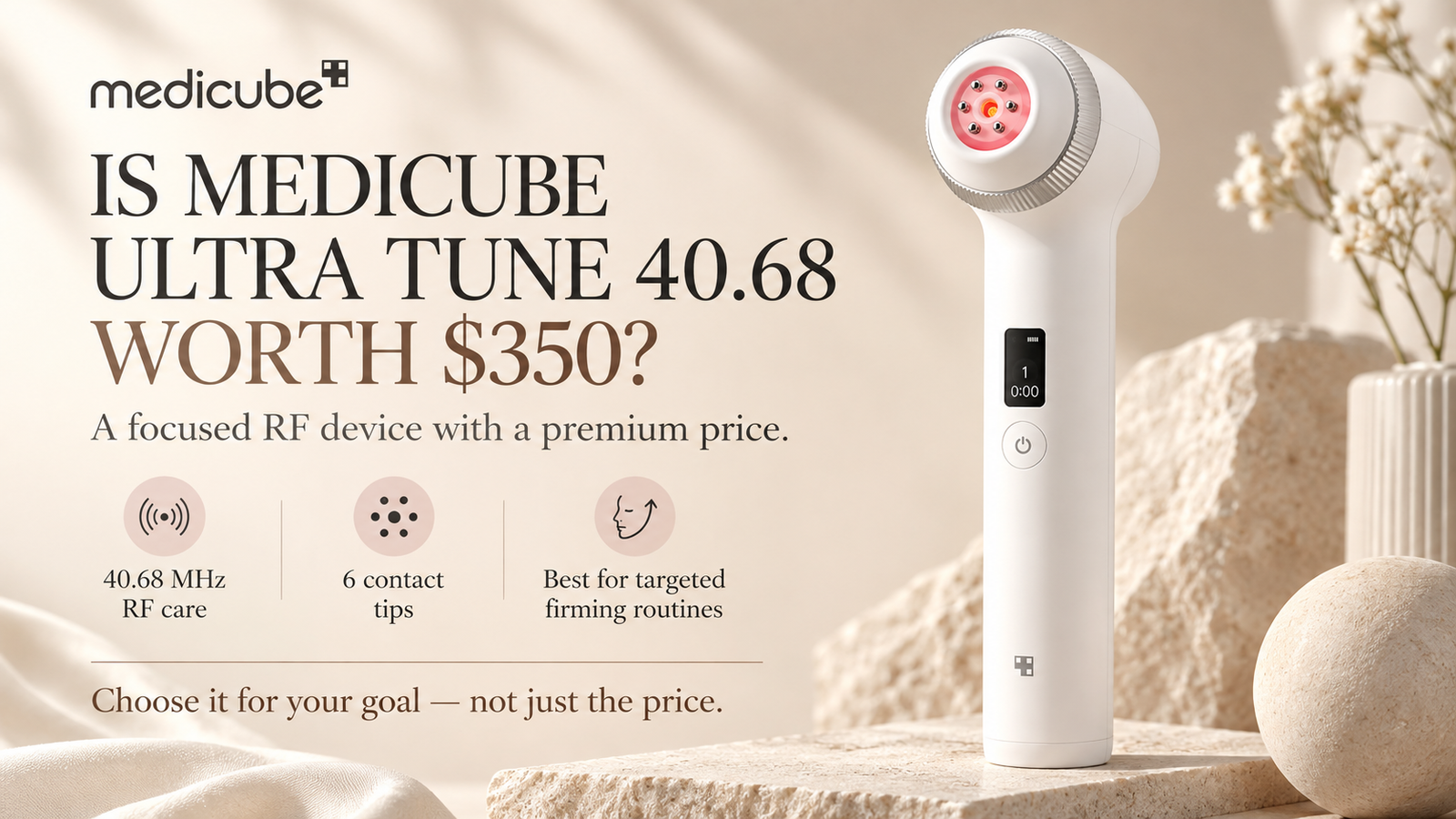
The Medicube Ultra Tune 40.68 is not the Medicube device I would recommend to everyone.
At the current official U.S. sale price of $350, it makes the most sense for someone who specifically wants at-home RF-focused firming and elasticity care — and knows they will actually use the device consistently.
Our short verdict: Ultra Tune 40.68 is worth considering if firming is your main device goal. Skip it if you primarily want glow, skincare absorption, sheet-mask boosting or a broad all-in-one device.
The biggest reason to buy it is not that “40.68” sounds more powerful. Ultra Tune combines 40.68 MHz radiofrequency with microcurrent and occupies a more specialized role in Medicube’s device lineup.
The biggest reasons to hesitate are the $350 price, the need to keep all six treatment tips in proper contact with the skin, the hands-on treatment time and the limited independent evidence for this exact device.
This is an evidence-based buying review based on current official product information, published RF research and available consumer and editorial experience. K-Beauty Clarity has not personally conducted a controlled hands-on test of this device.
This article contains affiliate links. If you purchase through these links, we may earn a commission at no additional cost to you. As an Amazon Associate I earn from qualifying purchases. See our affiliate disclosure for details.
Check the current Medicube Ultra Tune 40.68 price on Amazon
Medicube Ultra Tune 40.68: Quick Verdict
| Question | Answer |
|---|---|
| Medicube US price checked Sep. 14, 2026 | $350 sale price / $530 displayed reference price |
| Main technology | 40.68 MHz RF + microcurrent |
| Main goal | Firming, elasticity and visible line care |
| Recommended session | About 5–10 minutes |
| Official usage guidance | Up to 1–3 times daily, adjusted to skin condition |
| Dedicated conductive gel required? | No |
| Important usability requirement | All six tips must contact the skin |
| Best for | Committed shoppers specifically seeking RF-focused home care |
| Skip if | You want a cheaper first device or broad multi-mode care |
At a current $350 sale price, Ultra Tune should solve a specific problem. “I want a premium Medicube device” is not a good enough reason.
What Does “40.68” Actually Mean?
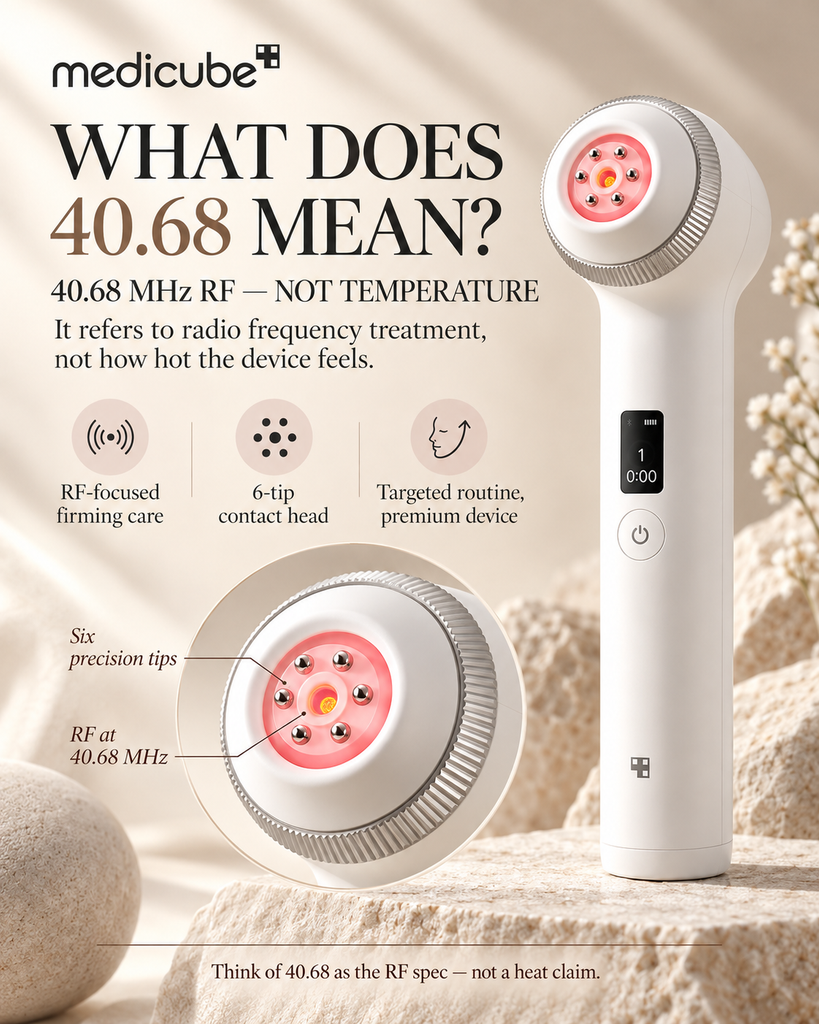
40.68 refers to the device’s radiofrequency frequency: 40.68 MHz.
Medicube’s official Japanese product page explicitly identifies Ultra Tune as a 40.68 MHz RF device.
The number is not a skin temperature, wattage rating, treatment depth, percentage improvement or performance score.
Medicube also says Ultra Tune operates at a radiofrequency approximately 20 times higher than its older Deep Shot device.
That is a technical frequency comparison made by the brand. It does not mean Ultra Tune produces 20 times more heat, reaches 20 times deeper, creates 20 times more collagen or delivers 20 times better visible results.
Frequency is only one part of RF-device performance. Electrode design, output, treatment time, skin contact and the device’s safety controls also affect how energy is delivered.
How Does Ultra Tune 40.68 Work?
Medicube describes Ultra Tune as combining two technologies.
Radiofrequency: Medicube positions RF as warming energy for elasticity and firmer-looking skin.
Microcurrent: Medicube positions its MC component around facial contour and volume-focused care.
The brand calls the combination Dual Tune-Wave™.
That is Medicube’s branded technology name. It should not be interpreted as independent proof of a specific lifting, collagen or anti-aging result.
Does At-Home RF Actually Have Evidence Behind It?
Yes — but evidence for home-use RF as a category is not the same as independent evidence for this exact Medicube device.
A 2022 randomized, controlled split-face study enrolled 33 women aged 35 to 60 and evaluated one home-use RF beauty device over 12 weeks. Thirty-two participants completed the study.
Compared with the facial side treated with a marketed anti-aging cosmetic, the RF-treated side showed statistically significant improvements in wrinkles, radiance, skin color and skin thickness.
That supports the plausibility of at-home RF as a category.
It does not prove that Medicube Ultra Tune 40.68, with its own electrode design, output, microcurrent component and usage protocol, will produce the same result.
What Do Medicube’s Clinical Numbers Actually Mean?
Medicube currently publishes the following finished-device results on its U.S. product page:
| Brand-reported measure | Reported improvement |
|---|---|
| Forehead lines | 29.8% |
| Glabellar lines | 10.0% |
| Crow’s feet | 6.1% |
| Smile lines | 6.6% |
| Neckline | 13.0% |
Medicube reports these figures from its own “AGE-R Ultra Tune 40.68 human application test report” and states that individual results can vary.
The public U.S. product page does not provide enough detail for shoppers to independently evaluate the participant count, study duration, control condition, blinding, measurement protocol, statistical analysis or complete test report.
These numbers support Medicube’s product claims, but they should not be read as guaranteed results or as proof that Ultra Tune is superior to every other home RF device.
The Biggest Usability Catch: All Six Tips Need Contact
This may matter more in daily use than the technology name.
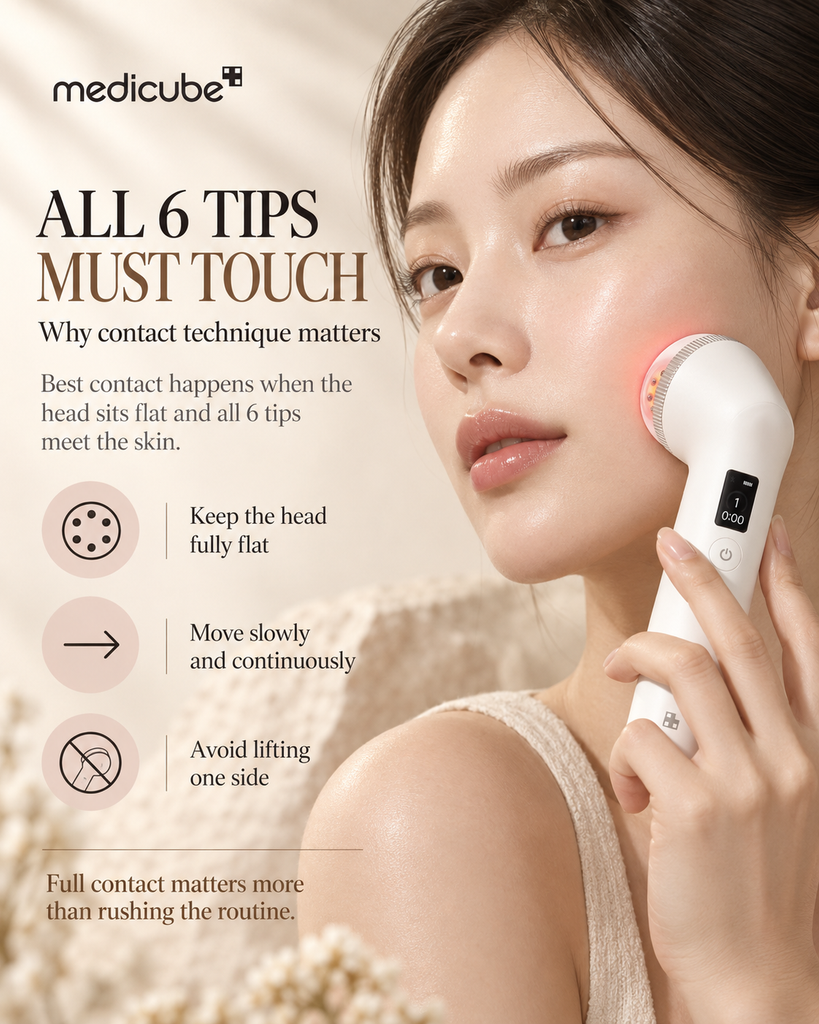
Medicube says energy is delivered only when all six tips are in full contact with the skin.
The brand also says the device may automatically adjust output if you move too slowly or pause in one area.
This makes contact angle part of the technique. Narrow, curved or bony facial areas may be less intuitive to treat than broader cheek areas.
That same issue also appears in user and editorial reviews, where the forehead and chin are mentioned as areas that can take more practice.
Do You Need Conductive Gel?
No dedicated conductive gel is required according to Medicube.
The brand says to complete your skincare routine, allow those products to absorb and then use Ultra Tune.
That is a meaningful convenience advantage over home RF devices that require a separate conductive gel.
But “no dedicated gel required” does not mean you should press harder if the device does not glide comfortably. Correct contact is more important than forcing pressure.
How Often Are You Supposed to Use It?
Medicube currently says Ultra Tune may be used daily and gives guidance of one to three sessions per day, around 5–10 minutes per session, while also telling users to adjust the frequency and duration to their skin condition.
That should be treated as usage guidance, not a target that every buyer needs to reach.
Three sessions per day are not automatically better than one.
Medicube also tells first-time users to start at level 1 and increase gradually.
What Does It Feel Like?
Warmth is expected with RF use.
Medicube says temporary residual warmth may occur after treatment. If you feel strong heat or significant discomfort, the brand instructs you to lift the device from the skin and reduce the intensity.
Do not increase the intensity simply to chase a stronger sensation.
If significant redness, swelling, pain, blistering or irritation persists or worsens, stop using the device and seek appropriate medical advice.
Medicube also tells users to keep the head moving rather than holding it in one place.
Where Should You Not Use It?
Medicube specifically tells users not to use Ultra Tune on the Adam’s apple, eyelids or the area directly below the eyes.
The brand says the device may be used around the eye area at level 1, but the eyelids and the area directly under the eyes should still be avoided.
If you are unsure whether RF is appropriate for you because of a medical condition, implanted device or recent procedure, check the current manufacturer instructions and ask a qualified clinician before use.
What Do Actual Users Like and Dislike?
As checked September 14, 2026, Hwahae’s Ultra Tune product page displayed a 4.50 out of 5 rating and 20 total reviews.
The useful part is not the average score. It is the recurring practical feedback.
Reported positives include:
- a firmer-feeling or more defined appearance with consistent use
- no need for a separate conductive gel
- app connectivity and routine tracking
- the convenience of performing RF-focused care at home
Reported drawbacks include:
- the high purchase price
- results that may feel gradual rather than dramatic
- six-tip contact taking practice on areas such as the forehead or chin
- the device feeling relatively heavy to some users
- cleaning around the treatment head after use
- heat, redness or irritation when use becomes too aggressive for the individual
These are uncontrolled consumer reports, not clinical evidence. They are most useful as usability signals.
What Did a Longer Editorial Hands-On Review Find?
In a Harper’s Bazaar review, beauty editor Katie Intner described using Ultra Tune for months and completing dozens of sessions.
She reported positive changes in firmness, smoothness and overall appearance, while also noting a learning curve and difficulty gliding the metal treatment head over flatter, bonier areas such as the forehead and chin.
That is useful hands-on experience, but it remains one editor’s experience rather than a controlled clinical trial.
Harper’s Bazaar also discloses that it may earn commission from purchases made through some links in its commerce content.
Ultra Tune 40.68 vs Booster Pro X2
This is the most important alternative to consider before spending $350.
Ultra Tune is the more specialized purchase. Medicube positions it around RF plus microcurrent for elasticity and line-focused care.
Booster Pro X2 is the broader multi-mode purchase. Its current official lineup includes Booster, Air Shot, MC, Derma Shot, Dual, Mask and AI modes.
At the official U.S. prices checked September 14, 2026, Booster Pro X2 is currently listed at $249, compared with $350 for Ultra Tune.
That $101 difference matters.
If you mainly want multiple types of skincare-device care from one purchase, Ultra Tune becomes harder to justify.
If RF-focused firming is specifically why you are shopping, Ultra Tune’s specialization makes more sense.
For the full side-by-side decision, see our Medicube Booster Pro X2 vs Ultra Tune 40.68 comparison.
See the current Medicube Ultra Tune 40.68 price on Amazon
Who Should Buy the Medicube Ultra Tune 40.68?
Ultra Tune makes the most sense if you:
- want RF-focused firming and elasticity care specifically
- are prepared to spend around $350 on a specialized device
- already know you can maintain a beauty-device habit
- are comfortable learning the six-tip contact technique
- prefer not to buy a dedicated conductive gel
- understand that home-device results are likely to be gradual and variable
Who Should Skip It?
Skip Ultra Tune if you:
- want a lower-cost first beauty device
- mainly care about glow or skincare absorption
- want one device with many different treatment modes
- expect dramatic clinic-level tightening
- dislike spending several minutes manually moving a device around your face
- know an expensive device is likely to end up unused
If you are still deciding what you want a Medicube device to do, start with our Medicube AGE-R buying guide before spending more.
Final Verdict: Is Medicube Ultra Tune 40.68 Worth $350?
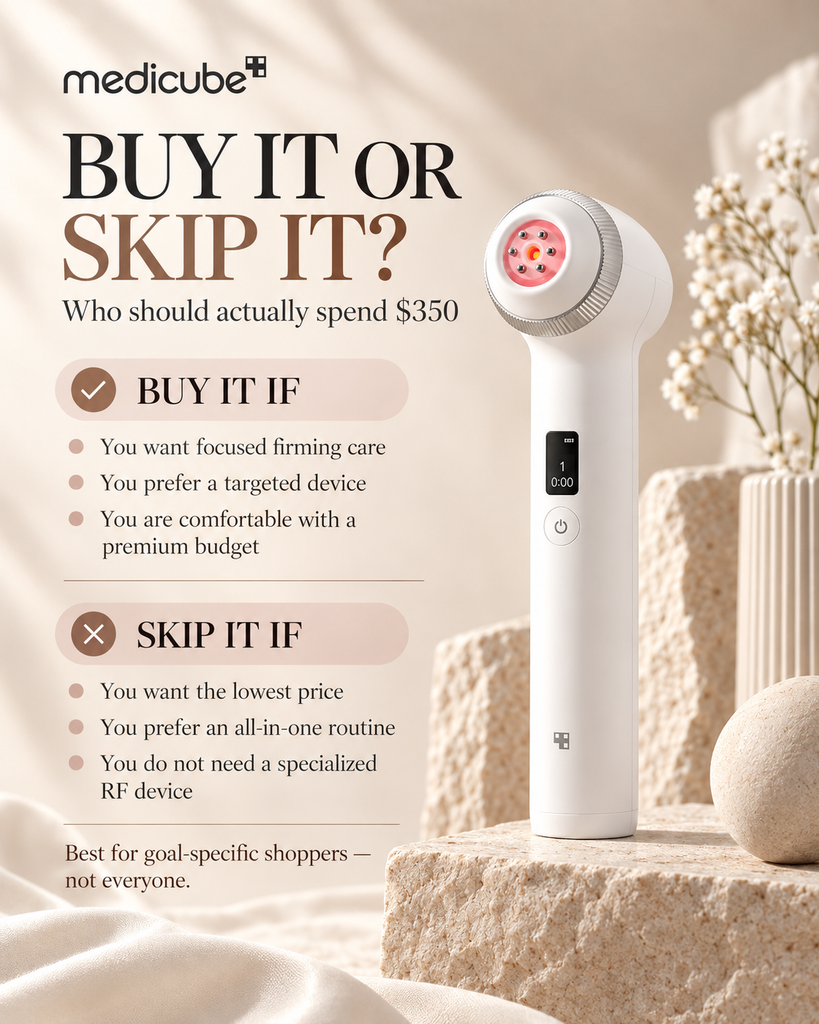
Ultra Tune 40.68 is worth considering for a narrow buyer: someone who specifically wants at-home RF-focused firming and elasticity care and is willing to use the device consistently.
Medicube currently sells Ultra Tune for $350, compared with a displayed $530 reference price. The device combines 40.68 MHz radiofrequency with microcurrent, requires careful six-tip contact and can be used after absorbed skincare without a dedicated conductive gel.
Medicube also reports improvements in several line-related measurements from its own human application test. Those are brand-provided results, and the public product page does not provide enough methodology to treat them as an independent head-to-head clinical trial.
Independent research supports the broader possibility that some home-use RF devices can improve measured signs of skin aging over time. But the published 12-week randomized split-face study discussed here tested a different home RF device — not Medicube Ultra Tune 40.68.
Buy Ultra Tune if RF-focused firming is clearly your primary device goal.
Skip it if you mainly want glow, skincare-product application support, sheet-mask use, multiple treatment modes or a lower-cost first beauty device.
And do not treat “40.68 MHz” as a performance score. It identifies the RF frequency; it does not guarantee a particular treatment depth, collagen response, lifting result or superiority over another RF device.
Frequently Asked Questions
What does 40.68 mean on Medicube Ultra Tune?
It refers to the device’s 40.68 MHz radiofrequency. It is a frequency specification, not the device temperature, treatment depth or a score showing how effective it is.
Is Medicube Ultra Tune an RF device?
Yes. Medicube identifies Ultra Tune 40.68 as a device combining radiofrequency with microcurrent.
Does Medicube Ultra Tune require conductive gel?
No dedicated conductive gel is required according to Medicube. The brand says to use the device after your regular skincare has fully absorbed.
Can you use Ultra Tune every day?
Medicube currently says yes and recommends about 5–10 minutes per session, up to one to three times daily, while also telling users to adjust the frequency and duration according to their skin condition.
Why does Ultra Tune sometimes stop delivering energy?
Medicube says all six treatment tips must be in full contact with the skin. The device may also adjust its energy output if it is moved too slowly or held over one area.
Can you use Ultra Tune around the eyes?
Medicube says it may be used around the eye area at level 1, but specifically instructs users to avoid the eyelids and the area directly below the eyes.
Is Ultra Tune better than Booster Pro X2?
Not universally. Ultra Tune is the more specialized RF-focused device. Booster Pro X2 is the broader multi-mode device and is currently less expensive on Medicube US. Your primary treatment goal should decide between them.
Does Ultra Tune have independent clinical proof?
Medicube publishes its own human-application test results for Ultra Tune. Independent studies support the broader home-use RF category, but the research cited here did not test this exact Medicube device.
Is Ultra Tune worth $350?
It can be worth $350 for someone specifically committed to RF-focused firming care. It is harder to justify for beginners, occasional device users or shoppers who would benefit more from a versatile multi-mode device.
Sources & Product Verification
- Medicube US — RF Ultra Tune 40.68
- Medicube US — Ultra Tune How to Use
- Medicube Japan — Ultra Tune 40.68 MHz Product Page
- Medicube US — Booster Pro X2
- PubMed — Randomized Split-Face Home-Use RF Clinical Trial
- Hwahae — Ultra Tune Consumer Reviews
- Harper’s Bazaar — Ultra Tune Editorial Review
Prices, official usage guidance and product information were checked September 14, 2026. Prices, promotions, availability and device guidance can change.