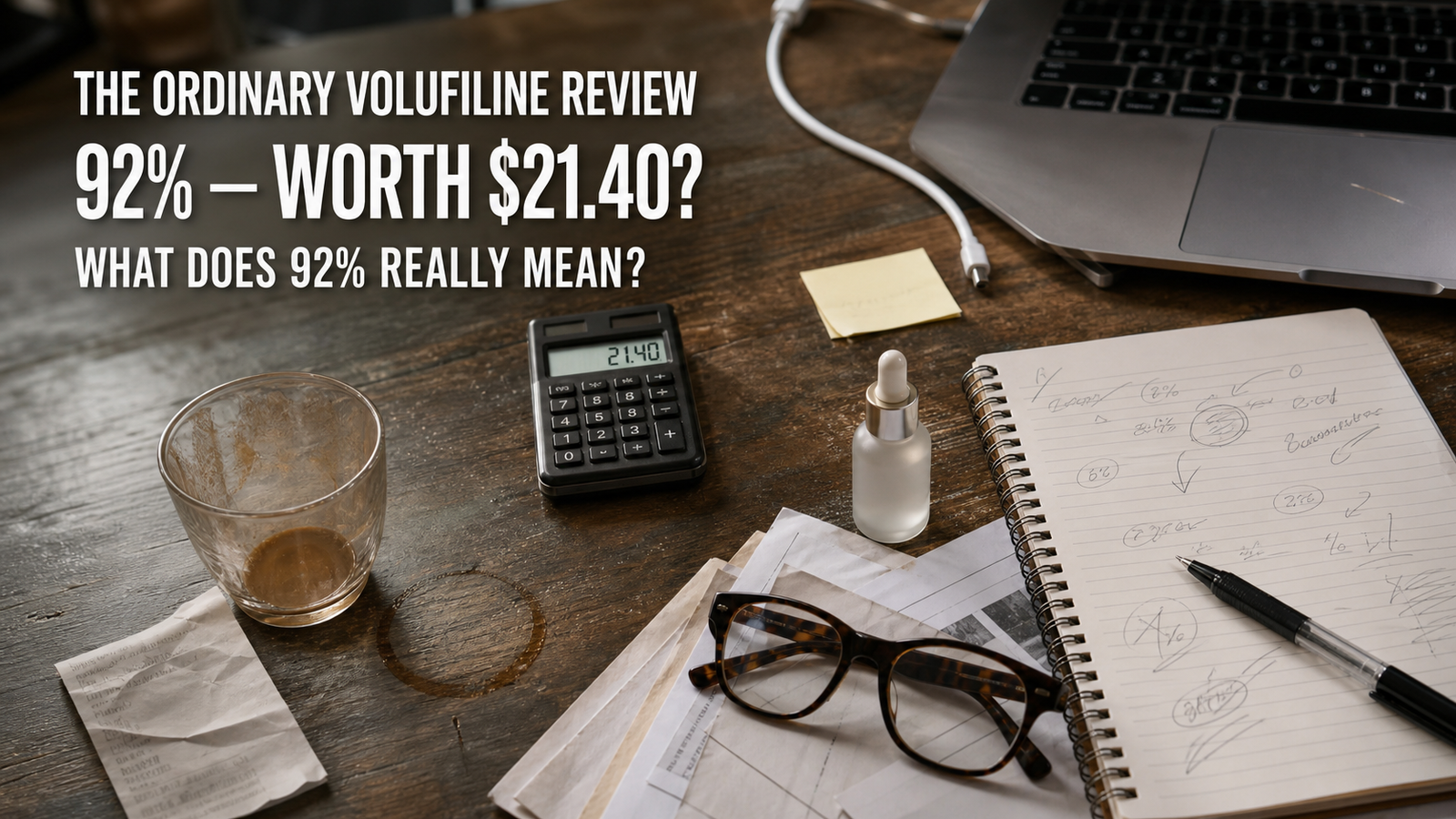
This The Ordinary Volufiline review starts with the number that makes this product unusually easy to misunderstand:
92%.
The Ordinary currently sells Volufiline 92% + Pal-Isoleucine 1% for $21.40 per 15mL bottle in the U.S. The brand positions it as a targeted serum for areas that look hollow or affected by visible volume loss.
That sounds unusually strong.
But 92% Volufiline does not mean 92% pure sarsasapogenin.
It does not mean 92% facial-volume improvement.
And it does not mean this serum has been proven to behave like injectable filler.
Volufiline is a branded cosmetic ingredient supplied by Croda, not the name of one pure active molecule.
So the real buying question is:
Is this highly Volufiline-focused $21.40 serum worth trying if you keep your expectations realistic?
My evidence-based verdict is:
Yes, for Volufiline-curious shoppers who want an affordable targeted experiment.
No, if the result you actually expect is predictable facial-fat restoration or “filler in a bottle.”
K-Beauty Clarity did not personally test this product. This review is based on the current official formula and directions, supplier information, expert commentary, published third-party editorial testing, and public retailer feedback.
Price and product information were checked on August 31, 2026 and can change.
The Ordinary Volufiline Review: Quick Verdict
Buy it if you want:
- a highly Volufiline-focused finished formula
- a short seven-ingredient serum
- targeted rather than full-face application
- a relatively low-cost $21.40 experiment
- a formula without retinol in the current INCI
- realistic expectations for subtle or inconsistent visible results
Think twice if:
- you dislike rich, slippery, or oil-like sensory textures
- your skin congests easily
- you expect a conventional lightweight water serum
- you want dramatic results within days
- you are buying mainly because 92% sounds automatically stronger than every lower-percentage Volufiline product
Skip it if you expect:
- injectable-filler replacement
- predictable restoration of facial fat
- guaranteed correction of deep tear-trough hollows
- permanent structural facial-volume change
- results that can be predicted from the percentage alone
The Ordinary Volufiline 92%: Quick Facts
Official product: Volufiline 92% + Pal-Isoleucine 1%
Size: 15mL
Official U.S. price checked: $21.40
Official status checked: Trending
Format: Targeted water-free serum
Volufiline disclosure: 92%
Palmitoyl Isoleucine: 1%
Current ingredient count: 7
Current official INCI: Hydrogenated Polyisobutene, Caprylyl Glycol, Polyglyceryl-3 Stearate, Palmitoyl Isoleucine, Anemarrhena Asphodeloides Root Extract, Rhus Succedanea Fruit Wax, Tocopherol.
Current brand labels: water-free, alcohol-free, oil-free, silicone-free
Brand-positioned target areas: under-eyes, temples, cheeks, and smile lines
Official application: shake well; apply after moisturizer directly to clean, dry target areas as needed
Best reason to buy: a focused way to experiment with a high disclosed Volufiline ingredient-system inclusion
Worst reason to buy: assuming 92% proves filler-like facial-volume restoration
What Does 92% Volufiline Actually Mean?
This is the most important part of the review.
The Ordinary discloses 92% Volufiline in the finished serum.
Croda, the supplier behind Volufiline, lists the ingredient’s INCI as:
Hydrogenated Polyisobutene (and) Anemarrhenae Asphodeloides (Root) Extract.
Croda also explicitly identifies Volufiline as a cosmetic ingredient, not a finished product.
That changes how the 92% label should be read.
The useful conclusion is:
A very large disclosed proportion of The Ordinary’s finished formula is built around the Volufiline ingredient system.
It does not mean:
- 92% pure sarsasapogenin
- 92% facial-volume improvement
- 92% more facial fat
- 18.4 times the visible effect of a 5% product
- filler-equivalent performance
Volufiline is the trade ingredient system.
It is not one pure active molecule.
That distinction becomes especially important when comparing The Ordinary with Korean products labeled 5%, 50,000ppm, or even “100% Volufiline.”
Our best Volufiline Korean skincare products guide explains why those labels should not be ranked as simple pure-active percentages.
What Is Actually in the Formula?
The current formula is unusually short:
- Hydrogenated Polyisobutene
- Caprylyl Glycol
- Polyglyceryl-3 Stearate
- Palmitoyl Isoleucine
- Anemarrhena Asphodeloides Root Extract
- Rhus Succedanea Fruit Wax
- Tocopherol
That simplicity is one of the strongest arguments for this product.
There is no long peptide blend.
No PDRN.
No retinol.
No niacinamide headline.
No collagen complex.
No long list of botanical extracts competing for attention.
If your specific question is:
“I want to see whether a Volufiline-focused finished formula does anything noticeable for me.”
The Ordinary makes that experiment relatively straightforward.
What Does the 1% Palmitoyl Isoleucine Add?
The second headline ingredient is 1% Palmitoyl Isoleucine.
The Ordinary describes it as a supporting lipoamino acid intended to support a plumper appearance, improve the look of fine lines, and support elasticity.
That is brand-provided ingredient positioning.
It should not be translated into:
“1% Palmitoyl Isoleucine has independently been proven to rebuild my facial volume.”
The useful point is simpler.
The Ordinary is not literally selling a one-ingredient Volufiline bottle.
The finished serum combines the Volufiline ingredient system with a second ingredient selected specifically to support the formula’s plumping positioning.
Why Does an “Oil-Free” Serum Feel Oil-Like?
This is an unusual but important detail.
The Ordinary currently labels this product:
- water-free
- oil-free
- alcohol-free
- silicone-free
At the same time, some editorial testers describe the sensory experience as noticeably oil-like, rich, or slippery.
Those statements are not necessarily contradictory.
“Oil-free” is a brand formulation classification. It does not guarantee a water-light skin feel.
The formula is anhydrous, and Hydrogenated Polyisobutene is the first ingredient.
So if you expect the texture of a conventional watery hyaluronic-acid serum, this product may surprise you.
Cosmopolitan editors described an oily consistency or noticeably rich texture during their testing.
Texture preference therefore matters almost as much as the ingredient percentage.
How Do You Use The Ordinary Volufiline?
The official The Ordinary product page currently instructs users to:
- Shake well.
- Apply as needed after moisturizer.
- Apply directly to clean, dry target areas.
- Use only on unbroken skin.
- Patch test before use.
The wording “after moisturizer” and “clean and dry target areas” comes directly from the current brand directions.
I would not reinterpret that into a different layering order.
This is also not positioned as a conventional all-over serum.
Think:
small amount, selected area, targeted finishing step.
The brand currently discusses areas including:
- under-eyes
- temples
- cheeks
- smile lines
That targeted use also makes the 15mL size more understandable.
Can You Use It Under the Eyes?
The Ordinary specifically positions the product for hollow-looking under-eye areas.
But “under-eye hollow” is not one single condition.
A hollow or dark-looking under-eye can be influenced by:
- skeletal anatomy
- tear-trough structure
- fat-pad position
- skin thickness
- pigmentation
- visible blood vessels
- puffiness
- surface dehydration
- fine lines
- lighting and shadow
A topical serum cannot be assumed to correct every one of those causes.
The realistic buying case is:
It may be worth testing if you want a targeted cosmetic product for mildly depleted-looking, crepey, or hollow-looking under-eye skin.
It should not be treated as a predictable method for rebuilding a deep structural tear trough.
Keep the product out of the eyes and do not apply it directly to the inner eye or mucosal surfaces.
Can The Ordinary Volufiline Replace Under-Eye Filler?
No.
A topical Volufiline serum should not be described as a replacement for injectable filler.
Injectable fillers physically place material beneath the skin at controlled tissue depths to change volume and contour.
Current expert commentary does not identify credible peer-reviewed facial evidence showing that topical Volufiline predictably restores facial fat or reproduces the structural volume created by injectable fillers.
Allure’s recent expert review also emphasizes that evidence for meaningful facial-fat growth remains limited and that hydration, emollience, surface smoothing, and light reflection may explain part of the visibly “plumper” appearance some users notice.
So:
Possible subtle cosmetic improvement? Reasonable to investigate.
Predictable filler replacement? No.
How Strong Is the Evidence for Volufiline?
This is where viral marketing gets ahead of the evidence.
Volufiline has supplier data and a long cosmetic-use history, but the available evidence should not be treated as equivalent to a large independent facial clinical trial.
Frequently cited data around Volufiline have included non-facial testing.
That is important because results from another body area cannot automatically be converted into:
- correction of tear-trough hollows
- cheek-fat restoration
- lip augmentation
- predictable facial contour changes
Recent dermatologists interviewed by both Allure and Cosmopolitan emphasize the same basic limitation:
The current evidence does not justify calling topical Volufiline a proven facial-fat-restoration treatment.
The percentage on The Ordinary’s bottle does not solve that evidence gap.
What About Smile Lines?
The Ordinary officially includes smile-line areas in its targeted positioning.
But a smile line can appear more visible because of multiple factors:
- repeated movement
- surface dryness
- skin texture
- elasticity changes
- deeper facial structure
- volume distribution
A topical product may make an area look smoother or subtly fuller.
That is different from physically replacing deeper structural volume.
At $21.40, a targeted experiment can still make sense if that distinction is acceptable to you.
What About Using Volufiline Around the Lips?
Some consumers and beauty editors use Volufiline products around the lip area in pursuit of a fuller-looking appearance.
But The Ordinary’s current official product positioning focuses on targeted facial areas such as under-eyes, temples, cheeks, and smile lines.
It does not currently present this as a dedicated lip treatment.
So viral lip-plumping videos should not be treated as guaranteed product performance.
Do not apply the serum inside the mouth, directly to mucosal tissue, or onto broken or cracked skin.
If you experiment around the external lip area, patch test first and stop if irritation occurs.
Does The Ordinary Volufiline Actually Work?
There is no clean universal yes-or-no answer.
Current editorial and consumer experiences are mixed.
Some users and editors report:
- a smoother immediate appearance
- subtle under-eye plumping
- softer-looking smile lines
- slightly fuller-looking targeted areas
- enough improvement to keep using the product
Others report:
- little or no meaningful change
- a texture that feels too rich
- tingling or irritation
- congestion or breakouts
- disappointment after expecting dramatic volume restoration
That variation is exactly why the 92% number should not dominate the decision.
A high disclosed ingredient-system inclusion does not guarantee a dramatic visible response for every person.
What Did Cosmopolitan’s Editors Experience?
Cosmopolitan published three editor experiences spanning roughly one to three months of use.
The outcomes were not identical.
One editor reported a more noticeable improvement in under-eye appearance over time.
Another mainly liked the immediate smoothing and plumping appearance from the formula’s texture while describing the longer-term change as modest.
A third reported some initial inflammation followed by a subtle fuller-looking appearance around targeted areas.
That is useful real-world context.
It is not controlled clinical evidence.
The product also won Cosmopolitan’s 2026 Holy Grail Beauty Award for Best Skincare Steal.
That tells us editors considered it an unusually good-value beauty product.
It does not turn the award into an efficacy trial.
What Does Current Retailer Feedback Tell Us?
Current retailer feedback remains mixed.
At the final check, Ulta Beauty continued to list the product at $21.40 with an active review base.
The most useful takeaway is not the exact average rating, because ratings and review counts change constantly.
Instead, retailer and editorial feedback point to a recurring split:
People who like it tend to value:
- targeted application
- subtle plumping or smoothing
- affordability
- the focused formula
- use around small areas rather than the whole face
People who dislike it tend to mention:
- insufficient visible change
- rich or oil-like sensory feel
- irritation or tingling
- congestion
- application preferences
Consumer reviews help identify practical patterns.
They are not proof that the product will or will not work for you.
Is the Applicator a Problem?
Because this is a targeted serum, controlled dispensing matters.
Cosmopolitan’s editor-tested The Ordinary roundup specifically listed:
“Applicator could use some improvement.”
That is useful practical feedback.
It is not evidence of a universal packaging defect.
I would not reject the product solely because of that comment, but I would avoid dispensing more than needed.
This is a targeted formula, not a full-face serum.
What About Sensitive or Acne-Prone Skin?
A seven-ingredient formula may appeal to people who prefer shorter ingredient lists.
That does not make irritation impossible.
The Ordinary itself recommends patch testing and says to stop use if irritation occurs.
Cosmopolitan’s dermatologist commentary also notes that plant-derived ingredients can irritate some users and that an oil-soluble ingredient system may not suit every acne-prone person.
If you tend to break out easily:
start on one small target area rather than applying it across multiple parts of the face immediately.
Do not assume that a short INCI automatically means universally non-irritating.
How Long Should You Test It?
Do not use one application as proof of long-term facial-volume change.
Some editorial testers describe an immediate smoother or fuller-looking surface effect.
Perceived cumulative changes in editor testing were generally discussed after weeks or months rather than after one use.
But those experiences are anecdotal.
There is no verified timeline guaranteeing that you will see a visible result after two weeks, four weeks, or two months.
If you choose to test the product, take your own baseline photos under the same:
- lighting
- camera distance
- angle
- facial expression
Then compare them later under the same conditions.
This reduces some of the misleading visual differences caused by lighting and posing.
Personal progress photos are still not clinical evidence.
Is $21.40 Good Value?
For the right buyer, yes.
The current official U.S. price is:
$21.40 for 15mL.
The product is intended for targeted rather than all-over application, so 15mL may last longer than the bottle size initially suggests.
The value proposition is strongest if your question is:
“I want an affordable way to test a highly Volufiline-focused finished formula.”
The value becomes much weaker if:
- you dislike the texture
- you will not use targeted products consistently
- your skin reacts poorly
- you expect dramatic structural facial-volume change
At $21.40, the financial risk is relatively low.
The expectation risk is much higher.
The Ordinary Volufiline vs Medicube: Which Should You Buy?
These two products solve different problems.
The Ordinary makes more sense if your priority is:
- Volufiline itself
- a minimalist formula
- the much higher disclosed Volufiline-system inclusion
- no retinol in the current formula
- a targeted serum format
Medicube makes more sense if your priority is:
- a balm stick
- richer moisturization
- surface smoothing and glow
- portability
- PDRN/Sodium DNA
- retinol
- NAD/NMN
- peptides
- a broader multi-active formula
For the full buying decision, read our Medicube vs The Ordinary Volufiline comparison.
If you are specifically considering the balm, our Medicube PDRN Pink Collagen Volume Multi Balm review goes deeper into its 5% Volufiline claim, finished formula, and practical use.
The important point is:
92% versus 5% is not an 18.4-times efficacy comparison.
Is the 92% Number Actually an Advantage?
Yes—but only in a specific sense.
The Ordinary publicly discloses an unusually high 92% Volufiline ingredient-system inclusion.
That makes it a particularly Volufiline-focused finished formula.
That is a legitimate buying advantage if Volufiline itself is what you want to experiment with.
But it does not automatically determine:
- skin delivery
- individual tolerance
- visible response
- whether your concern is actually caused by volume loss
- how much long-term change you will see
- whether this is the best format for your routine
My interpretation is therefore:
92% is a meaningful formulation disclosure.
It is not an efficacy multiplier.
Who Should Buy The Ordinary Volufiline?
Consider buying it if:
- you specifically want to experiment with Volufiline
- you prefer short, focused formulas
- $21.40 feels like a reasonable trial price
- you want targeted rather than full-face application
- mild hollow-looking or depleted-looking areas are your concern
- you understand that results may be subtle
- you are willing to use it consistently
- you do not expect filler-level structural change
Who Should Skip It?
Skip it if:
- you expect predictable facial-fat growth
- you expect injectable-filler replacement
- you want guaranteed correction of deep under-eye hollows
- rich or oil-like textures bother you
- your skin congests easily and you do not want to experiment
- you are purchasing only because the number 92% sounds dramatically stronger
- you need a product with strong independent facial clinical evidence
Where Should You Buy It?
Start with the official The Ordinary Volufiline 92% + Pal-Isoleucine 1% product page.
When this review was finalized, the official U.S. listing showed:
$21.40 / 15mL / Trending
You can also compare current availability at Ulta Beauty and Sephora.
Prices, promotions, stock, ratings, and review counts can change.
Final Verdict: Is The Ordinary Volufiline Worth It?
Yes—if you specifically want to experiment with Volufiline without spending much money.
The Ordinary has created a highly focused formula:
- 92% Volufiline ingredient system
- 1% Palmitoyl Isoleucine
- seven total ingredients
- targeted application
- $21.40 price
That makes it one of the more straightforward current products for someone asking:
“Does a Volufiline-focused finished formula do anything noticeable for me?”
But the strongest reason to buy it is also the reason to keep expectations controlled.
This is a targeted Volufiline experiment.
It is not topical filler.
It is not 92% pure sarsasapogenin.
And 92% does not guarantee dramatic facial-volume restoration.
Published third-party editorial testing and public feedback cited in this review show mixed experiences: some people report subtle changes in areas such as the under-eyes or smile lines, while others mainly notice surface smoothing, little visible change, or a texture they do not enjoy.
So my final verdict is:
Worth trying at $21.40 if you are Volufiline-curious and comfortable with uncertainty.
Not worth buying if “filler in a bottle” is the result you actually expect.
Bottom line:
The Ordinary is a highly Volufiline-focused finished formula, but its 92% label describes the ingredient-system inclusion—not 92% pure sarsasapogenin, predictable facial-fat restoration, or filler-like results.
Sources & Product Verification
The Ordinary — Volufiline 92% + Pal-Isoleucine 1%
Croda — Volufiline 2026 Market Update
Ulta Beauty — The Ordinary Volufiline 92% + Pal-Isoleucine 1%
Sephora — The Ordinary Volufiline 92% + Pal-Isoleucine 1%
Cosmopolitan — Three Editor Volufiline Test
Cosmopolitan — 2026 Holy Grail Beauty Awards