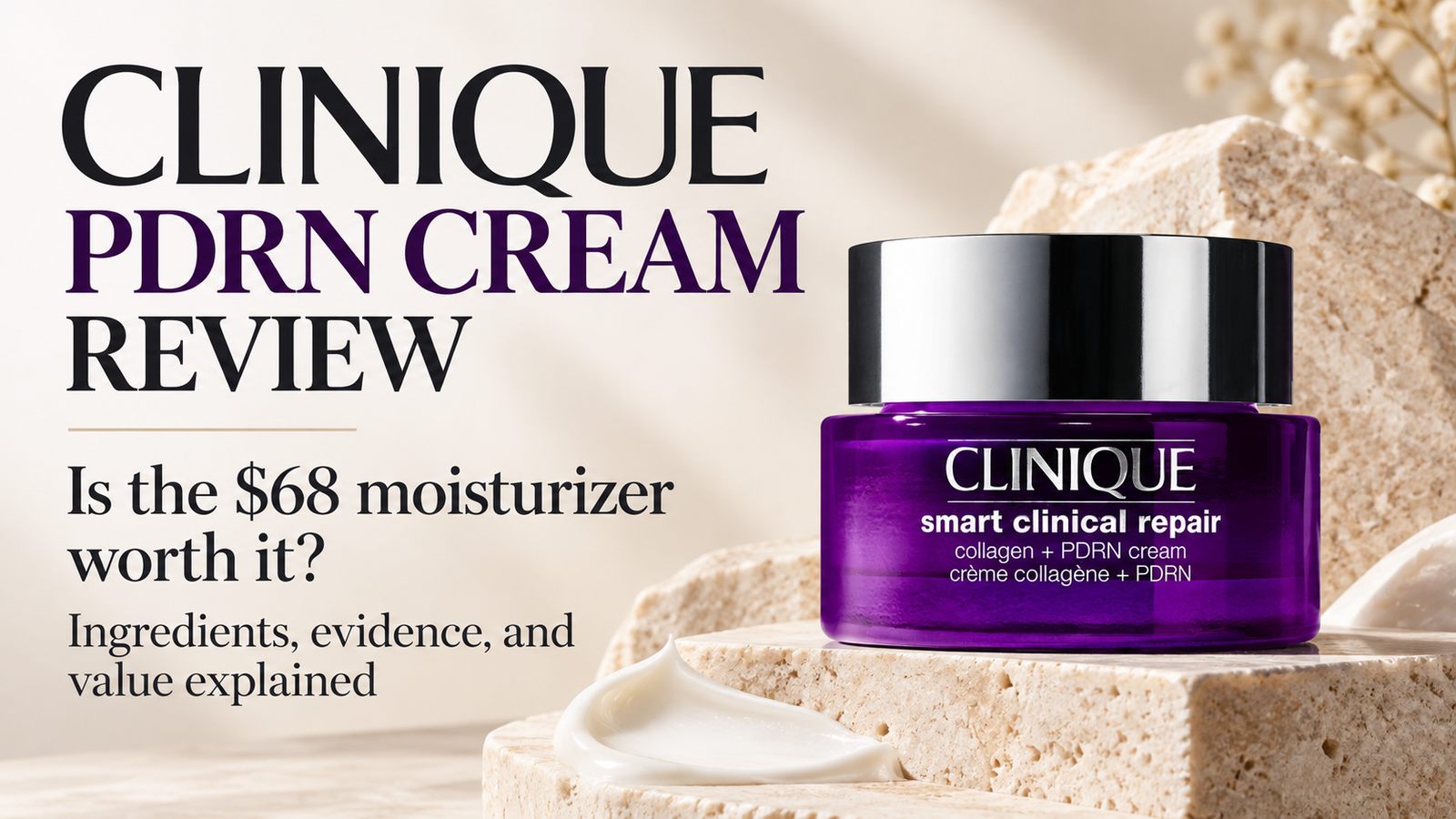
Is the new Clinique PDRN cream worth $68? For the right buyer, yes—but not because PDRN automatically makes it stronger or more effective than cheaper Korean PDRN creams.
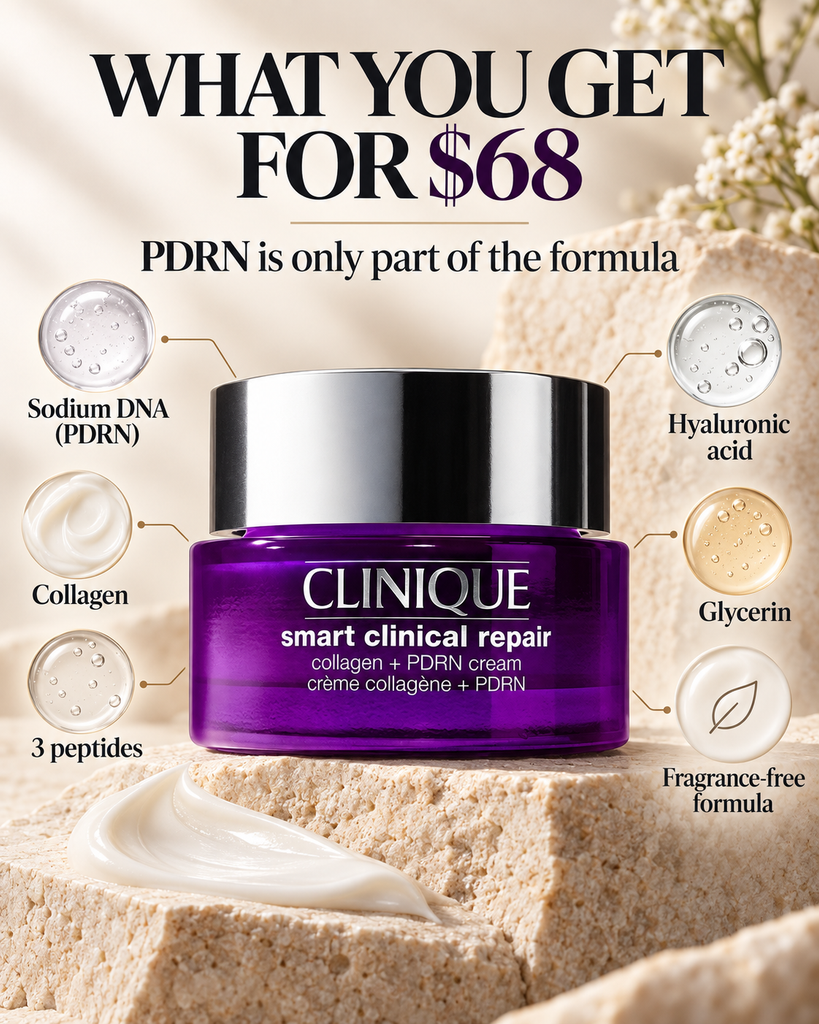
The more convincing reason to consider Clinique Smart Clinical Repair™ Collagen + PDRN Cream is the complete formula: a fragrance-free premium moisturizer built around collagen, Sodium DNA, peptides, hyaluronic acid, glycerin and a substantial moisturizing base.
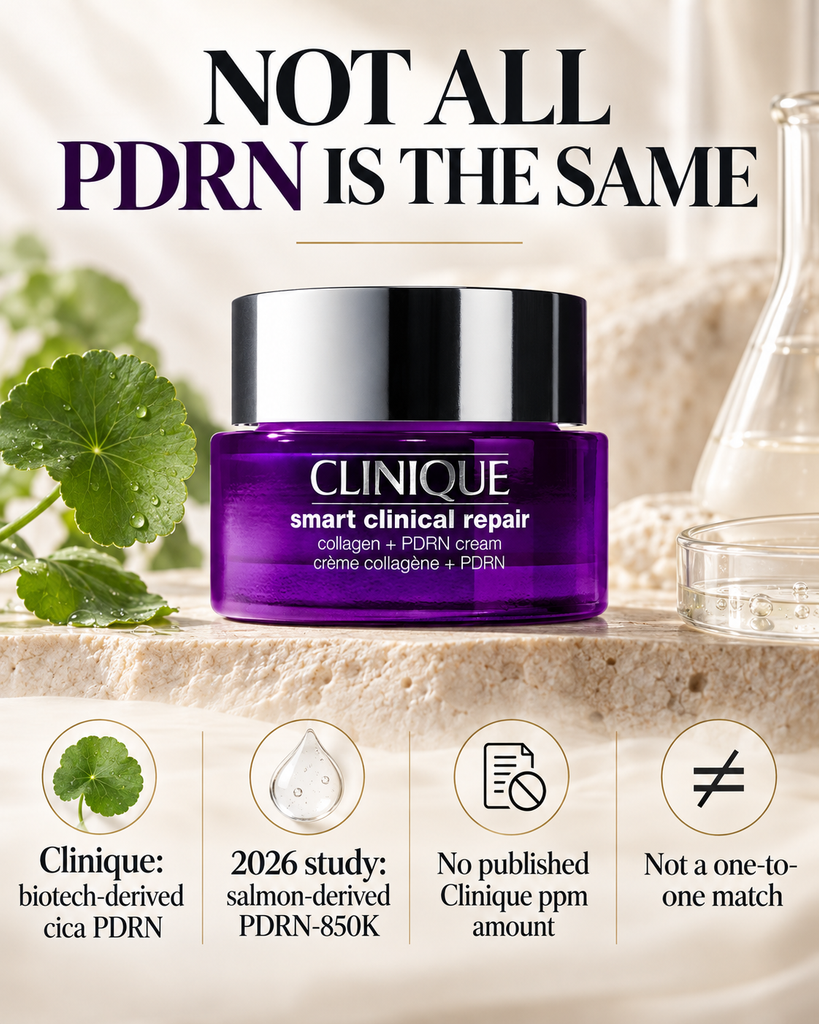
The biggest catch is evidence. Clinique publishes finished-product clinical testing for this cream, which is useful. But the brand does not disclose a PDRN percentage or ppm concentration on the current U.S. product page, and Clinique describes its PDRN as biotech-derived from cica rather than the defined salmon-derived PDRN-850K material used in the most notable 2026 topical PDRN study.
So the short answer is:
Worth considering if: you already want a premium Clinique moisturizer, prefer a fragrance-free formula, like the idea of a non-salmon PDRN source and value finished-product testing.
Compare cheaper options first if: your main goal is simply to buy the “strongest PDRN” or get the lowest cost per milliliter. Clinique does not publish a concentration that lets us make a meaningful potency comparison.
Current U.S. price: $68 for 1.7 oz / 50 mL, or about $13.60 per 10 mL, checked September 15, 2026.
This is an evidence-based buying review based on current product information, published ingredient data, brand-provided finished-product testing and available PDRN research. It is not a hands-on wear test.
Clinique PDRN Cream Review: Quick Facts
| Product | Clinique Smart Clinical Repair™ Collagen + PDRN Cream |
|---|---|
| Current U.S. Price | $68 |
| Size | 1.7 oz / 50 mL |
| Cost per 10 mL | About $13.60 |
| PDRN-Related INCI | Sodium DNA |
| PDRN Source | Clinique describes it as biotech-derived from cica |
| PDRN Concentration | Not disclosed on the current U.S. product page |
| Highlighted Ingredients | Collagen, PDRN, peptides, hyaluronic acid and glycerin |
| Fragrance | Clinique states 100% fragrance free |
| Brand Testing | 24 women after one use; 35 women after four weeks |
| Best For | Shoppers looking for a premium fragrance-free moisturizer focused on hydration, visible plumpness, firmness and bounce |
| Main Catch | No disclosed PDRN concentration and no direct evidence that its cica-derived PDRN is clinically interchangeable with studied salmon-derived PDRN materials |
This article contains affiliate links. If you purchase through these links, we may earn a commission at no additional cost to you. As an Amazon Associate I earn from qualifying purchases. See our affiliate disclosure.
Where to buy: Check Clinique Smart Clinical Repair Collagen + PDRN Cream on Amazon.
Is Clinique PDRN Cream Worth $68?
I would not pay $68 for this cream simply because the label says PDRN.
I would consider paying $68 if I specifically wanted the complete Clinique formula.
That distinction matters.
Clinique highlights collagen, PDRN, peptides, hyaluronic acid and glycerin as the key ingredients. The current published ingredient list for this same product also shows Sodium DNA alongside Palmitoyl Tripeptide-1, Palmitoyl Tetrapeptide-7, Acetyl Hexapeptide-8, Sodium Hyaluronate and multiple moisturizing and supporting ingredients.
Clinique also provides finished-product testing rather than relying only on general PDRN marketing.
But this is still a premium moisturizer. At $68 for 50 mL, it costs about $13.60 per 10 mL.
If your real shopping goal is simply “I want a good PDRN moisturizer,” there are much less expensive options.
Our best PDRN creams comparison breaks down current Korean moisturizers by PDRN source, formula, fragrance, price and evidence.
The Clinique purchase makes more sense for someone who values the complete formula, fragrance-free positioning and finished-product testing—not someone chasing the largest PDRN number.
What Is Actually in the Clinique PDRN Cream?
The formula is more interesting than the PDRN headline alone.
Clinique officially highlights collagen, PDRN, peptides, hyaluronic acid and glycerin.
The current published INCI for the same 50 mL product lists Collagen followed by Sodium DNA, the INCI name Clinique associates with its PDRN positioning.
It also lists three recognizable peptide ingredients:
Palmitoyl Tripeptide-1, Palmitoyl Tetrapeptide-7 and Acetyl Hexapeptide-8.
Other listed ingredients include glycerin, Sodium Hyaluronate, Acetyl Glucosamine, Caffeine, Ergothioneine, Murumuru Seed Butter, Petrolatum and Aminopropyl Ascorbyl Phosphate.
Ingredient lists can change and can occasionally differ by market, so the carton on the product you actually buy remains the final reference.
This is why I see the product first as a well-rounded premium moisturizer that includes PDRN, rather than a concentrated PDRN treatment.
What Kind of PDRN Does Clinique Use?
This is the most important distinction in the review.
Clinique describes the topical PDRN in this cream as biotech-derived from the cica plant, Centella asiatica.
The brand’s ingredient guide says consumers will see it on the ingredient list as Sodium DNA.
Clinique does not currently disclose a consumer-facing percentage, ppm concentration, molecular-size profile or purity specification for the PDRN on its U.S. product page.
That means there is no evidence-based way to calculate whether this cream contains more, less or “stronger” PDRN than a salmon-derived cream that publishes a ppm figure.
For example, we cannot responsibly say:
“Clinique is stronger than a 1,000 ppm PDRN cream.”
We also cannot say:
“Clinique contains less PDRN than Medicube or Anua.”
The information required for those comparisons simply is not publicly standardized.
If you are new to the ingredient, our guide to what PDRN skincare actually is explains why source, concentration, molecular characteristics, delivery and the finished formula all matter.
Is Clinique’s Cica-Derived PDRN the Same as Salmon PDRN?
We should not assume that the two are clinically interchangeable.
Clinique describes its material as biotech-derived from cica. Many other PDRN skincare products instead use fish- or salmon-derived Sodium DNA.
The word PDRN alone does not establish that two materials have identical molecular characteristics, purity specifications, fragment distributions, concentrations or delivery behavior.
That distinction matters because a 2026 randomized, double-blind, split-face human study tested a specific 0.1% PDRN-850K eye cream against an otherwise matched 0.1% retinol eye cream over 28 days.
The clinical analysis included 31 participants.
That study provides promising evidence for one defined topical PDRN material and one specific finished formulation.
It did not test Clinique Smart Clinical Repair Collagen + PDRN Cream.
Therefore, the study does not prove that Clinique’s biotech-derived cica PDRN has the same molecular properties, delivery behavior or clinical effects as the PDRN-850K material tested in that trial.
If you want the full research context, our PDRN vs retinol guide explains what that study did—and did not—prove.
What Do Clinique’s Clinical Results Actually Show?
Clinique does publish product-specific testing for this cream.
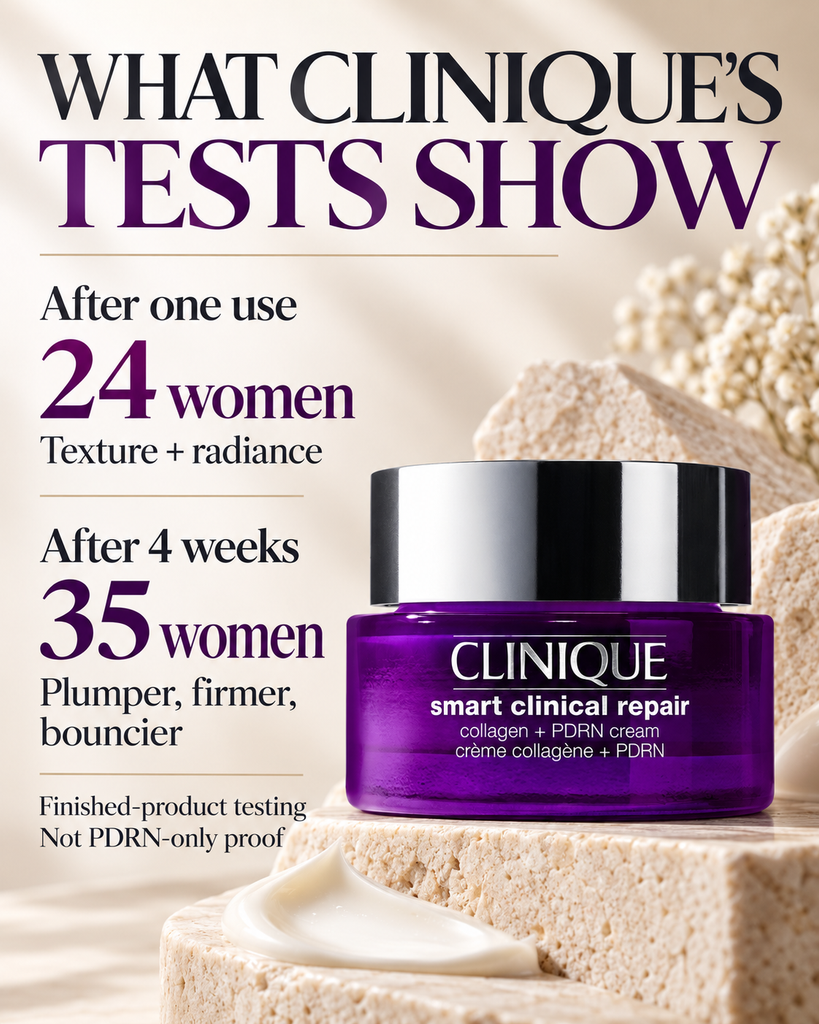
On the current U.S. product page, the brand states that after one use, clinical testing on 24 women found improvement in texture and radiance.
Clinique also states that after four weeks, clinical testing on 35 women found that skin looked plumper and felt firmer and bouncier.
Those claims are more relevant to this purchase than taking the results of an unrelated PDRN study and pretending they apply directly to Clinique.
But they still require context.
These are brand-provided finished-product clinical test claims. The current public U.S. page gives the sample sizes and duration but does not provide enough methodology to independently evaluate details such as the comparator, blinding, measurement methods, effect sizes or full statistical analysis.
And because the finished cream was tested, these results do not tell us how much of the reported change came specifically from Sodium DNA versus collagen, peptides, humectants, emollients or the moisturizer base.
The fair conclusion is:
Clinique provides useful finished-product testing, but that testing does not isolate PDRN as the sole cause of the reported results.
Is It Really Fragrance-Free and Suitable for Sensitive Skin?
Clinique states that the cream is 100% fragrance free, dermatologist tested and allergy tested, and it labels the product as safe for sensitive skin.
Those are useful shopping details, particularly for someone who deliberately avoids added fragrance.
But “safe for sensitive skin” should not be interpreted as “guaranteed not to irritate sensitive skin.”
Fragrance-free removes one potential trigger. It does not eliminate the possibility of irritation, breakouts or contact allergy from another ingredient in a finished formula.
If your skin is highly reactive, introduce one new product at a time. Persistent burning, itching, swelling, rash or worsening redness is a reason to stop rather than continuing simply because the package says sensitive-skin friendly.
Our Korean skincare for sensitive skin guide explains why the complete formula and your own reaction matter more than any one label claim.
Is Clinique PDRN Cream Vegan?
Do not assume that the finished product is vegan simply because Clinique describes its PDRN as biotech-derived from cica.
A single ingredient source does not establish the vegan status of the whole formulation.
A current U.S. retailer-published ingredient list for this same product includes Whey Protein / Lactis Protein.
Because Clinique’s U.S. consumer page does not currently make a clear finished-product vegan claim, shoppers who require a vegan formula should verify the latest carton or obtain confirmation from Clinique before purchasing for that reason.
The safer conclusion is not “cica-derived PDRN equals vegan.”
It is: the PDRN source and the vegan status of the complete finished product are separate questions.
What Does Clinique Say About the Texture?
Clinique describes this cream as bouncy and lightweight.
That is the level of texture claim we can verify from the current U.S. product page.
This review has not performed a controlled hands-on wear test, so I would not make stronger claims about absorption speed, tackiness, pilling, makeup compatibility or how it finishes on oily versus dry skin.
Those experiences can also change depending on how much product you use and what you layer underneath.
Clinique PDRN Cream vs Korean PDRN Creams
The most useful comparison is not “Western brand versus Korean brand.”
It is what material is being used, what the complete formula contains, what the brand discloses and how much you are paying.
Several Korean PDRN creams disclose salmon-derived Sodium DNA, and some brands publish a specific ppm figure.
Clinique takes a different approach. It describes its PDRN as biotech-derived from cica but does not publish a directly comparable concentration on the current U.S. product page.
Clinique also combines that positioning with recombinant collagen, peptides and a premium moisturizer base.
Neither approach automatically wins.
If you care most about a disclosed PDRN concentration or lower price per milliliter, some Korean options are easier to evaluate.
If you care more about a fragrance-free Clinique moisturizer with finished-product clinical testing and you are comfortable paying a premium, Clinique has a clearer case.
If Medicube is the alternative you are considering, our Clinique PDRN Cream vs Medicube comparison breaks down the current price gap, cica-derived versus salmon-DNA PDRN positioning, formula differences, and the 2026 Singapore batch-recall context.
What Is Special About Clinique’s Collagen?
Clinique says the cream uses recombinant collagen developed through fermentation technology and designed using the natural sequence of skin’s own collagen.
That is useful information about the ingredient technology.
It should not be interpreted as proof that applying this cream rebuilds dermal collagen or reproduces the effects of an injectable, device treatment or unrelated clinical study.
The recombinant collagen is part of the finished cosmetic formula—not independent evidence that the cream structurally replaces lost dermal collagen.
How to Use Clinique Smart Clinical Repair Collagen + PDRN Cream
As a moisturizer, use the cream after serum or treatment steps.
A simple routine would be:
Morning: cleanser → serum or treatment → Clinique PDRN Cream → broad-spectrum sunscreen.
Evening: cleanser → serum or treatment → Clinique PDRN Cream.
You do not need to add another PDRN serum simply because this moisturizer contains PDRN. More products carrying the same trend ingredient do not automatically produce better results.
Who Should Buy Clinique PDRN Cream?
Consider it if: you already want a premium Clinique moisturizer; you prefer fragrance-free skincare; your main goals are hydration, visible plumpness, firmness and bounce; you are interested in Clinique’s biotech-derived cica PDRN positioning; or you value finished-product clinical testing.
Compare alternatives first if: your priority is the highest disclosed PDRN concentration; you want the lowest cost per milliliter; you specifically want salmon-derived PDRN; vegan status is essential to you; or you are buying because you expect this cream to reproduce results from an unrelated PDRN clinical study.
Ready to compare the current price? Check Clinique Smart Clinical Repair Collagen + PDRN Cream on Amazon.
FAQ
How much does Clinique PDRN Cream cost?
Clinique Smart Clinical Repair Collagen + PDRN Cream currently costs $68 for 1.7 oz / 50 mL on the U.S. Clinique site. Prices and promotions can change.
What percentage of PDRN is in Clinique PDRN Cream?
Clinique does not currently disclose a consumer-facing PDRN percentage or ppm amount on its U.S. product page. The brand identifies Sodium DNA as the INCI name associated with its PDRN.
Is Clinique PDRN salmon-derived?
Clinique does not present this product’s PDRN as salmon-derived. The brand describes its topical PDRN as biotech-derived from the cica plant, Centella asiatica.
Is Clinique PDRN Cream vegan?
Do not assume so from the PDRN source alone. A current retailer-published ingredient list for this product includes Whey Protein / Lactis Protein, and the current U.S. Clinique page does not clearly certify the finished product as vegan. Check the latest packaging or confirm with Clinique if vegan status is essential.
Does Clinique PDRN Cream have clinical testing?
Yes. Clinique states that clinical testing involved 24 women after one use and 35 women after four weeks. These are brand-provided finished-product claims, not an independent peer-reviewed trial isolating the effect of PDRN.
Is Clinique PDRN Cream good for sensitive skin?
Clinique labels the formula safe for sensitive skin, dermatologist tested, allergy tested and 100% fragrance free. Those claims do not guarantee that every person with sensitive skin will tolerate the formula.
Is Clinique PDRN Cream better than Korean PDRN creams?
There is no evidence-based way to make that blanket conclusion. PDRN source, concentration disclosure, supporting ingredients, formula architecture, price and product-specific testing differ across products.
Can I use Clinique PDRN Cream with retinol?
A moisturizer containing PDRN can potentially be used in the same overall routine as a retinoid if your skin tolerates the finished products. There is no general evidence that this Clinique cream automatically prevents retinoid irritation or makes a retinoid more effective.
Bottom Line: Is Clinique PDRN Cream Worth It?
Clinique Smart Clinical Repair™ Collagen + PDRN Cream is worth considering as a premium, fragrance-free moisturizer—not as a proven “strongest PDRN” treatment.
At $68 for 50 mL, it costs about $13.60 per 10 mL. Clinique positions the formula around hydration, visible plumpness, firmness and bounce, and officially highlights collagen, PDRN, peptides, hyaluronic acid and glycerin.
The brand identifies the PDRN-related INCI name as Sodium DNA and describes its topical PDRN as biotech-derived from cica. However, it does not currently publish a consumer-facing PDRN percentage, ppm amount or directly comparable molecular specification.
That means there is no evidence-based way to say that Clinique contains more PDRN, stronger PDRN or more effective PDRN than a cheaper cream with a stated salmon-PDRN or Sodium DNA figure.
Clinique also provides useful finished-product testing: 24 women after one use and 35 women after four weeks. But those tests evaluate the complete cream, not PDRN in isolation.
Consider it if you already want a premium Clinique moisturizer, prefer fragrance-free skincare and value the complete formulation and brand testing.
Compare cheaper alternatives first if your main goal is the highest disclosed PDRN concentration or the lowest cost per milliliter.
For that comparison, see our best PDRN creams guide.
Sources & Product Verification
Clinique U.S.: Smart Clinical Repair™ Collagen + PDRN Cream
Clinique Ingredient Guide: PDRN
Clinique Ingredient Guide: Collagen
Bloomingdale’s: Current U.S. Retailer Ingredient List
PubMed: 2026 topical PDRN-850K study
Prices, ingredient lists, claims and availability were checked September 15, 2026 and may change. Brand-provided testing is identified as such. This article is for educational purposes and is not medical advice.