PDRN vs retinol has become one of the more interesting skincare comparisons of 2026 — especially after a new clinical study tested them head-to-head.
In that study, one 0.1% PDRN-850K eye cream produced larger short-term improvements in several periocular skin measurements than a 0.1% retinol eye cream.
That sounds like a major win for PDRN.
But does it mean you should replace retinol with PDRN?
Not necessarily.
The more accurate conclusion is this:
Retinol still has the broader and more established evidence base for photoaging, while topical PDRN now has promising human evidence that deserves attention.
The two ingredients also work differently, and the best choice depends on your goals, tolerance and the finished products you are actually using.
Here is what the evidence currently shows.
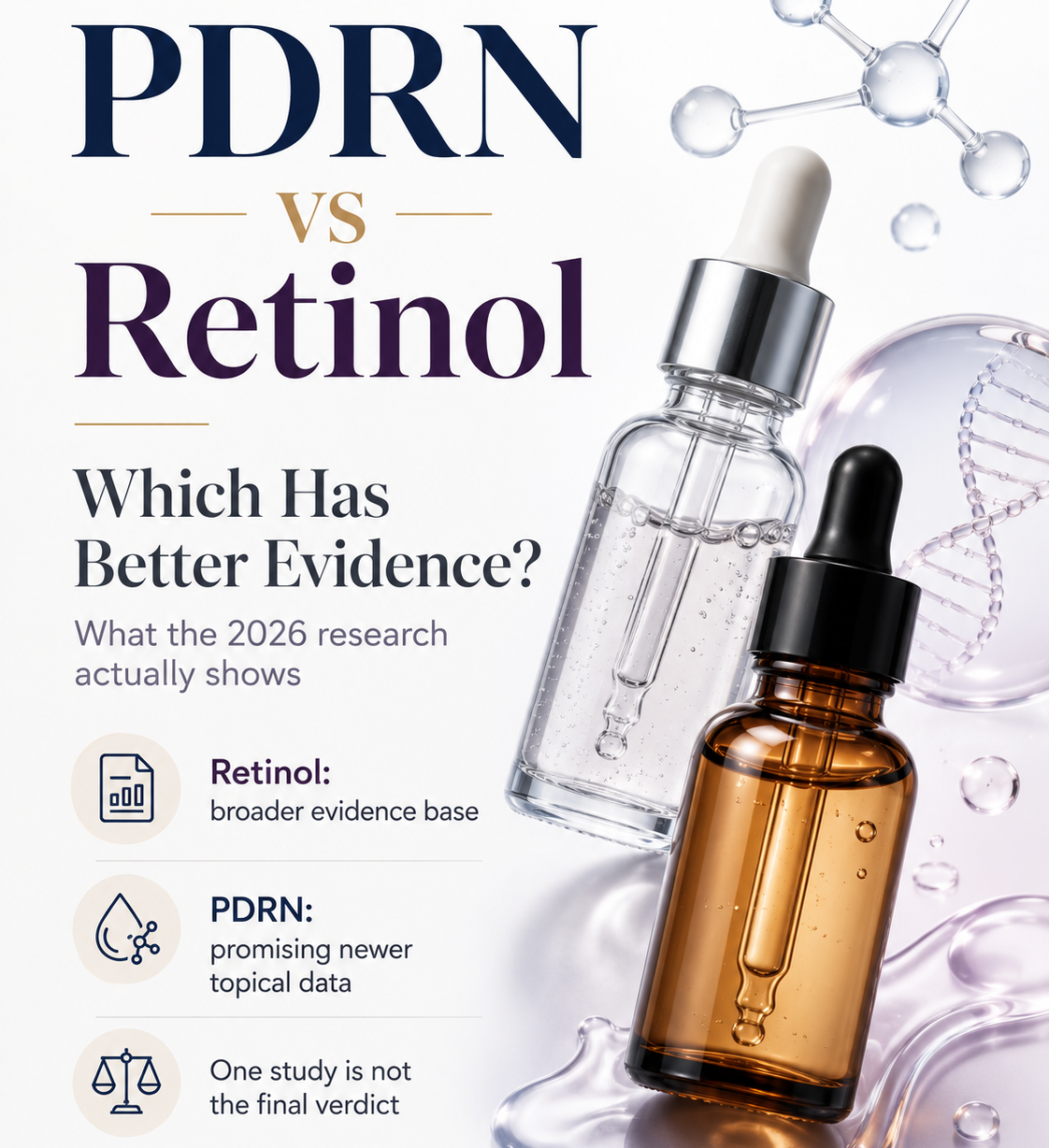
PDRN vs Retinol: The Short Answer
If you want the simplest answer:
Choose retinol if your priority is the ingredient with the deeper evidence base for fine lines, uneven texture and photoaging.
Consider PDRN if you are interested in a newer K-beauty active with promising early topical evidence, particularly in formulas designed around hydration, plumpness and skin-supportive care.
But there is an important catch.
A 2026 clinical trial directly comparing one PDRN formula with one retinol formula favored the PDRN side on several short-term measurements.
That does not prove every PDRN serum or cream is better than every retinol product.
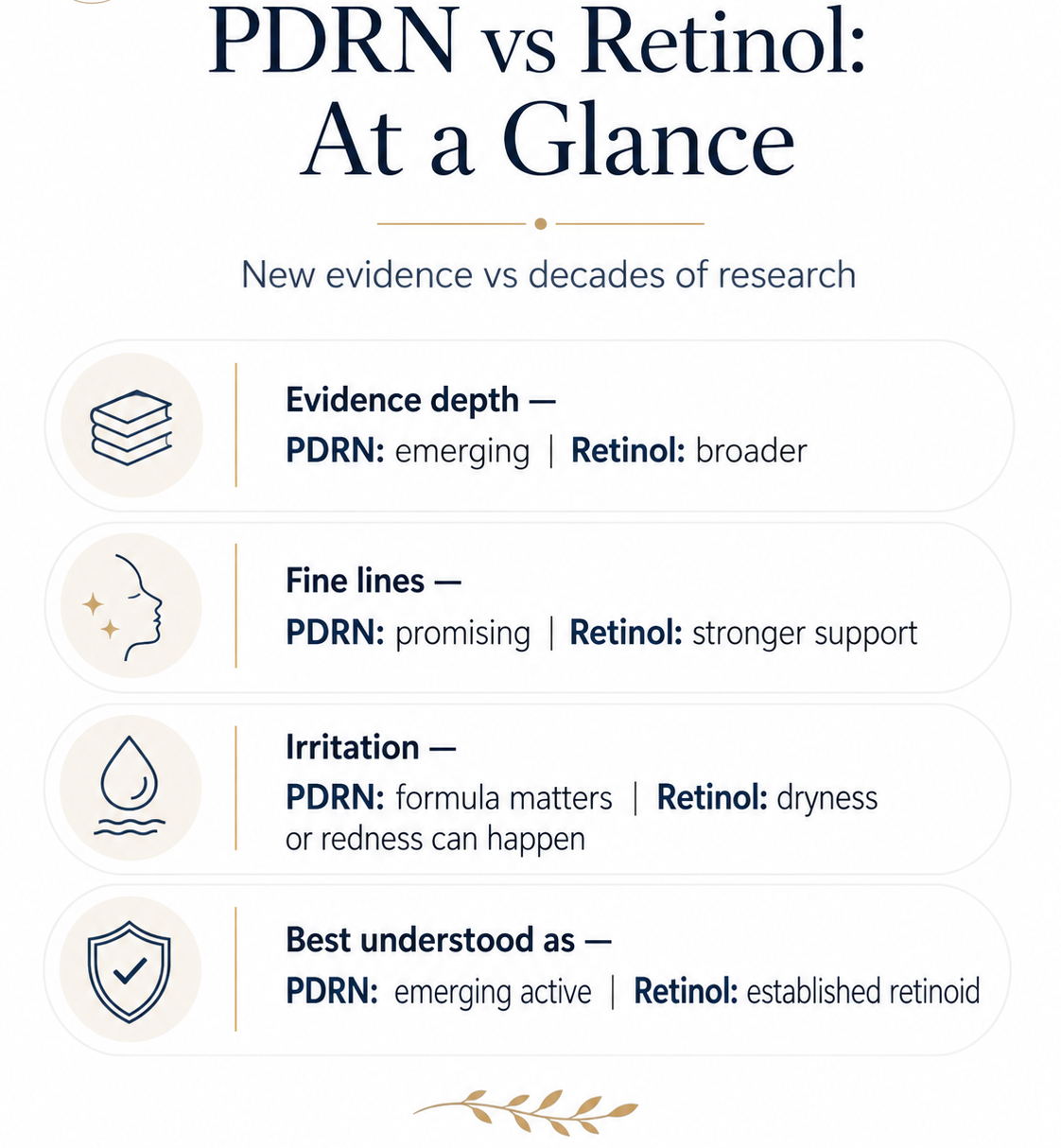
PDRN vs Retinol at a Glance
| Question | PDRN | Retinol |
|---|---|---|
| Evidence depth | Emerging for topical skincare | Much broader |
| Human topical data | Growing | Well established |
| Fine-line evidence | Promising | Stronger overall |
| Long-term photoaging evidence | Limited | Much deeper |
| Irritation potential | Depends on formula; limited topical safety database | Dryness, peeling or redness can occur |
| 2026 direct comparison | Specific PDRN formula performed very well | Comparator in the same trial |
| Best described as | Emerging topical active | Established cosmetic retinoid |
| Overall winner | Not established | Not universal |
The biggest mistake is treating one promising PDRN study as proof that an entire ingredient category has overtaken retinol.
What Is the Difference Between PDRN and Retinol?
Although both ingredients are now marketed for aging skin, they are not versions of the same thing.
They come from completely different ingredient families.
What Is PDRN?
PDRN stands for polydeoxyribonucleotide.
It refers to DNA-derived fragments that have been studied in regenerative and medical contexts for years. More recently, PDRN has become increasingly visible in topical Korean skincare.
The exact source, molecular size, concentration and delivery system can differ significantly between products.
For example, the PDRN-850K material used in the major 2026 topical study was a highly purified PDRN extracted from salmon sperm, with an average molecular weight of no more than 850 kDa.
That does not mean every cosmetic labeled “PDRN” contains the same material.
If you are comparing finished moisturizers rather than PDRN in the abstract, our best PDRN creams guide breaks down current formulas by source, price, fragrance, and evidence.
And it definitely does not mean every PDRN cosmetic has been clinically tested.
If you are completely new to the ingredient, read our full guide to what PDRN skincare is and what the evidence actually shows before comparing individual products.
What Is Retinol?
Retinol is a vitamin A derivative and part of the broader retinoid family.
In skin, retinol must undergo conversion steps before reaching retinoic acid, the biologically active form involved in retinoid signaling.
This is one reason retinol is different from prescription tretinoin.
Retinol and tretinoin should not be treated as interchangeable terms.
Tretinoin is retinoic acid itself and has a much larger prescription-drug evidence base. Retinol is available in many nonprescription cosmetic formulations and generally acts more gradually.
That distinction matters whenever someone claims that “retinol has decades of research.”
Some of the strongest retinoid research is actually research on tretinoin or other retinoids, not necessarily on every over-the-counter retinol serum.
Still, human evidence for cosmetic retinol is substantially broader than the current topical PDRN evidence base.
What Did the 2026 PDRN vs Retinol Study Actually Find?
This is the study that makes the comparison especially relevant in 2026.
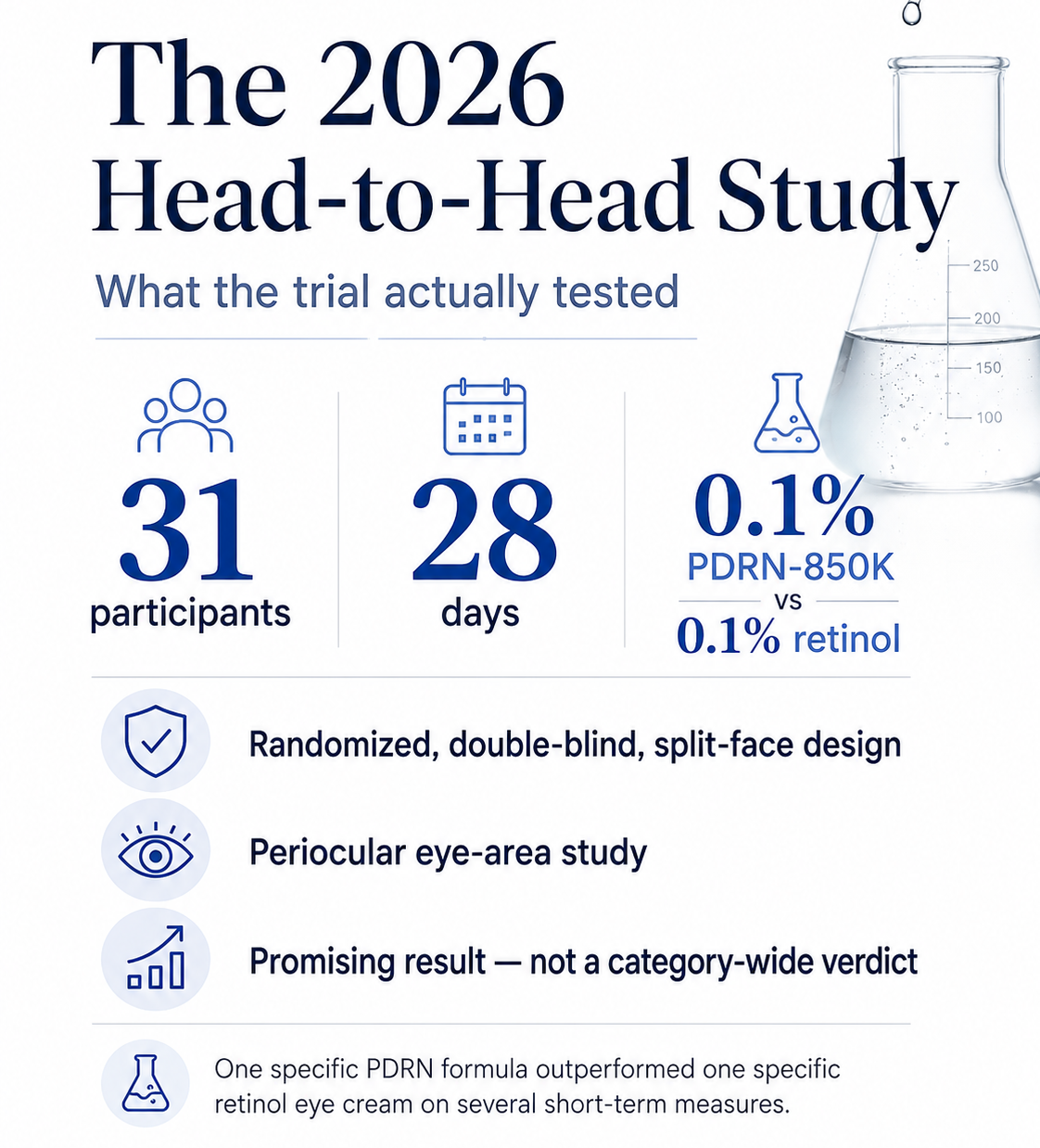
Researchers published a randomized, double-blind, split-face clinical study in PLOS ONE in July 2026.
The Study Design
The clinical portion included:
- 31 healthy Chinese women
- Ages 35 to 55
- Participants with self-reported sensitive skin
- Periocular fine lines or wrinkles
- 0.1% PDRN-850K eye cream on one side
- 0.1% retinol eye cream on the other side
- Twice-daily application
- 28 days
- Daytime sunscreen required
Because it was a split-face study, each participant effectively served as her own comparison.
That is a useful design for reducing some person-to-person variability.
The Results
By Day 28, the researchers reported approximately:
- 20% to 23% reductions in crow’s-feet wrinkle area and number on the PDRN-850K side
- About 6% to 7% reductions on the retinol side
The PDRN side also produced larger changes in several measurements related to dermal thickness, density, elasticity, firmness and under-eye appearance.
The researchers described several of these improvements as roughly twice those seen with the retinol comparator.
Both treatments were reported as well tolerated in the clinical study, with no adverse reactions reported.
That is impressive.
But the context is just as important as the numbers.
Why the Study Does Not Prove PDRN Is Better Than Retinol
This is where skincare headlines can become misleading.
The study did not test:
“PDRN as a category versus retinol as a category.”
It tested:
one specific 0.1% PDRN-850K eye cream against one specific 0.1% retinol eye cream for 28 days in 31 participants.
Those are very different claims.
1. The Study Was Small
Thirty-one participants can provide useful preliminary clinical information, particularly with a split-face design.
But it is not enough to establish universal superiority across populations, products and formulations.
2. It Lasted Only 28 Days
Four weeks is a short period when evaluating long-term photoaging.
Retinoid benefits are commonly evaluated across longer treatment periods.
A short trial may capture hydration, plumping and early structural measurements differently from longer-term remodeling.
3. It Focused on the Eye Area
The findings cannot automatically be generalized to every part of the face or to every skincare concern.
4. The PDRN Formulation Was Specific
PDRN-850K had defined molecular characteristics, concentration and formulation.
A serum sold under a generic “PDRN” label may use a different source, molecular size, concentration or delivery system.
5. Formulation Matters for Retinol Too
Two products containing the same percentage of retinol are not automatically equivalent.
Stability, encapsulation, delivery system, packaging and the rest of the formula can influence how a retinol product performs.
So the strongest scientifically defensible conclusion is:
The study provides promising evidence for that PDRN-850K formulation. It does not prove that all topical PDRN outperforms retinol.
Which Has Better Evidence for Wrinkles?
Retinol currently wins on overall evidence depth.
That does not mean every retinol product will outperform every PDRN product.
It means researchers have substantially more human data on retinol and the wider retinoid family.
A 2024 integrated analysis examined six vehicle-controlled studies using the same 0.1% stabilized bioactive retinol.
The analysis included:
- 237 participants using retinol
- 234 using vehicle
- Assessments at Weeks 4, 8 and 12
Researchers reported greater improvements with retinol than vehicle across multiple signs of photoaging.
A later network meta-analysis covering 23 randomized controlled trials and 3,905 participants also found significant improvement in fine wrinkles with retinol among the topical interventions studied.
By comparison, high-quality human research on topical cosmetic PDRN is still relatively limited.
This is why a single head-to-head trial should not erase the difference in evidence depth.
What About Tretinoin?
Tretinoin deserves separate treatment.
It is not simply “stronger retinol.”
Tretinoin is retinoic acid and is used as a drug, while cosmetic retinol has to be metabolically converted within the skin.
If you are comparing a PDRN cosmetic with an over-the-counter retinol product, prescription tretinoin evidence should not be used as if it directly proves the performance of that cosmetic retinol product.
This distinction is frequently blurred in skincare marketing.
Is PDRN Gentler Than Retinol?
You will often see a simple claim:
“PDRN is gentle. Retinol is irritating.”
Reality is more complicated.
Retinoids can cause dryness, scaling, peeling, redness or irritation, particularly depending on the molecule, concentration, formulation and how quickly they are introduced.
However, not every retinol product causes severe irritation.
In the 2024 pooled analysis of 0.1% stabilized retinol, reported irritation events were relatively few and were described as mild to moderate and transient.
Likewise, the 2026 PDRN-850K trial reported good tolerability — but remember that the topical PDRN safety database is much smaller.
So we would not make either of these claims:
“PDRN never irritates sensitive skin.”
or
“Retinol always irritates sensitive skin.”
A more useful rule is:
Evaluate the finished formula, not just the hero ingredient on the front of the bottle.
Fragrance, exfoliating acids, alcohols, other actives and the base formulation can all change how a product feels on your skin.
PDRN vs Retinol for Sensitive Skin
This is one of the more interesting use cases for PDRN.
The participants in the 2026 PDRN-850K trial had self-reported sensitive skin, and both the PDRN and retinol test products were well tolerated during the 28-day study.
That makes the PDRN result relevant.
But it still does not establish that every PDRN formula is suitable for every person with sensitive skin.
If you already tolerate retinol well, there is no evidence-based reason to stop using it simply because PDRN is newer.
If your skin repeatedly struggles with retinol products, a PDRN-containing hydrating product may be an interesting alternative for certain cosmetic goals, but it should not automatically be considered an equivalent substitute for every retinoid benefit.
If your skin frequently reacts to new products, our Korean skincare for sensitive skin guide explains how to simplify your routine, evaluate skincare label claims, and introduce one new product at a time.
PDRN vs Retinol by Skin Goal
Here is the practical comparison.
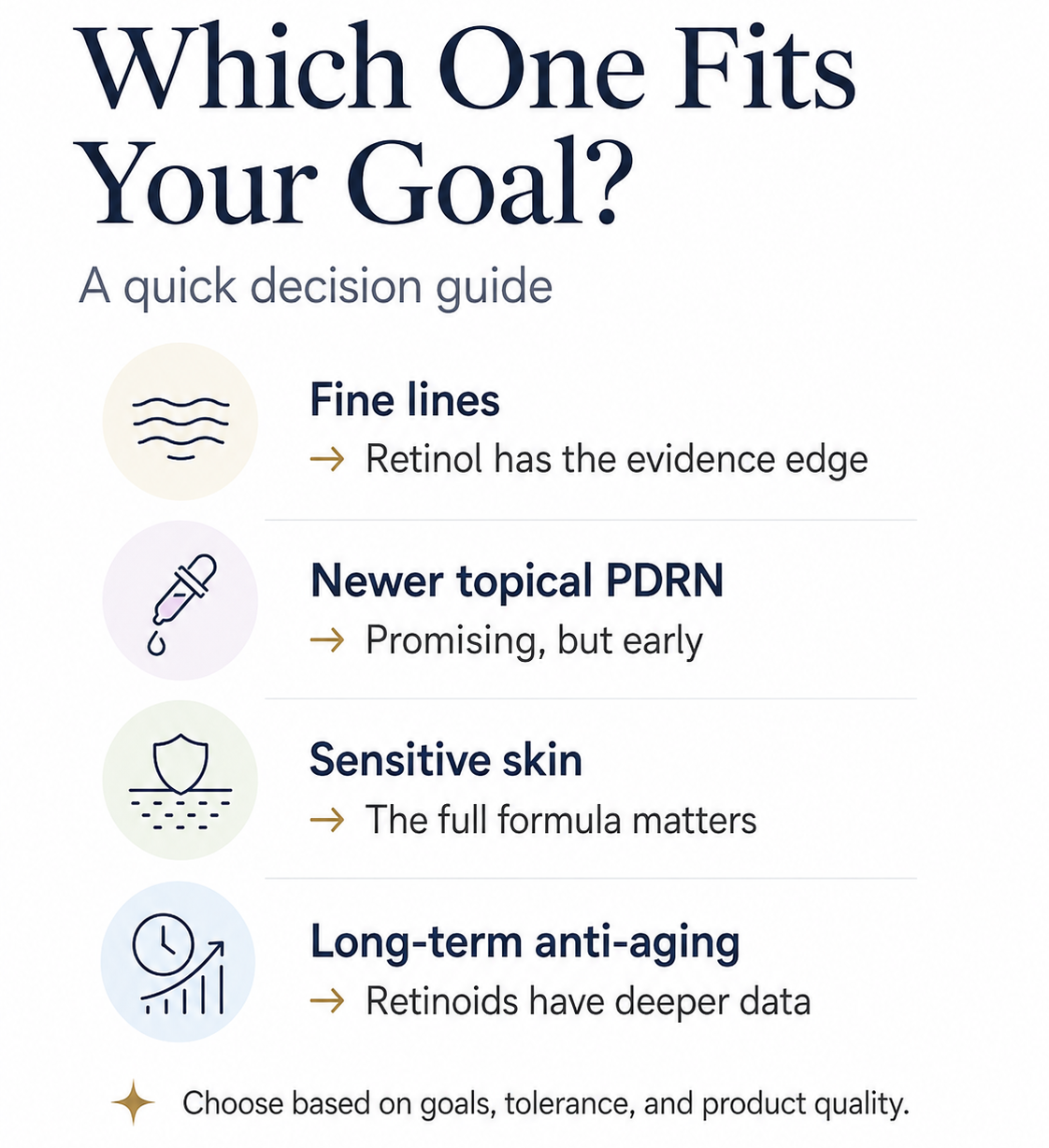
Fine Lines and Photoaging
Current advantage: Retinol for evidence depth
PDRN has promising new evidence, but retinol has a much larger research history.
Skin Texture
Current advantage: Retinol
Retinol is much better established for visible texture and photoaging-related changes.
Hydration and Plumper-Looking Skin
Potential advantage: PDRN-containing formulas
Many PDRN products are built into hydrating serum and cream systems.
However, hydration benefits may come from the entire formulation — not PDRN alone.
Check for supporting ingredients such as glycerin, hyaluronic acid, panthenol, ceramides or other humectants and emollients.
Sensitive or Easily Irritated Skin
No universal winner
PDRN is promising, but finished-product tolerability matters.
Low-strength or well-formulated retinol products may also be tolerated by many users.
Long-Term Anti-Aging Evidence
Current advantage: Retinoids
The depth and duration of evidence remain much stronger.
Acne
Do not treat PDRN as a replacement for evidence-based retinoid acne treatments.
PDRN cosmetics and retinoid medications belong to very different evidence and regulatory categories.
If acne is your primary concern, a healthcare professional can help you choose an appropriate treatment.
Can You Use PDRN and Retinol Together?
Potentially, yes.
There is no obvious reason that every PDRN cosmetic and every retinol cosmetic must be separated into different routines.
But there is an equally important point:
We do not currently have strong clinical evidence proving that adding topical PDRN makes retinol more effective or reliably prevents retinol irritation.
That claim appears frequently in marketing.
The evidence is not strong enough for us to present it as established fact.
If you want to use both, think in terms of product compatibility and tolerance, rather than assuming they create a scientifically proven synergy.
A simple routine might look like this:
Morning
- Gentle cleanser
- Hydrating PDRN serum or essence
- Moisturizer
- Broad-spectrum sunscreen
Evening
- Gentle cleanser
- Retinol product according to its directions
- Moisturizer
Another option is using a PDRN-containing moisturizer or serum on non-retinol nights.
There is no requirement to use them this way.
If you are also comparing newer longevity-positioned ingredients, our NAD+ skincare guide explains why emerging NAD+ products should not yet be treated as evidence-equivalent to retinoids.
If you need a broader layering framework, see our Korean skincare routine order guide for morning and evening placement of treatments, moisturizer, and sunscreen.
It is simply a straightforward method that avoids introducing multiple unfamiliar products at once.
If you are new to retinol, introducing several new active products simultaneously also makes it harder to identify what caused irritation if your skin reacts.
Should You Replace Retinol With PDRN?
For most people, the current evidence does not justify a blanket recommendation to replace retinol with PDRN.
Instead, ask what you are trying to achieve.
Stay With Retinol If:
- You already tolerate it well
- Fine lines and photoaging are your main concerns
- You prefer an ingredient with a deeper evidence base
- Your existing routine is working
Consider Exploring PDRN If:
- You are interested in newer K-beauty ingredient technology
- Hydration and plumper-looking skin are priorities
- You want to explore the emerging topical PDRN evidence
- You understand that individual product evidence varies substantially
Consider Both If:
- Your skin tolerates your retinol routine
- You also want a hydrating PDRN product
- The formulas work comfortably together
- You are not expecting PDRN to magically eliminate retinol irritation
You do not need to chase every new skincare ingredient.
A newer ingredient should earn its place in your routine by solving a problem your existing routine does not solve.
How to Shop for PDRN Products More Critically
If you’re deciding between two popular PDRN serums, see our Anua PDRN vs Medicube PDRN comparison for a formula-by-formula breakdown.
The 2026 research makes PDRN more interesting.
It also makes careful product selection more important.
When evaluating a PDRN cosmetic, look beyond the word PDRN on the front label.
Ask:
Is the PDRN Source Disclosed?
Some products use fish-derived material, while others market plant-derived or alternative nucleotide ingredients.
They should not automatically be treated as scientifically identical.
Is the Concentration Disclosed?
A product may prominently advertise PDRN without clearly explaining how much is present.
Is the Molecular Specification Available?
The 2026 study used a defined medium-length material called PDRN-850K.
That does not mean every product marketed with the same general ingredient name has the same molecular characteristics.
Has the Finished Product Been Tested?
Ingredient-level research is useful.
Finished-product human testing is more relevant when deciding whether a specific serum or cream actually delivers the claimed cosmetic effect.
Clinique is a good example of why those questions matter. Our Clinique PDRN Cream review separates its biotech-derived cica PDRN positioning from the brand’s finished-product clinical testing and the independent salmon-derived PDRN-850K research.
Are the Claims Realistic?
Be cautious when ordinary cosmetics are marketed with language that sounds like treatment of disease, permanent structural repair or guaranteed regeneration.
In the United States, cosmetic products and ingredients generally do not require FDA premarket approval, except for certain color additives.
“FDA registered” or “made in an FDA-registered facility” is not the same thing as FDA approved.
PDRN vs Retinol: Which One Would We Choose?
There is no single answer for every skin type.
But based on the evidence available in 2026:
For the strongest established evidence for photoaging, retinol remains the safer evidence-based choice.
For an emerging topical ingredient with genuinely interesting new clinical data, PDRN is worth watching — and potentially worth using in a well-formulated product.
That is a much more defensible conclusion than saying one ingredient has completely replaced the other.
The 2026 PDRN-850K study changed the conversation.
It did not finish it.
Frequently Asked Questions
Is PDRN Better Than Retinol?
Not proven overall.
A 2026 split-face study found that one 0.1% PDRN-850K eye cream produced greater improvement than one 0.1% retinol eye cream on several short-term periocular measurements.
However, the trial involved only 31 participants and lasted 28 days.
Retinol still has the broader overall evidence base.
Does PDRN Work Faster Than Retinol?
There is not enough evidence to make that claim across products.
The PDRN-850K study showed measurable changes by Day 14, but that finding applies to the specific formulation and study design.
Is PDRN Safer for Sensitive Skin?
It may be well tolerated in some formulas, but there is not enough research to say every PDRN product is safer than every retinol product.
The 2026 study reported good tolerability for both treatments.
Can I Use PDRN and Retinol in the Same Routine?
Potentially.
Whether the combination is comfortable depends on the complete formulas and your skin tolerance.
There is currently insufficient high-quality clinical evidence to claim that topical PDRN reliably prevents retinol irritation or makes retinol work better.
Is PDRN a Retinoid?
No.
PDRN consists of DNA-derived nucleotide fragments.
Retinol is a vitamin A derivative and belongs to the retinoid family.
They are fundamentally different ingredients.
Is PDRN the Same as Salmon DNA?
Not exactly.
Some PDRN preparations are derived from salmon or trout DNA. The PDRN-850K material studied in the 2026 trial was extracted from salmon sperm.
But product sources and specifications vary, so you should not assume every PDRN cosmetic contains the same material.
Is Retinol the Same as Tretinoin?
No.
Retinol is a vitamin A derivative that requires conversion steps in the skin.
Tretinoin is retinoic acid itself and is regulated as a drug.
Evidence for prescription tretinoin should not automatically be presented as evidence for every cosmetic retinol product.
Should I Use PDRN or Retinol First?
There is no universal rule.
If you already have a stable retinol routine, there is no need to stop it just because PDRN is trending.
If you are introducing new products, adding one at a time can make it easier to assess tolerance.
Bottom Line
PDRN vs retinol is not a simple battle between a new ingredient and an old one.
The most interesting development is that topical PDRN now has a randomized human study directly comparing one PDRN formulation with retinol — and the results were promising.
But evidence quality is not just about who won one trial.
It is also about:
- Number of studies
- Number of participants
- Study duration
- Replication
- Product formulation
- Population diversity
- Long-term outcomes
By those standards, retinol still has the deeper evidence base in 2026.
PDRN, however, has moved beyond being just a K-beauty marketing trend.
It now has enough emerging topical evidence to deserve serious attention.
The next question is not simply:
“Which ingredient is better?”
It is:
“Which specific product has the evidence, formulation and tolerability profile that fits your skin?”
Last reviewed: August 21, 2026
This article is for educational purposes only and is not medical advice. If you have a skin condition, use prescription retinoids, are pregnant or breastfeeding, or have concerns about a skincare ingredient, consult an appropriate healthcare professional.
References
- Ye R, Wang Q, Du L, Li L, Hu F. Topical medium-length PDRN enhances dermal extracellular matrix repair in photodamaged skin via PI3K-Akt/TGF-β-regulated pathways. PLOS ONE. 2026;21(7):e0350905. DOI: 10.1371/journal.pone.0350905.
- Farris P, Berson D, Bhatia N, et al. Efficacy and Tolerability of Topical 0.1% Stabilized Bioactive Retinol for Photoaging: A Vehicle-Controlled Integrated Analysis. Journal of Drugs in Dermatology. 2024;23(4):209–215. DOI: 10.36849/JDD.8124.
- Comparative efficacy of topical interventions for facial photoaging: a network meta-analysis. PubMed-indexed systematic review and network meta-analysis, 2025. PMID: 40707570.
- U.S. Food and Drug Administration. Cosmetic Ingredients.
- U.S. Food and Drug Administration. Wrinkle Treatments and Other Anti-aging Products.