A Korean skincare routine does not need 10 steps.
For most people, the useful framework is much simpler:
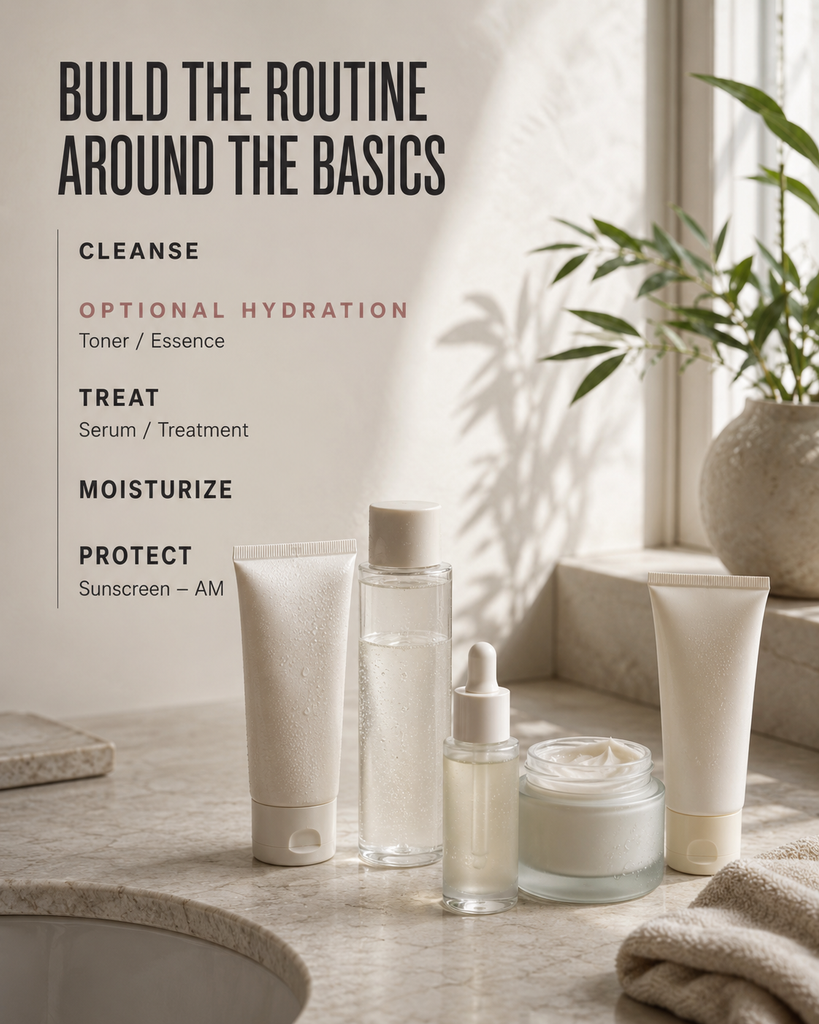
Cleanse → treat → moisturize → protect.
Toners, essences, ampoules, serums, masks, and other K-beauty steps can be added when they serve a clear purpose—but they are not automatically required.
That framework is more useful than blindly following a fixed 10-step routine.
Quick Answer: Korean Skincare Routine Order
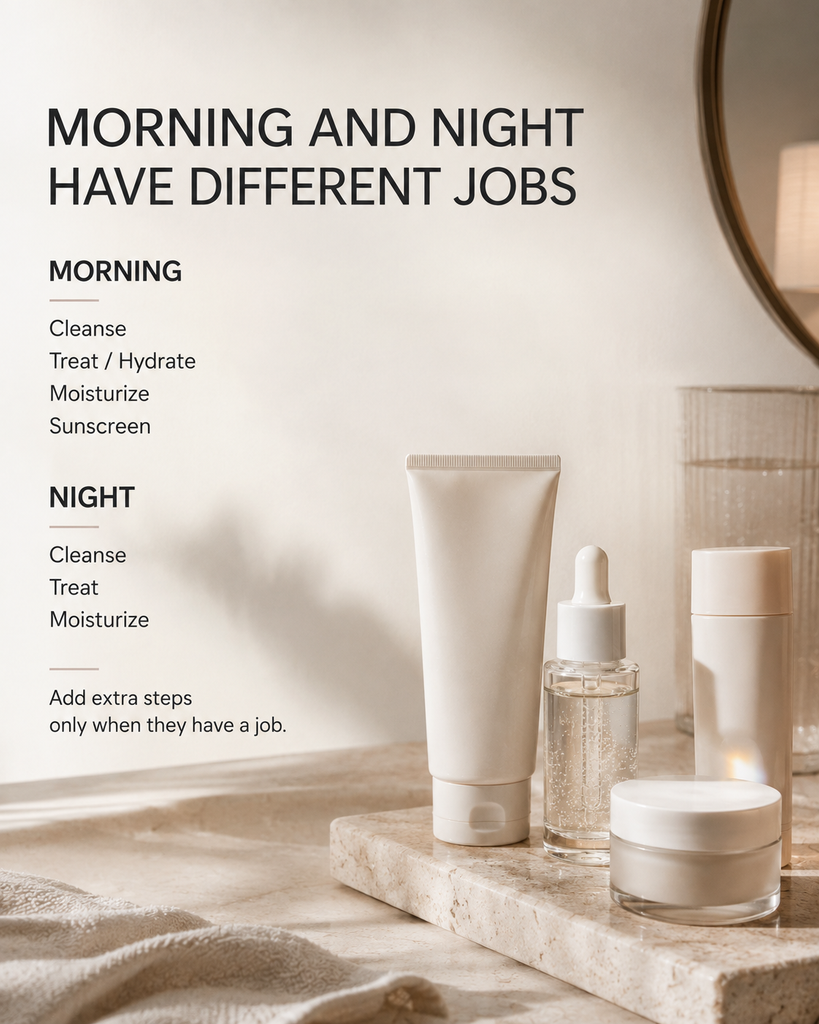
Morning
- Cleanser or gentle rinse
- Toner or essence — optional
- Serum or treatment
- Moisturizer
- Sunscreen
Evening
- Makeup or sunscreen removal if needed
- Cleanser
- Toner or essence — optional
- Treatment or serum
- Moisturizer
- Sleeping mask or occlusive — optional
The important rule is not simply “thinnest to thickest.”
A better rule is:
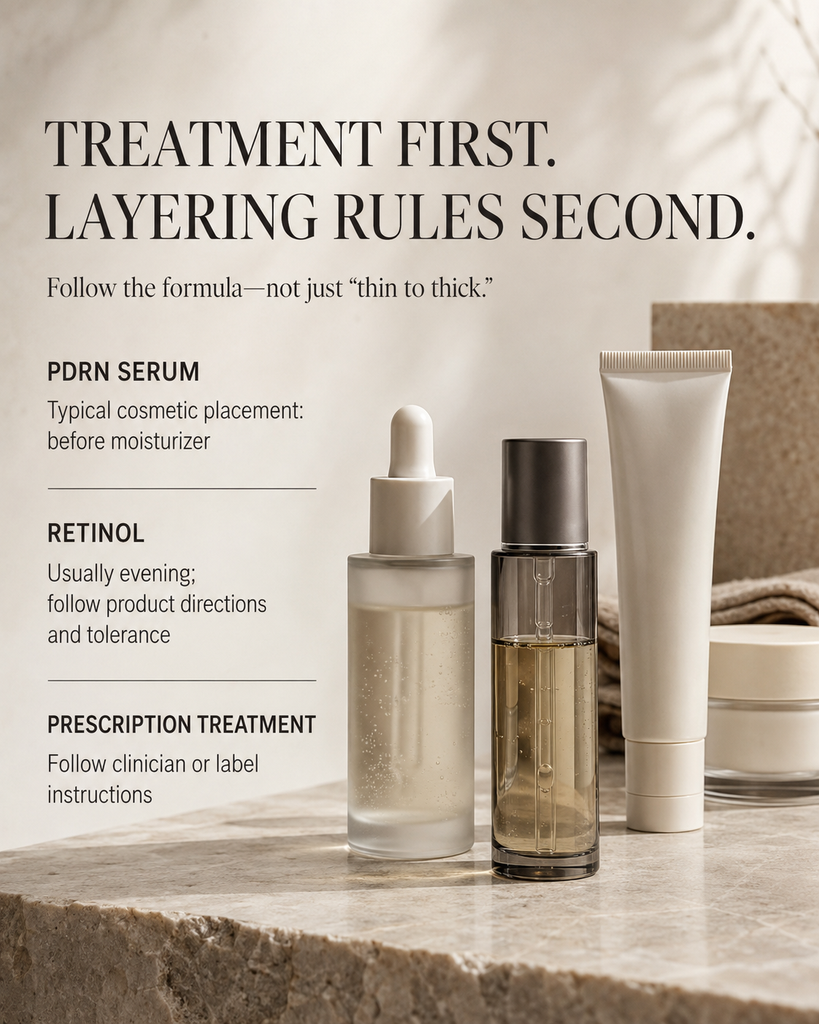
Follow treatment instructions first, then layer supportive products around them.
Do You Really Need a 10-Step Korean Skincare Routine?
No.
The famous multi-step Korean skincare routine helped introduce many global consumers to product categories such as essences, ampoules, sheet masks, and sleeping packs.
But there is no rule that healthy skin requires all of them.
A useful routine may contain only:
- cleanser
- one treatment or serum if needed
- moisturizer
- sunscreen in the morning
Adding more products can sometimes create more problems rather than more benefits.
Think of Korean skincare as a flexible product system, not a mandatory number of steps.
The Most Important Rule: Function Before Texture
You will often hear this rule:
Apply skincare from thinnest to thickest.
It is useful as a starting point.
A watery toner will usually make more sense before a heavy cream.
But texture alone should not determine everything.
Three things matter more.
1. Product Instructions
If a treatment tells you to apply it directly to clean, dry skin, those instructions matter more than a generic layering chart.
2. Prescription or Medical Treatment Instructions
If a dermatologist has prescribed a topical medication, follow the instructions provided for that treatment.
Do not move it around your routine simply because another cosmetic product feels thinner.
3. What the Product Is Supposed to Do
A toner and a moisturizer serve different jobs.
A sunscreen has a different purpose from a hydrating essence.
Routine order should help each product perform its intended role.
Step 1: Cleanser
Cleansing comes first because it removes material that can interfere with the rest of your routine.
That may include:
- excess oil
- sweat
- makeup
- sunscreen
- environmental debris
The AAD recommends using a gentle cleanser and avoiding aggressive scrubbing, particularly for acne-prone or easily irritated skin.
Do You Need to Double Cleanse?
Not automatically.
Double cleansing generally means:
oil-based cleanser or cleansing balm → water-based cleanser
It can be useful when you are removing:
- substantial makeup
- water-resistant sunscreen
- heavier cosmetic layers
But it is not a mandatory Korean skincare ritual.
If one gentle cleanse removes what you need without leaving your skin uncomfortable, there is no prize for cleansing twice.
If sunscreen or makeup remains after cleansing, use a removal method that works for that formula instead of scrubbing harder.
Over-cleansing can be counterproductive if it leaves your skin tight, dry, or irritated.
Step 2: Toner — Optional
Toner comes after cleansing.
Modern Korean toners can serve very different purposes.
Some focus on:
- hydration
- soothing
- lightweight humectants
Others may contain:
- exfoliating acids
- acne-focused ingredients
- stronger actives
That means the word “toner” does not tell you enough about how a product should be used.
A simple hydrating toner can usually sit near the beginning of the routine.
An exfoliating toner should be treated more like an active step.
Do You Need Toner?
No.
If your cleanser, treatment, and moisturizer already work well together, toner is optional.
Use toner because the formula fills a need—not because a Korean skincare diagram tells you that Step 2 must exist.
Step 3: Essence — Optional
Essence usually follows toner and precedes heavier serums or creams.
The distinction between toner, essence, serum, and ampoule is not standardized enough to make the product name alone a reliable guide to potency.
A modern essence might be:
- very watery
- highly moisturizing
- fermented
- barrier-focused
- treatment-oriented
That is why ingredient list, directions, texture, and intended purpose matter more than the category name.
Toner vs Essence: Do You Need Both?
Usually not.
If both products mainly provide lightweight hydration, using both may simply duplicate the same job.
Choose both only when each contributes something you actually want.
Step 4: Serum, Ampoule, or Treatment
This is where Korean skincare routines become more complicated.
Products marketed as:
- serum
- ampoule
- booster
- treatment
can contain very different ingredient systems.
Examples include:
- niacinamide
- vitamin C
- peptides
- retinoids
- exfoliating acids
- PDRN-branded ingredients
- barrier-support ingredients
Instead of trying to decide whether “ampoule goes before serum,” ask:
Which product is the actual treatment, and what do its directions say?
If you use several treatment products at once, routine complexity and irritation risk can rise quickly.
If NAD+ is one of the newer treatment categories you are considering, our NAD+ skincare guide explains the evidence and delivery questions, while our best NAD+ Korean skincare products guide compares current formulas and supporting actives.
Where Does PDRN Go in a Skincare Routine?
For a typical cosmetic PDRN serum or ampoule, placement will usually depend on the finished formula and brand directions.
A practical default for many serum-like formulas is:
Cleanse → optional toner/essence → PDRN serum → moisturizer
If your PDRN product is a cream, toner, ampoule, or a formula combined with another active ingredient, follow that product’s own directions instead.
PDRN is not one standardized cosmetic formula.
If your PDRN step is a moisturizer, our best PDRN creams guide compares current options by formula, PDRN source, fragrance, price, and skin goal.
If you are still trying to understand the category, start with our guide to what PDRN skincare is.
Also remember that a topical PDRN cosmetic should not be treated as equivalent to an injectable or professional PDRN procedure.
Where Does Retinol Go?
Retinol is commonly used as an evening active.
A simple starting point is:
Cleanse → retinol → moisturizer
If your skin becomes dry or irritated, some people use moisturizer before retinol or both before and after it.
Follow the directions for your specific retinoid, prescription instructions when applicable, and speak with a dermatologist if irritation persists.
That is one reason universal skincare layering graphics can be misleading.
If you are deciding how PDRN and retinol fit into the same routine, our PDRN vs retinol guide explains the difference between the two categories and why they should not be treated as interchangeable.
Do You Need to Use PDRN and Retinol Together?
No.
More treatments do not automatically create better results.
If you are new to an active ingredient, introducing one change at a time makes it easier to evaluate:
- tolerance
- irritation
- dryness
- whether the product is doing anything useful for your routine
Step 5: Moisturizer
Moisturizer usually comes after treatment or serum steps.
Its role is not simply to make skin feel richer.
A suitable moisturizer can help support skin comfort and reduce dryness associated with some active ingredients.
For people using acne treatments, the AAD notes that moisturizer can help skin tolerate ingredients that may cause dryness or irritation.
Do Oily Skin Types Need Moisturizer?
Oily skin does not automatically mean moisturizer should be eliminated.
The more useful question is whether the formula fits the skin.
Someone with oily or acne-prone skin may prefer a lighter moisturizer, while someone with dry skin may need something more substantial.
Step 6: Sunscreen — Morning
Sunscreen belongs at the end of the morning skincare routine, before makeup.
Give sunscreen enough time to form an even layer before applying makeup.
If makeup causes pilling, simplify the layers underneath rather than automatically adding more skincare.
Your sunscreen choice should be based on the current label and directions of the specific product you use, not simply whether it is Korean, trending, or marketed as cosmetically elegant.
What About Makeup?
Makeup follows your skincare and sunscreen.
A basic morning sequence is therefore:
Cleanse → treatment/hydration → moisturizer → sunscreen → makeup
If your sunscreen pills under makeup, adding more skincare underneath is not necessarily the solution.
You may need to simplify the layers or reconsider product compatibility.
Korean Skincare Routine Order for Morning
A practical morning routine can be very short.
Minimal Morning Routine
1. Cleanse or rinse
Use a cleanser if you need one. Some people with dry or easily irritated skin prefer a simple water rinse in the morning.
2. Optional serum
Use this only if it serves a clear goal.
3. Moisturizer
Adjust texture to your skin.
4. Sunscreen
This is the essential daytime protection step.
Expanded Morning Routine
If your skin tolerates more layers:
Cleanser → hydrating toner → essence → serum → moisturizer → sunscreen
You still do not need every category.
Korean Skincare Routine Order at Night
Evening routines usually focus on cleansing, treatment, and moisturization.
Minimal Evening Routine
Cleanser → treatment if needed → moisturizer
If You Wore Makeup or Hard-to-Remove Sunscreen
Makeup remover/oil cleanser → water-based cleanser → treatment → moisturizer
Expanded Evening Routine
First cleanse → second cleanse → toner → essence → serum/treatment → moisturizer → optional sleeping mask
Again, this is a menu—not a requirement.
Where Do Exfoliants Go?
Exfoliating products vary widely.
A liquid acid toner is not the same as:
- a wash-off exfoliant
- an exfoliating cleanser
- a leave-on acid serum
- a treatment prescribed by a dermatologist
Follow the specific directions.
Do not assume that every acid belongs in one universal position.
More importantly, do not stack several exfoliating or irritating products simply because they technically fit into different “steps.”
What About Sheet Masks?
Sheet masks are optional.
They usually make most sense after cleansing and lighter prep steps but before the final moisturizer.
However, there is no need to use one daily simply because sheet masks are strongly associated with K-beauty.
Use them when you enjoy them or when the formula adds something useful.
What About Sleeping Masks?
A sleeping mask generally belongs near the end of an evening routine.
For many products:
moisturizer → sleeping mask
or the sleeping mask may replace a conventional moisturizer.
Check the product directions.
Using both does not automatically improve the result.
How Long Should You Wait Between Skincare Steps?
You generally do not need a fixed timer between every cosmetic product.
For most cosmetic layers, wait only long enough for the previous product to spread evenly and stop feeling overly wet or slippery.
Allow enough time for a layer to settle if applying the next product immediately causes:
- pilling
- streaking
- uneven application
Specific treatments can be different.
Follow treatment-specific directions rather than applying a universal “wait 10 minutes between every step” rule.
Can You Use Too Many Korean Skincare Products?
Yes.
A product can be good individually and still be unnecessary in your routine.
Common examples of overlap include:
- hydrating toner + hydrating essence + hydrating ampoule + hydrating serum
- several peptide serums
- multiple exfoliating products
- multiple anti-aging treatments started at the same time
The risk is not only spending more money.
Too many layers can make it harder to identify:
- what is helping
- what is irritating your skin
- what is causing pilling
- what you actually need to repurchase
This is the same buying principle we use in our Olive Young K-Beauty Edit at Sephora guide:
Skin goal first. Trend second.
How to Build Your Own Korean Skincare Routine
Start with the smallest routine that covers your actual needs.
Step 1: Establish the Basics
Start with:
- cleanser
- moisturizer
- sunscreen
Step 2: Identify One Real Skin Goal
For example:
- dehydration
- acne
- uneven tone
- irritation
- texture
- fine lines
Step 3: Add One Targeted Product
Choose one serum, treatment, toner, or other product that addresses that goal.
Step 4: Evaluate Before Adding More
Do not add several trend ingredients at once.
The same rule applies to beauty devices: add one only if it solves a clear problem in your routine. If you’re considering Medicube’s current-generation device, our Medicube Booster Pro X2 vs Booster Pro comparison breaks down the current price difference, Dual and Mask Modes, the 2X power claim, and whether existing Booster Pro owners actually need to upgrade.
If firming is the specific problem you want a device to solve, our Medicube Ultra Tune 40.68 review explains what 40.68 MHz actually means, the six-tip contact requirement, and when the RF-focused device is worth considering.
If you cannot tell what a product is supposed to contribute, it probably does not need to be added yet.
Step 5: Adjust the Routine to Your Skin
The “correct” routine is the one that:
- you can use consistently
- your skin tolerates
- addresses an actual need
- does not create unnecessary complexity
Common Routine Order Mistakes
Mistake 1: Believing You Need Every Korean Skincare Step
You do not.
Mistake 2: Treating “Thinnest to Thickest” as an Absolute Rule
It is a shortcut, not a substitute for product directions.
Mistake 3: Starting Several Actives at Once
This can make irritation harder to troubleshoot.
If your skin frequently stings, burns, or reacts when you introduce new products, see our Korean skincare for sensitive skin guide for a simpler way to build and test your routine.
Mistake 4: Buying Two Products for the Same Job
A toner, essence, and serum may all be primarily hydrating.
Check what each formula actually adds.
Mistake 5: Putting Trend Ingredients Ahead of Basic Routine Needs
If you do not have a moisturizer or sunscreen that works for you, another expensive serum may not be the most useful next purchase.
If PDRN is the treatment category you are considering, our comparison of the best PDRN products at Sephora can help you evaluate different formula systems after your basic routine is established.
The Bottom Line
The best Korean skincare routine order is not a fixed 10-step ritual.
For most routines, think:
Cleanse → optional hydration → treatment → moisturize → protect.
Morning:
Cleanse → optional toner/essence → serum → moisturizer → sunscreen
Evening:
Cleanse → optional toner/essence → treatment → moisturizer
Add more only when each extra product has a clear job.
The most useful routine is not the one with the most steps.
It is the one you understand, tolerate, and consistently use.
The best Korean skincare routine is not the one with the most steps. It is the one where every step has a job.
Frequently Asked Questions
What Is the Correct Korean Skincare Routine Order?
A practical general order is cleanser, optional toner or essence, serum or treatment, moisturizer, and sunscreen in the morning.
Product-specific treatment instructions can override this general framework.
Does Toner Go Before Serum?
Usually, yes.
A lightweight hydrating toner is typically used after cleansing and before serum.
However, active or exfoliating toner formulas should be treated according to their specific directions.
Does Essence Go Before Serum?
Usually.
Essences are commonly applied after toner and before serum, but product texture and directions matter more than the category name.
Does Serum Go Before Moisturizer?
Usually, yes.
Most serum-style treatments are applied before moisturizer.
Does Retinol Go Before or After Moisturizer?
It depends on the product and your tolerance.
Many retinoids are used before moisturizer, while some people may be advised to use moisturizer first to reduce irritation.
Follow the directions for the specific product or medical treatment you use.
Where Does PDRN Go in a Skincare Routine?
A typical cosmetic PDRN serum may be used after cleansing and optional toner or essence, then followed by moisturizer.
Check the finished product’s directions because PDRN formulas are not standardized.
Does Sunscreen Go Before or After Moisturizer?
Sunscreen generally comes after moisturizer as the final skincare step in the morning.
Do You Need Toner and Essence?
No.
Both are optional.
If they perform essentially the same hydration role, using both may be unnecessary.
Do You Need a 10-Step Korean Skincare Routine?
No.
A basic routine can work with cleanser, moisturizer, sunscreen, and a targeted treatment when needed.
Can I Use Several Serums in One Routine?
You can sometimes layer compatible serums, but more is not automatically better.
Using several treatments can increase complexity, pilling, and irritation risk and can make it harder to know which product is helping.
Sources & References
- Should I Apply My Skin Care Products in a Certain Order? — American Academy of Dermatology
- Acne: Tips for Managing — American Academy of Dermatology
- Moisturizer: Why You May Need It If You Have Acne — American Academy of Dermatology
- Acne: Diagnosis and Treatment — American Academy of Dermatology
- Sunscreen: How to Help Protect Your Skin from the Sun — U.S. Food and Drug Administration