Prices and availability were checked on Sephora U.S. on August 23, 2026.
PDRN skincare is becoming much easier to find in the U.S.
Sephora now carries both traditional salmon-derived c-PDRN products and newer plant-based products marketed with proprietary PDRN-inspired or PDRN-branded ingredient systems.
Those products should not automatically be treated as the same material or assumed to have the same evidence base.
The harder question is:
Which one actually fits your routine?
Our five category picks are:
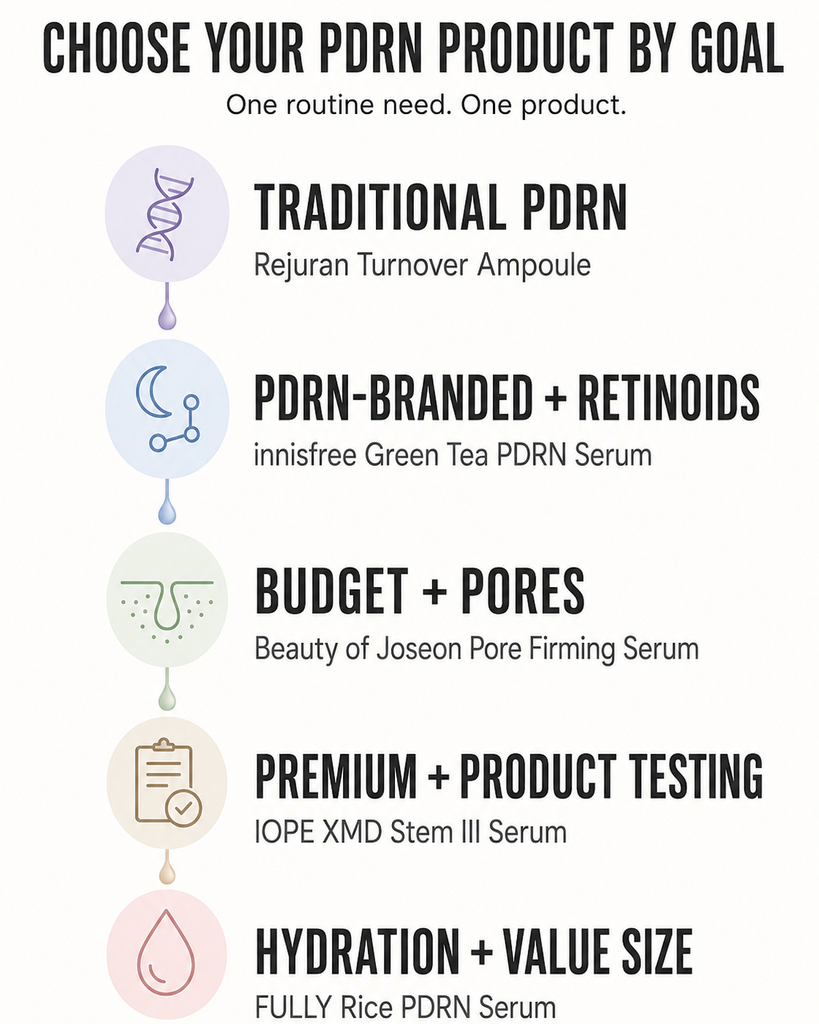
- Traditional salmon-derived PDRN: Rejuran Turnover Ampoule c-PDRN 0.5% — $52
- Rejuran is also part of the new U.S. Olive Young-curated assortment at Sephora. See our Olive Young at Sephora guide for a broader look at the launch and other K-beauty picks worth considering.
- PDRN-branded system + retinoids: innisfree Retinol Green Tea PDRN™ Firming Serum — $37
- Lowest entry price: Beauty of Joseon Pore Firming Red Bean PDRN™ Serum — $17
- Premium finished-product testing: IOPE XMD Stem III Clinical Recovery Serum — $59
- Hydration + size value: FULLY Rice PDRN Glow Barrier Boosting Serum — $27
Prices and availability can change. Check the current Sephora listing before buying.
These are category picks, not a clinical ranking from strongest to weakest.
Each product is here for a different reason: ingredient transparency, retinoid pairing, price, brand-reported product testing, or size value.
And before comparing any of them, remember one rule:
A PDRN percentage is only meaningful when you know exactly what that percentage measures.
Quick Comparison: 5 PDRN Products at Sephora
For a mobile-friendly comparison, here is the practical breakdown.
Rejuran Turnover Ampoule
$52 / 30 mL
Approx. $17.33 per 10 mL
Main reason to buy: Traditional salmon-derived c-PDRN positioning
innisfree Retinol Green Tea PDRN™ Firming Serum
$37 / 25 mL
Approx. $14.80 per 10 mL
Main reason to buy: PDRN-branded system paired with retinoids
Beauty of Joseon Pore Firming Red Bean PDRN™ Serum
$17 / 30 mL
Approx. $5.67 per 10 mL
Main reason to buy: Lowest entry price
IOPE XMD Stem III Clinical Recovery Serum
$59 / 30 mL
Approx. $19.67 per 10 mL
Main reason to buy: Brand-reported finished-product testing
FULLY Rice PDRN Glow Barrier Boosting Serum
$27 / 50 mL
Approx. $5.40 per 10 mL
Main reason to buy: Largest size and hydration-first value
Do not choose solely by price or by the largest number attached to “PDRN.”
If you are still unclear about what PDRN itself is, start with our guide to what PDRN skincare is before choosing a product.
What We Looked for in These PDRN Products
This comparison is not based on which bottle shows the biggest PDRN number.
We looked at five things.
1. What Does the PDRN Label Actually Mean?
Traditional PDRN is a DNA-derived material, and much of the established medical and aesthetic literature involves salmonid-derived sources.
The cosmetic market now also includes branded systems such as Green Tea PDRN™, Red Bean PDRN™, and Rice PDRN.
Brands may describe some of these as vegan or plant-derived alternatives.
That does not automatically establish that they are molecularly identical to traditional salmon-derived PDRN or supported by the same evidence.
2. How Transparent Is the Formula?
A product is easier to evaluate when the brand clearly explains:
- the source
- the ingredient terminology
- what a percentage actually refers to
- the other active ingredients in the formula
A large proprietary-complex percentage does not automatically tell you how much isolated PDRN is inside the bottle.
3. What Else Is in the Formula?
In many products, the rest of the formula may matter more to your routine than the PDRN label.
Retinoids, niacinamide, ceramides, hyaluronic acid, peptides, emollients, and other ingredients can substantially change the practical role of the serum.
4. Has the Finished Product Been Tested?
Research on PDRN as a material does not automatically prove that every commercial PDRN serum performs the same way.
Finished-product testing is useful when available.
But brand-sponsored testing should be interpreted as brand-reported product evidence, not independent proof.
5. Does the Product Fill a Real Gap?
Do not add a serum simply because it contains PDRN.
If you already use a retinoid, several hydrating serums, niacinamide, or a strong barrier-focused routine, some of these products may add more overlap than value.
1. Rejuran Turnover Ampoule c-PDRN 0.5% — Traditional PDRN Pick
Current Sephora price: $52
Size: 1.01 oz / 30 mL
Positioning: c-PDRN 0.5%
Source: salmon-derived
If your reason for shopping this category is:
“I specifically want a product built around traditional salmon-derived PDRN,”
Rejuran is the clearest option in this group.
The Rejuran Turnover Ampoule c-PDRN 0.5% is currently listed at Sephora at $52 for 30 mL.
Rejuran describes its c-PDRN ingredient as hydrolyzed salmon DNA, while the product ingredient list includes Hydrolyzed DNA.
Why It Stands Out
Its main advantage is clarity around the ingredient story.
The buying rationale is straightforward:
- salmon-derived c-PDRN positioning
- stated 0.5% c-PDRN
- Hydrolyzed DNA in the ingredient list
- a finished serum built specifically around that ingredient system
Best for
- shoppers specifically seeking salmon-derived PDRN
- people exploring PDRN as the main reason for the purchase
- experienced skincare users
- shoppers comfortable with premium serum pricing
Skip It If
- vegan sourcing matters to you
- simple dehydration is your main concern
- you already own several treatment serums
- you expect a topical cosmetic to work like an injected Rejuran procedure
A cosmetic serum and an in-clinic injectable procedure are not interchangeable.
K-Beauty Clarity verdict:
The clearest pick when traditional salmon-derived PDRN is the reason you are shopping.
2. innisfree Retinol Green Tea PDRN™ Firming Serum — PDRN-Branded System + Retinoids
Current Sephora price: $37
Size: 0.84 oz / 25 mL
Positioning: 56% Green Tea PDRN™
Additional active system: 1% Triple Retinol Complex™
This is a very different formula from Rejuran.
innisfree describes Green Tea PDRN™ as a vegan alternative inspired by traditional salmon-derived PDRN.
The brand says the system begins with Jeju green tea and uses a fermentation process that produces Lactobacillus Ferment Lysate as the foundation for Green Tea PDRN™.
That distinction matters.
It should not automatically be treated as molecularly identical to traditional salmon-derived PDRN.
The formula also contains a 1% Triple Retinol Complex™ alongside 56% Green Tea PDRN™.
Why the 56% Number Needs Context
The 56% refers to innisfree’s proprietary Green Tea PDRN™ system.
It does not mean this product contains 112 times as much directly comparable PDRN as Rejuran’s 0.5% c-PDRN serum.
Ask:
Percentage of what, exactly?
before comparing any two marketing percentages.
Why It Stands Out
The retinoid component gives the formula a clear reason to exist beyond the PDRN trend.
You are also buying a retinoid-focused skincare product.
Best for
- shoppers interested in a vegan PDRN-inspired concept
- people who actually want to introduce a retinoid
- routines focused on visible texture and signs of aging
- users who do not already use another retinoid
Skip It If
- you specifically want traditional salmon-derived PDRN
- your routine already contains another retinoid
- your skin does not tolerate retinoids well
- you mainly want a simple hydration serum
If you already use retinol, this formula may create unnecessary duplication.
For the broader ingredient comparison, read our PDRN vs retinol guide.
If you are pregnant, breastfeeding, or unsure whether a retinoid fits your situation, follow the product labeling and seek appropriate professional guidance.
K-Beauty Clarity verdict:
Best fit when the retinoid formula matters as much as the PDRN-branded story.
3. Beauty of Joseon Pore Firming Red Bean PDRN™ Serum — Lowest-Cost Entry Point
Current Sephora price: $17
Size: 1.01 oz / 30 mL
Positioning: Red Bean PDRN™
At $17, the Beauty of Joseon Pore Firming Red Bean PDRN™ Serum is the least expensive product in this comparison.
Beauty of Joseon describes Red Bean PDRN™ as an ingredient made from purified red bean DNA fragments.
That is the brand’s ingredient positioning.
It should not be assumed to be clinically equivalent to traditional salmon-derived PDRN simply because both use PDRN terminology.
The current ingredient list also includes Sodium DNA, niacinamide, squalane, ceramide NP, beta-glucan, and a peptide.
Why It Stands Out
The product has a clear cosmetic goal beyond the trend ingredient:
the appearance of pores and skin texture.
Beauty of Joseon also reports finished-product testing.
The brand reports a four-week study involving 21 subjects for several pore and texture measurements.
That is useful product-specific information, but it remains a small brand-reported study rather than large independent clinical evidence.
Best for
- shoppers with a limited budget
- people interested in a vegan PDRN-branded formula
- routines focused on the appearance of pores and texture
- people who do not want to spend $40–$60 to explore the category
Skip It If
- you specifically want traditional salmon-derived PDRN
- pore appearance is not a meaningful concern
- you already use several niacinamide or hydration serums
- the PDRN label is your only reason for buying it
K-Beauty Clarity verdict:
The easiest low-cost entry point in this group.
4. IOPE XMD Stem III Clinical Recovery Serum — Premium Product-Testing Pick
Current Sephora price: $59
Size: 1.01 oz / 30 mL
Positioning: 92.3% PDRN H.A.™ Liposome Complex
IOPE is the most expensive product in this comparison.
The IOPE XMD Stem III Clinical Recovery Serum is marketed around a 92.3% PDRN H.A.™ Liposome Complex.
That wording is important.
The 92.3% refers to a proprietary complex.
It should not be interpreted as 92.3% isolated pure PDRN.
What Makes Its Product Testing Interesting
IOPE reports an instrumental split-face comparison involving 33 participants.
According to the brand, one side received a 1 cc PDRN procedure while the other side used the serum twice daily for four weeks.
The brand measured parameters including:
- pores
- skin volume
- hydration
- elasticity
- barrier-related measurements
This is more product-specific information than simply pointing to generic PDRN literature.
However, it is a small, brand-reported comparison.
It should be viewed as preliminary product-specific evidence, not proof that a cosmetic serum is interchangeable with an in-clinic procedure.
Why It Stands Out
The finished formula itself has been evaluated using defined instrumental measurements.
That gives shoppers more product-specific information to consider.
Best for
- shoppers who prioritize finished-product testing
- people comfortable with premium pricing
- experienced skincare buyers
- users comparing higher-priced Korean skincare formulas
Skip It If
- $59 is outside your skincare budget
- you interpret 92.3% as pure PDRN
- you expect an at-home serum to replace a professional procedure
- you would rather start with a simpler lower-cost formula
K-Beauty Clarity verdict:
The premium pick for shoppers who place extra value on brand-reported finished-product testing.
5. FULLY Rice PDRN Glow Barrier Boosting Serum — Hydration + Size Value Pick
Current Sephora price: $27
Size: 1.76 oz / 50 mL
Positioning: Rice PDRN
The FULLY Rice PDRN Glow Barrier Boosting Serum takes a more hydration-focused approach.
At 50 mL for $27, it provides the largest volume in this five-product comparison.
It also has the lowest approximate price per 10 mL in the group.
Why the Rice PDRN Label Needs Context
The product is marketed using the term Rice PDRN.
That should not automatically be interpreted as meaning the formula contains the same type of material used in traditional salmon-derived PDRN products.
The more practical way to evaluate it is as a hydration- and barrier-focused finished serum that also uses PDRN branding.
Why It Stands Out
Its biggest practical advantage is simple:
more serum for the money.
For someone focused on hydration, glow, and a larger bottle, that may matter more than chasing the most technical ingredient claim.
Best for
- hydration-focused routines
- shoppers who prefer larger serum sizes
- people looking for better price-per-milliliter value
- routines that need moisture support more than another aggressive active
Skip It If
- you specifically want salmon-derived PDRN
- you want the clearest disclosed traditional PDRN concentration
- you already own multiple hydrating serums
- your only reason for buying it is the PDRN name
K-Beauty Clarity verdict:
The strongest size-value option for a hydration-first routine.
Why PDRN Percentages Cannot Be Compared at Face Value
This is the most important buying lesson in this guide.
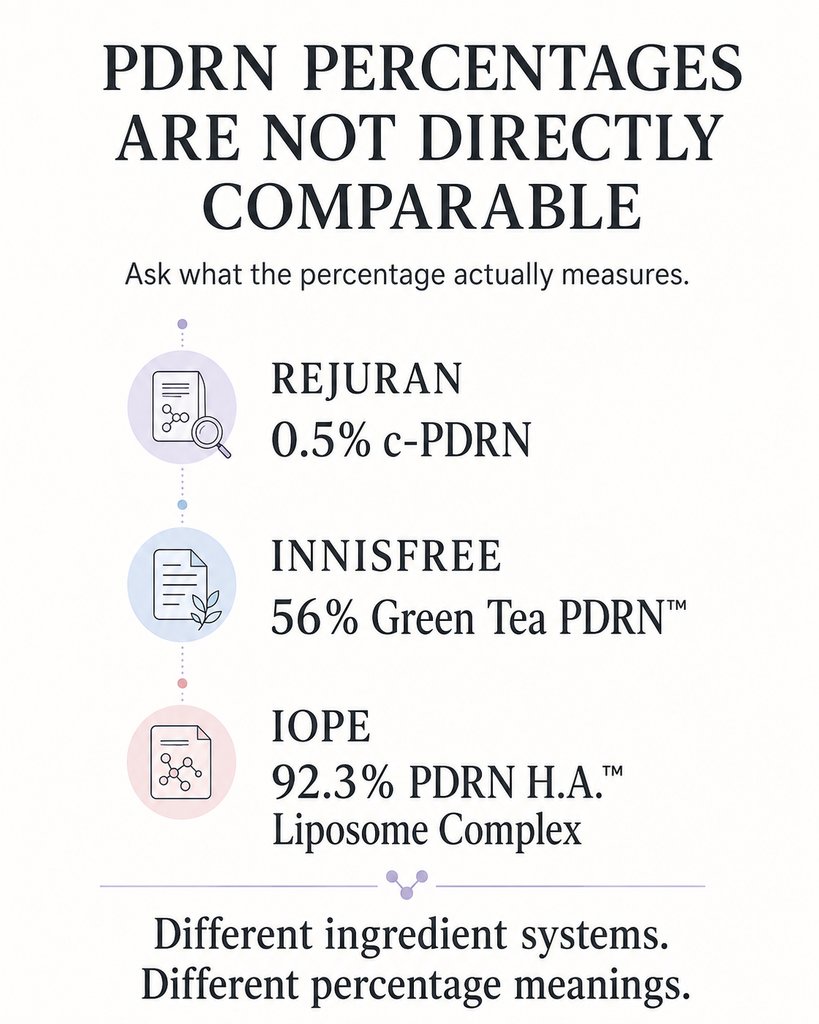
Consider three current labels:
Rejuran: 0.5% c-PDRN
innisfree: 56% Green Tea PDRN™
IOPE: 92.3% PDRN H.A.™ Liposome Complex
Reading only the numbers might make IOPE look dramatically more concentrated than Rejuran.
That is not a valid conclusion.
Each percentage refers to a different ingredient or proprietary system.
A percentage may describe:
- a defined c-PDRN material
- a proprietary fermentation system
- a branded PDRN + hyaluronic acid complex
- another multi-component ingredient preparation
Before comparing numbers, ask:
Percentage of what, exactly?
A PDRN percentage is only useful when you know what that percentage actually measures.
Salmon-Derived PDRN vs Plant-Based PDRN-Branded Systems
Traditional PDRN research has largely focused on DNA-derived PDRN associated with salmonid sources.
Products marketed around Green Tea PDRN™, Red Bean PDRN™, Rice PDRN, and similar plant-based concepts represent newer cosmetic approaches.
Brands may describe these as vegan alternatives.
That does not automatically establish that they contain the same material, behave the same way, or share the same evidence base as traditional salmon-derived PDRN.
Traditional Salmon-Derived PDRN May Make More Sense If
- the original PDRN ingredient category is specifically what interests you
- animal-derived ingredients fit your preferences
- source transparency matters more than vegan positioning
A Plant-Based PDRN-Branded Product May Make More Sense If
- vegan formulation is important
- the complete formula better matches your routine
- retinoids, peptides, ceramides, hydration, or pore-focused ingredients are the real reason for the purchase
The finished formula matters more than the trend label.
What Does the Topical PDRN Research Actually Show?
Topical PDRN research is becoming more interesting, but the results still need to be interpreted narrowly.
A 2026 PLOS ONE study evaluated a specific 0.1% PDRN-850K eye-cream formulation over 28 days.
The clinical portion used a randomized, double-blind, split-face design comparing that defined 0.1% PDRN-850K eye cream with an otherwise matched 0.1% retinol formula.
The study reported improvements in several measured periocular skin parameters.
That is promising evidence for that specific formulation under those study conditions.
It is not evidence that all five Sephora serums in this guide will produce the same results.
The study evaluated:
- one defined PDRN material
- one specific 0.1% eye-cream formulation
- a periocular application
- a 28-day study period
Formulation, molecular characteristics, concentration, delivery system, and accompanying ingredients can all matter.
Research involving injected or procedural PDRN also should not automatically be transferred to a leave-on cosmetic serum.
For the broader evidence, read our guide to what PDRN skincare is.
Which Sephora PDRN Product Fits Your Routine?
If Traditional PDRN Is the Main Reason You Are Shopping
Look at Rejuran Turnover Ampoule.
Its salmon-derived c-PDRN positioning is comparatively straightforward.
If You Actually Need a Retinoid
Consider innisfree Retinol Green Tea PDRN™ Firming Serum.
But if you already use another retinoid, it may create unnecessary duplication.
If You Want the Lowest Entry Price
Look at Beauty of Joseon Pore Firming Serum.
Its $17 price makes it easier to explore the category without premium-serum pricing.
If Product-Specific Testing Matters Most
Consider IOPE XMD Stem III Serum.
Keep the small, brand-reported study context in mind.
If Hydration and Size Matter More Than Ingredient Prestige
Look at FULLY Rice PDRN Serum.
Its 50 mL format gives it the strongest price-per-volume position in this comparison.
Should You Buy More Than One PDRN Serum?
Usually, no.
Using several products with PDRN branding does not automatically make a routine more effective.
You may simply create several overlapping serum steps.
Before buying another product, ask:
What new function does this add?
For example:
- Already use a retinoid? innisfree may be redundant.
- Already use niacinamide and several hydrating serums? Beauty of Joseon or FULLY may add limited functional novelty.
- Specifically exploring traditional PDRN? Rejuran may make more sense because its source and concentration positioning are clearer.
For another example of why finished formulas matter more than the trend ingredient alone, see our Anua PDRN vs Medicube PDRN comparison.
What to Check Before Buying PDRN at Sephora
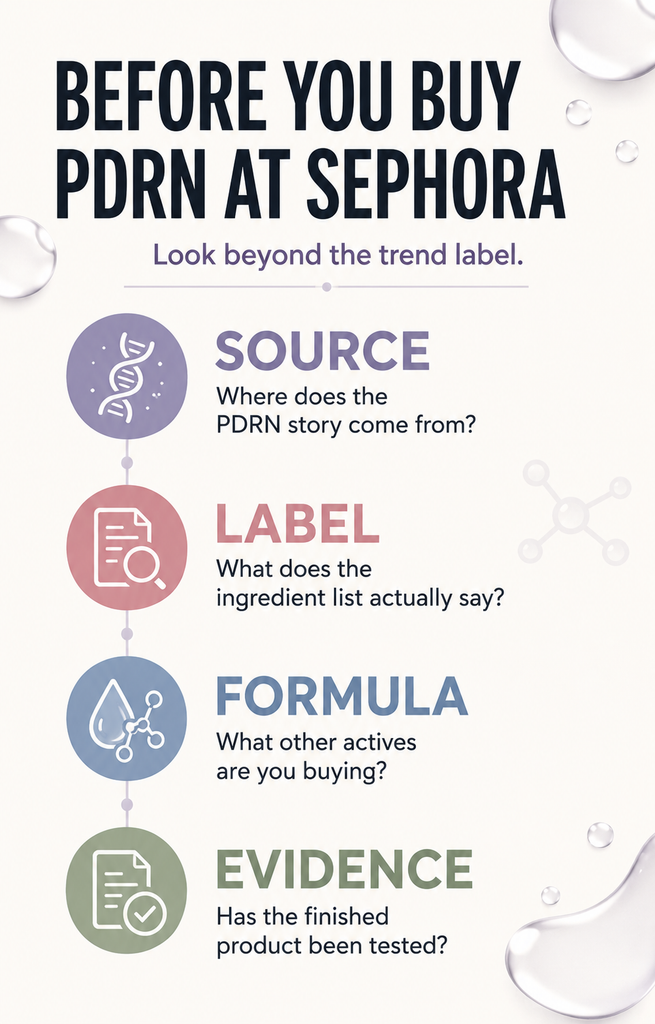
Use four checkpoints.
SOURCE
Where does the PDRN story come from?
Is it:
- salmon-derived
- a brand-described plant-derived DNA ingredient
- a fermentation-based proprietary system
- another branded PDRN complex
LABEL
What does the ingredient list actually say?
Look for terms such as:
- Hydrolyzed DNA
- Sodium DNA
- branded complexes
- fermentation ingredients
- the specific source described by the brand
FORMULA
What other actives are you actually buying?
Retinoids?
Niacinamide?
Peptides?
Ceramides?
Hyaluronic acid?
Those ingredients may matter more to your routine than the PDRN branding.
EVIDENCE
Has the finished product itself been tested?
Generic PDRN literature is useful background.
Product-specific evidence is more relevant when evaluating one particular bottle.
But always distinguish:
independent research
from:
brand-reported product testing.
The Bottom Line
There is no single PDRN product at Sephora that is best for everyone.
If traditional salmon-derived PDRN is the reason you are shopping, Rejuran Turnover Ampoule is the clearest fit in this group.
If you want a PDRN-branded vegan formula plus retinoids, innisfree offers the most distinctive combination.
If price is your priority, Beauty of Joseon offers the lowest entry point at $17.
If you value brand-reported finished-product testing, IOPE has the most ambitious product-specific testing story here, although the evidence is small and brand-reported.
And if hydration and size value matter most, FULLY gives you 50 mL for $27.
The most important rule is simpler than any ranking:
Do not buy the biggest PDRN percentage. Buy the finished formula that fills a real gap in your routine.
Frequently Asked Questions
What Is the Best PDRN Product at Sephora?
There is no single best option for every shopper.
For traditional salmon-derived PDRN positioning, Rejuran Turnover Ampoule is the clearest fit in this guide.
Other products may make more sense if you prioritize retinoids, vegan positioning, price, product-specific testing, or hydration value.
What Is the Cheapest PDRN Product in This Comparison?
Beauty of Joseon Pore Firming Red Bean PDRN™ Serum is currently the least expensive at $17 for 30 mL.
Does Sephora Sell Rejuran?
Yes.
Sephora currently carries Rejuran skincare, including the Turnover Ampoule c-PDRN 0.5%.
Does Sephora Sell Vegan PDRN Products?
Several brands market plant-based or vegan alternatives using PDRN terminology.
For example, innisfree describes Green Tea PDRN™ as a vegan alternative inspired by traditional PDRN, while Beauty of Joseon describes Red Bean PDRN™ as being made from purified red bean DNA fragments.
These branded systems should not automatically be assumed to be identical to salmon-derived PDRN.
Is 56% Green Tea PDRN Stronger Than 0.5% c-PDRN?
You cannot determine that from those percentages alone.
They refer to different ingredient systems and are not directly comparable concentration measurements.
Is IOPE 92.3% Pure PDRN?
That conclusion should not be made from the label.
IOPE describes the formula as containing 92.3% PDRN H.A.™ Liposome Complex.
The percentage refers to the proprietary complex, not necessarily isolated pure PDRN.
Is PDRN Better Than Retinol?
The evidence does not support a simple universal winner.
A 2026 study reported promising results from one specific 0.1% PDRN-850K eye-cream formulation compared with 0.1% retinol over 28 days.
That result should not be generalized to every PDRN or retinol product.
Read our full PDRN vs retinol comparison for the broader context.
Do I Need More Than One PDRN Product?
Probably not.
Choose one finished formula based on your existing routine, skin goals, and budget rather than stacking several products simply because they share PDRN branding.
Sources & References
- Rejuran Turnover Ampoule c-PDRN 0.5% — Sephora U.S., 2026
- c-PDRN Ingredient Information — Rejuran Cosmetics
- Retinol Green Tea PDRN™ Firming Serum — innisfree U.S.
- Pore Firming Red Bean PDRN™ Serum — Beauty of Joseon
- XMD Stem III Clinical Recovery Serum — IOPE International
- Rice PDRN Glow Barrier Boosting Serum — Sephora U.S.
- Topical Medium-Length PDRN Enhances Dermal Extracellular Matrix Repair in Photodamaged Skin — PLOS ONE, 2026