Exosomes are becoming one of the most talked-about concepts in Korean skincare, regenerative aesthetics, and post-procedure beauty.
You may see the term on serums, ampoules, “skin boosters,” spicule products, and treatments marketed for smoother texture, elasticity, hydration, or younger-looking skin.
But there is an important problem:
The word “exosome” on a skincare label does not tell you exactly what the product contains, where the vesicles came from, how they were processed, or whether the finished formula has meaningful human evidence.
Research into extracellular vesicles is genuinely promising.
Consumer marketing is moving much faster.
Here is what we actually know in 2026.
What Are Exosomes in Skincare?
Exosomes are small membrane-bound extracellular vesicles released by cells.
They can carry proteins, lipids, nucleic acids, and other biological material involved in cell-to-cell signaling, which is why researchers are studying specific extracellular-vesicle preparations in tissue repair, wound healing, inflammation, and skin biology.
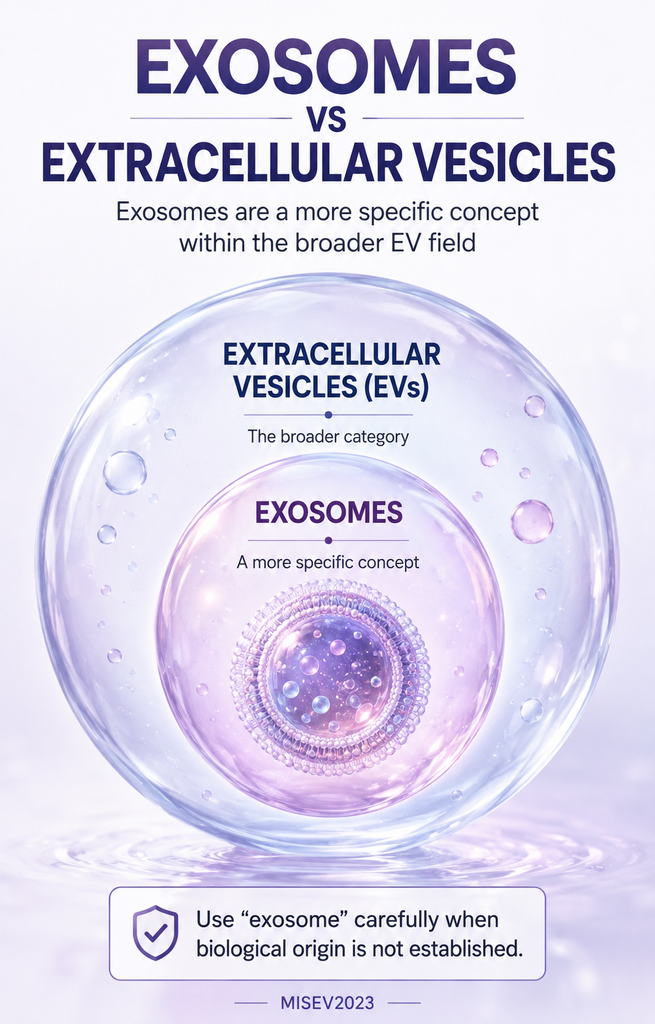
Exosomes belong to the broader family of extracellular vesicles, or EVs.
Extracellular vesicles are particles released from cells that are surrounded by a lipid bilayer and cannot replicate on their own.
But scientifically, the word exosome requires more care than beauty marketing usually gives it.
Exosomes vs Extracellular Vesicles: Are They the Same?
Not exactly.
Extracellular vesicles (EVs) are the broader category.
The term exosome traditionally refers to an EV subtype associated with a particular endosomal biogenesis pathway.
But proving the exact biological origin of isolated vesicles can be difficult.
For that reason, the International Society for Extracellular Vesicles recommends using the broader term extracellular vesicle unless the evidence supports a more specific biogenesis-based label such as “exosome.”
MISEV2023 specifically discourages using the term “exosome” when subcellular origin has not been demonstrated.
That distinction matters in skincare.
A product marketed as “exosome skincare” may involve:
- a characterized extracellular-vesicle preparation
- bacterial extracellular vesicles
- plant-derived vesicle preparations
- milk-derived vesicles
- human-cell-derived preparations used in research or aesthetic settings
- other vesicle-related cosmetic materials
These should not automatically be treated as biologically identical.
Why Are Exosomes Being Studied for Skin?
The scientific interest comes largely from cellular communication.
Extracellular vesicles can transport biological material between cells.
Specific EV preparations have therefore been investigated in laboratory and preclinical research for processes involving:
- collagen-related signaling
- inflammation
- oxidative stress
- wound healing
- pigmentation
- extracellular-matrix biology
That creates a reasonable scientific basis for studying EVs in skin rejuvenation.
But a plausible biological mechanism does not prove that a leave-on cosmetic serum produces meaningful anti-aging results.
The evidence has to be evaluated at the level of the actual intervention.
What Does the 2026 Evidence Say?
A 2026 scoping review of topical exosomes for skin rejuvenation evaluated both the clinical evidence and the commercial landscape.
Researchers screened 2,394 articles.
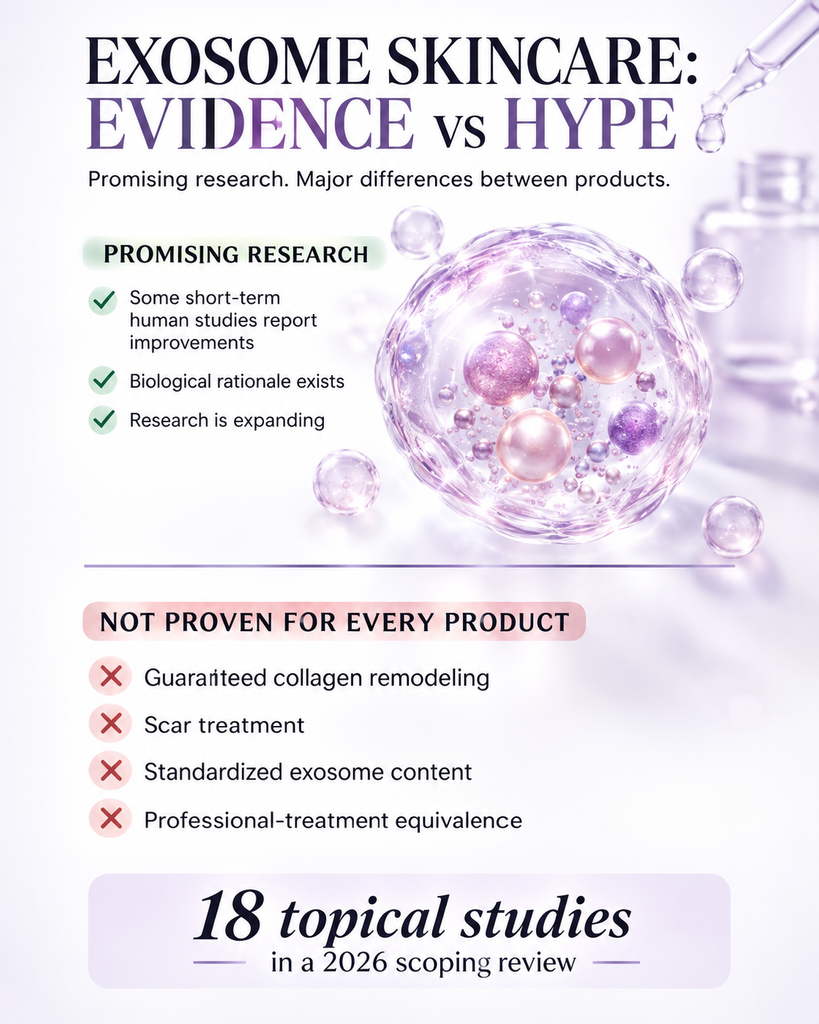
Only 18 studies met the review criteria for topical skin-rejuvenation research.
Reported outcomes across those studies included changes involving:
- wrinkles
- elasticity
- hydration
- pigmentation
- collagen
- elastin
But there were major limitations.
Human evidence remained relatively scarce.
The vesicle sources varied.
Ten studies used another delivery modality alongside the exosome preparation, while eight evaluated topical application alone.
Commercial products also provided limited information about factors such as:
- source
- isolation
- processing
- shelf life
The review concluded that stronger clinical evidence and better standardization are still needed.
That is much more precise than saying:
“Studies prove exosome skincare works.”
They do not prove that every product marketed as exosome skincare works.
What Do Human Studies Show?
A separate 2026 systematic review of human skin-rejuvenation studies evaluated 19 human studies of exosome-based interventions.
Some studies reported short-term improvements involving:
- hydration
- elasticity
- wrinkle appearance
- pores
- pigmentation
- overall skin appearance
But the 19 studies did not represent one standardized treatment.
They varied in:
- vesicle source
- dose
- route
- accompanying procedure
- outcome measurements
- study design
- follow-up duration
Most of the studies were not randomized.
The review also highlighted methodological heterogeneity and limited long-term follow-up.
So the current clinical picture is better summarized as:
Promising, but not standardized or definitive.
What Benefits of Exosome Skincare Are Most Plausible?
Several areas are worth continued investigation.
1. Hydration and Elasticity
Some human studies of specific exosome- or EV-based interventions have reported short-term improvements in hydration and elasticity.
That is encouraging.
But different preparations and delivery methods were used.
Those findings should not automatically be applied to an ordinary consumer serum.
2. Fine Lines and Wrinkle Appearance
Changes in wrinkle appearance have also been reported after certain interventions.
Again, this does not establish a universal anti-wrinkle benefit for every formula using “exosome” marketing.
3. Pigmentation and Overall Skin Appearance
Some studies have reported changes in pigmentation and broader aesthetic assessments.
The evidence remains heterogeneous.
The rest of the formula or an accompanying procedure may also contribute to the result.
4. Post-Procedure Rejuvenation
A meaningful portion of the current aesthetic literature combines an exosome- or EV-based preparation with another delivery method.
Examples include:
- microneedling
- fractional laser procedures
- other professional delivery techniques
Results from those combinations cannot automatically be attributed to the vesicle preparation alone.
They also cannot be assumed to apply to a leave-on serum used on intact skin.
Do Exosomes Increase Collagen?
This requires careful wording.
Some studies report collagen-related signals or measurements after specific EV/exosome interventions.
This does not justify a universal claim that every exosome serum builds collagen—especially when the product’s vesicle source, concentration, delivery system, and finished-formula evidence are not disclosed.
The more accurate conclusion is:
Certain EV/exosome interventions have produced promising collagen-related findings, but this has not been established across consumer exosome skincare as a category.
Are Plant Exosomes the Same as Human-Derived Exosomes?
Do not assume they are equivalent.
Beauty marketing may use terms such as:
- plant exosomes
- plant-derived vesicles
- stem-cell exosomes
- milk exosomes
- bacterial extracellular vesicles
- lactobacillus extracellular vesicles
These materials can differ substantially in biological origin, preparation, and characterization.
Even terminology becomes complicated.
MISEV2023 discourages the casual use of biogenesis-based terms such as “exosome” when the relevant biological origin has not actually been demonstrated.
For consumers, the practical takeaway is simple:
“Exosome” should not be treated as one standardized cosmetic ingredient.
What About Bacterial Extracellular Vesicles?
This is particularly relevant to current K-beauty products.
For example, Medicube’s U.S. Zero Exosome Shot product information lists:
Lactobacillus Extracellular Vesicles
and:
Hydrolyzed Sponge
This illustrates why a front-label “Exosome Shot” name does not, by itself, tell you the full identity, source, or delivery approach of the vesicle-related ingredient.
It also does not mean the product’s overall effects can be attributed solely to the extracellular-vesicle ingredient or hydrolyzed sponge.
The entire formula matters.
Medicube’s own lineup also shows why the number on an “exosome” product needs context. Our Medicube Exosome Shot 2000 vs 7500 comparison looks at the two current ingredient lists, the MILD vs STRONG positioning, and why the 7500 label does not prove 3.75 times greater effectiveness.
That difference becomes clearer in our Medicube Exosome Shot 2000 vs VT Reedle Shot 100 comparison, where Medicube’s extracellular-vesicle formula is compared with VT’s separate Cica Reedle™ approach.
If you want to see how this labeling works in a real product, read our Medicube Exosome Shot 2000 review, where we break down the “2000” label, the Lactobacillus Extracellular Vesicles ingredient, the spicule system, and Medicube’s pore claims.
Because ingredient lists and product versions can change, always check the current manufacturer listing for the exact product you are buying.
Do Exosome Serums Need Microneedling or Spicules?
No universal rule says an exosome cosmetic requires microneedling or spicules.
But delivery is an important issue.
The skin barrier is specifically designed to limit penetration.
A biological preparation showing activity in a laboratory setting cannot automatically be expected to reach the same location when simply applied to intact human skin.
That is one reason researchers have investigated EV/exosome preparations alongside delivery methods.
It is also why some K-beauty products combine extracellular-vesicle terminology with spicule-based formulations.
But:
Better delivery in one experimental or commercial system does not prove better clinical results in every finished product.
If you are unfamiliar with the technology, our separate guide explains how spicules work in skincare.
Exosomes vs PDRN: What Is the Difference?
They are fundamentally different technologies.
Exosomes / Extracellular Vesicles
These are vesicular biological particles investigated for cell-to-cell communication and transport of biological cargo.
PDRN
PDRN refers to polydeoxyribonucleotide-derived material used in regenerative and cosmetic contexts.
It is not an extracellular vesicle.
If you are new to this ingredient category, start with our guide to what PDRN skincare is.
The important point is:
PDRN and exosomes should not be grouped together simply because both are marketed under “regenerative skincare.”
Their composition, proposed mechanisms, sourcing, evidence, and regulatory considerations differ.
Are Exosomes Safe in Skincare?
That depends heavily on the product and route of administration.
The 2026 systematic review of human studies reported generally encouraging short-term safety findings for many topical applications.
But the review also emphasized methodological limitations and insufficient long-term follow-up.
That is very different from saying:
“All exosome skincare is proven safe.”
The category is too heterogeneous for that conclusion.
Relevant factors can include:
- biological source
- purity
- manufacturing
- isolation method
- contamination control
- storage
- formulation
- delivery method
- skin condition
- route of administration
Topical cosmetics and injections should be treated as very different risk categories.
What Does the FDA Say About Exosomes?
This topic is frequently misunderstood online.
FDA safety communications on exosome products have warned about unapproved exosome products marketed or administered to prevent, treat, or cure diseases or medical conditions.
The FDA has stated that there are no FDA-approved exosome products in that therapeutic context.
But that statement should not be rewritten as:
“The FDA has banned exosome cosmetics.”
Ordinary cosmetics are regulated under a different framework.
Except for color additives, cosmetic products and ingredients generally do not require FDA premarket approval.
FDA guidance on cosmetic approval and regulation explains that companies remain responsible for the safety and proper labeling of their cosmetic products.
There is also an important distinction based on intended use.
A product marketed to treat or prevent disease, or to affect the structure or function of the body, may fall under drug regulation rather than ordinary cosmetic regulation.
So avoid both misleading extremes:
“FDA-approved exosome serum.”
and
“Every cosmetic using exosome terminology is an illegal unapproved medical product.”
Neither is an accurate generalization.
What About Exosome Injections?
Do not treat injectable exosome interventions as interchangeable with skincare serums.
The route of administration changes the risk profile significantly.
A 2026 dermatology scoping review of exosome-based therapies identified human studies using delivery methods including:
- topical application
- microneedling
- fractional CO₂ laser
- injection
Adverse events were uncommon overall, but reported serious events included granulomas, necrosis, and allergic reactions after injection.
This is another reason route matters.
Do not use evidence from injected, laser-assisted, or microneedling-assisted exosome interventions to predict the effect or safety of a leave-on cosmetic serum.
The interventions are not equivalent.
How Can You Evaluate an Exosome Skincare Product?
Instead of asking only:
“How many exosomes does it contain?”
ask better questions.
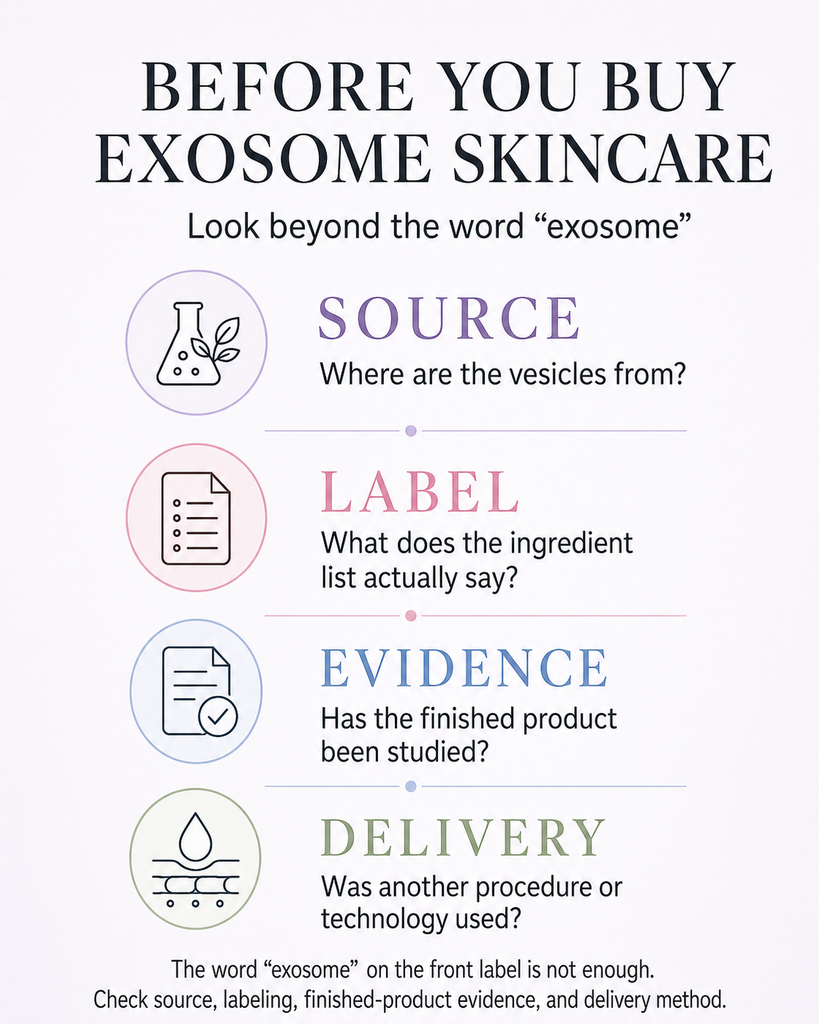
1. What Is the Source?
Look for information describing whether the vesicle-related material is:
- human-derived
- plant-derived
- milk-derived
- bacterial
- another EV preparation
If the brand does not explain the source at all, transparency is limited.
2. What Does the Ingredient List Actually Say?
The front label may say:
Exosome
while the ingredient list uses more precise terminology.
For example, Medicube’s current U.S. product information lists:
Lactobacillus Extracellular Vesicles
Reading the ingredient list tells you more than relying on the product name alone.
3. Is There Finished-Product Human Evidence?
A study on a completely different EV preparation does not prove another serum works.
Finished-product research is more useful when available.
4. Was Another Delivery Method Used?
If impressive study results involved:
- microneedling
- laser treatment
- injection
- another professional procedure
- specialized delivery technology
do not assume the same outcome will occur from topical application alone.
5. Are the Claims Realistic?
Be cautious with promises involving:
- dramatic regeneration
- scar removal
- guaranteed collagen remodeling
- medical-level tissue repair
- replacement of professional procedures
- guaranteed deep delivery
Scientific vocabulary does not automatically make a cosmetic claim scientifically established.
Are Exosome Products Worth Trying?
Possibly.
But they make more sense for an informed skincare buyer than for someone expecting a proven medical-level rejuvenation treatment in a bottle.
Reasons you may be interested:
- you enjoy emerging K-beauty technologies
- you understand that evidence is still developing
- the finished formula contains other useful skincare ingredients
- the manufacturer clearly identifies its EV/exosome-related ingredient
- the claims are realistic
Reasons to be skeptical:
- the biological source is never identified
- the marketing relies almost entirely on “stem cell” or “regeneration” language
- medical-style promises dominate the product page
- supporting studies involve unrelated preparations
- the marketing assumes all exosome products are biologically identical
What Does the Science Actually Say?
The evidence is easiest to understand in three levels.
Reasonably Supported
Extracellular vesicles are biologically active communication particles, and specific EV/exosome systems have shown findings relevant to skin-rejuvenation research.
There is legitimate science behind the field.
Promising but Not Yet Standardized
Some human studies of specific exosome- or EV-based interventions report short-term improvements in hydration, elasticity, wrinkle appearance, pigmentation, and overall skin appearance.
But studies vary substantially in:
- vesicle source
- preparation
- dose
- treatment protocol
- delivery method
- outcome measurement
Current reviews continue to call for better standardization and stronger randomized evidence.
Not Established for Every Consumer Product
The word “exosome” on a label does not prove that a serum:
- contains a standardized exosome preparation
- uses the same material studied in clinical research
- penetrates to a particular depth
- builds collagen
- treats scars
- regenerates damaged tissue
- reproduces professional-treatment results
That is the key distinction.
The Bottom Line
Exosome skincare is one of the most scientifically interesting—and most easily over-marketed—areas of modern K-beauty.
Extracellular vesicles genuinely play important roles in biological communication.
Early human research also suggests that specific exosome- or EV-based interventions may have potential in skin rejuvenation.
But the category is far from standardized.
Current studies and commercial products vary in:
- biological source
- isolation and processing methods
- terminology
- delivery systems
- formulations
- quality of evidence
That means the word “exosome” alone is not enough to judge a skincare product.
A better rule is:
Check the vesicle source, ingredient terminology, delivery method, finished-product evidence, and the quality of the claims.
Frequently Asked Questions
Are Exosomes the Same as Extracellular Vesicles?
Not exactly.
Extracellular vesicles are the broader category.
“Exosome” is a more specific biogenesis-related term.
Because exact biological origin can be difficult to establish, MISEV2023 generally recommends broader EV terminology unless the specific origin is supported.
Are Exosomes Stem Cells?
No.
Exosomes are not living cells.
They are extracellular vesicles released by cells.
A product marketed with “stem-cell-derived exosomes” should therefore not be interpreted as containing living stem cells.
Do Exosomes Penetrate the Skin?
It depends on the preparation and delivery method.
The skin barrier limits penetration.
That is one reason many studies use additional delivery technologies.
Results from one delivery method should not be generalized to every leave-on serum.
Do Exosomes Build Collagen?
Some studies report collagen-related findings after specific EV/exosome interventions.
That does not establish a universal collagen-building effect for every consumer exosome serum.
Are Plant Exosomes Real Exosomes?
Terminology is complicated.
Plant-derived vesicle preparations can be scientifically interesting, but the word “exosome” should not automatically be taken as proof that a preparation meets a rigorously characterized biogenesis-based definition.
Are Exosome Serums FDA Approved?
Ordinary cosmetics generally are not subject to FDA premarket approval, except for color additives.
FDA warnings about unapproved exosome products have involved therapeutic products marketed or administered to treat diseases or medical conditions.
Those are different regulatory contexts.
Are Exosome Serums Safe?
Short-term human evidence is encouraging for some topical interventions.
However, studies and products remain heterogeneous, and long-term evidence is limited.
Safety should be evaluated for the exact finished product and method of use.
Exosomes or PDRN: Which Is Better?
There is not enough standardized head-to-head evidence to declare one universally better.
They are also fundamentally different technologies.
Compare the actual product, formula, evidence, skin goal, and method of use rather than relying on the broader “regenerative skincare” label.
Sources & References
- Clinical Evidence and Commercial Landscape of Topical Exosomes for Skin Rejuvenation — Aesthetic Surgery Journal, 2026
- Efficacy of Exosome-Based Therapies for Skin Rejuvenation: A Systematic Review of Human Studies — Systematic Review, 2026
- Minimal Information for Studies of Extracellular Vesicles (MISEV2023) — Journal of Extracellular Vesicles
- Exosome-Based Therapies in Dermatology: A Scoping Review — Journal of Drugs in Dermatology, 2026
- Public Safety Notification on Exosome Products — U.S. FDA
- Does FDA Approve Cosmetics Before They Go on the Market? — U.S. FDA
- Zero Exosome Shot — Official Product Information & Ingredient List — Medicube U.S.