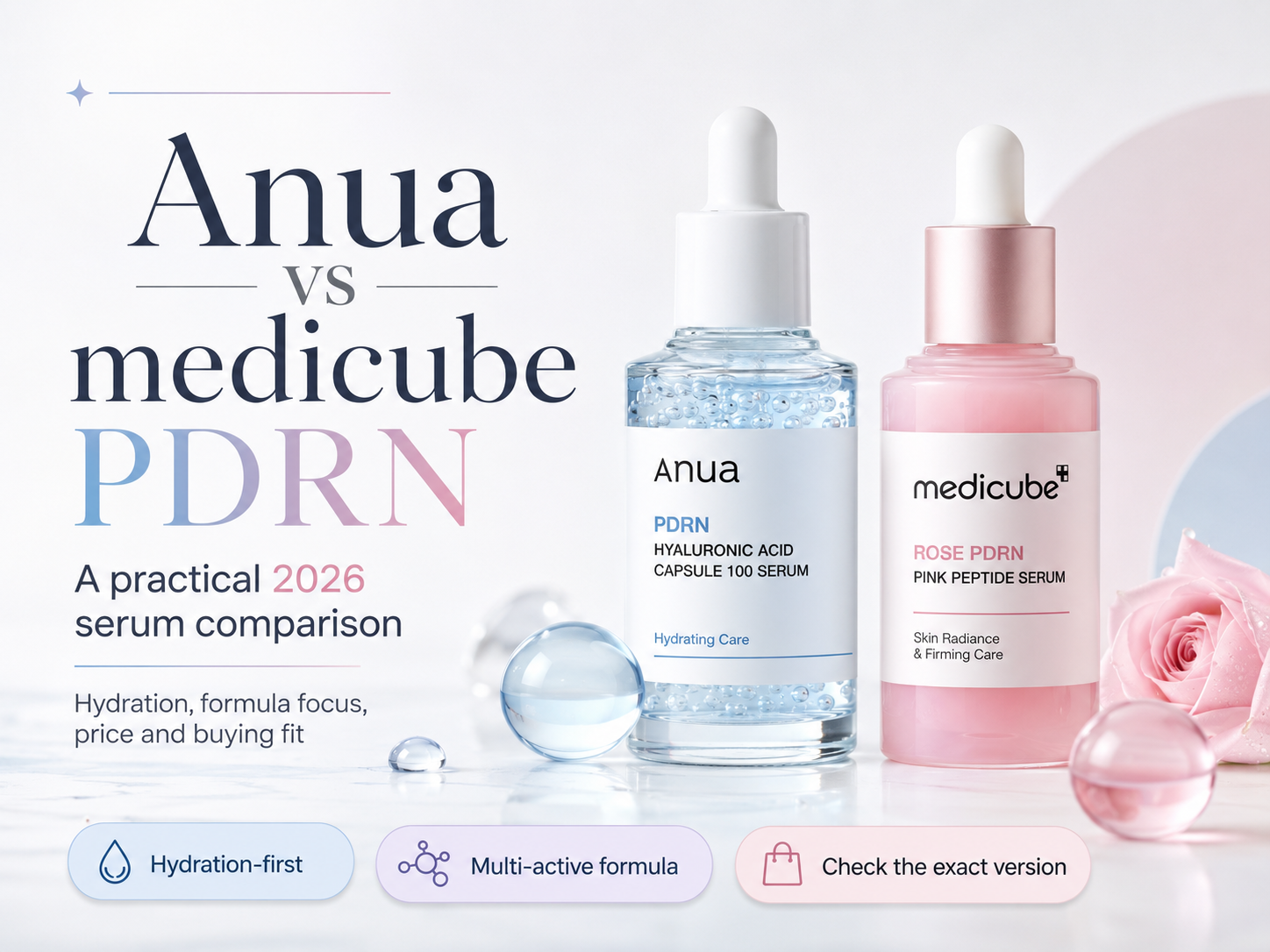
Anua PDRN vs Medicube PDRN is a much closer comparison than the packaging makes it look.
Both are Korean PDRN serums positioned around hydration, glow and firmer-looking skin, but their supporting formulas are different enough that one may make more sense for your routine than the other.
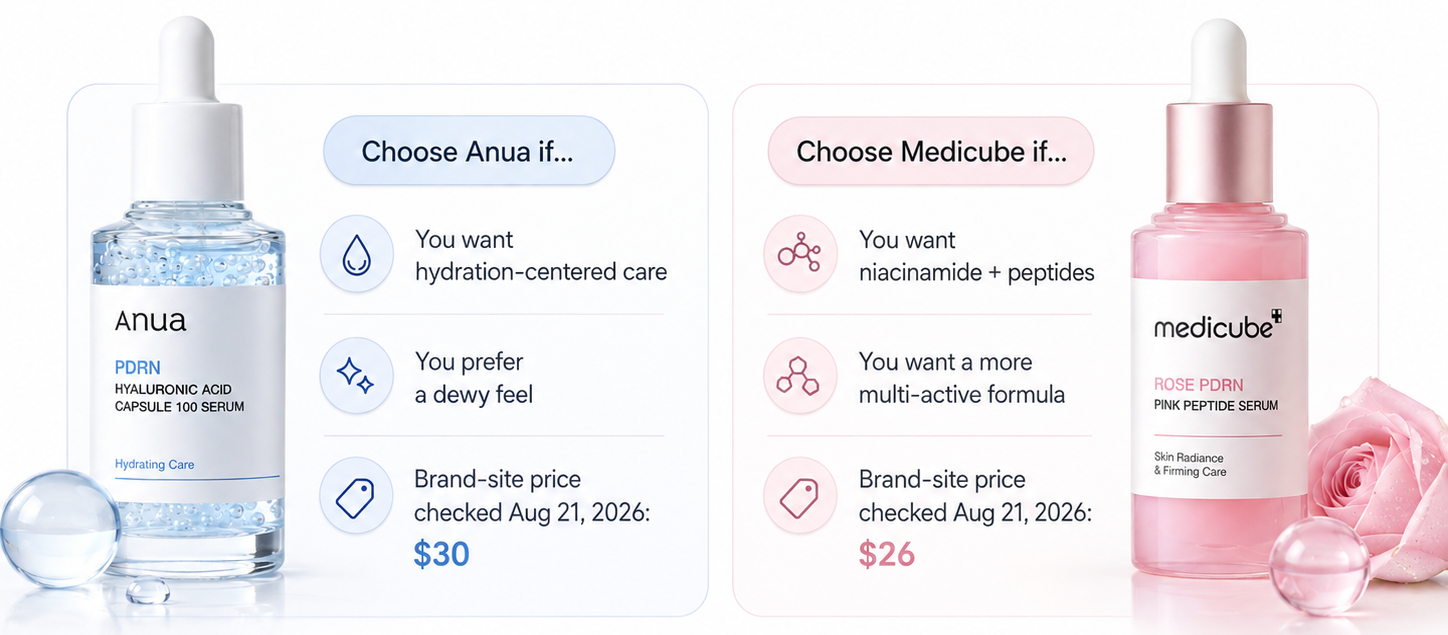
As of August 21, 2026, Anua’s U.S. site lists the PDRN Hyaluronic Acid Capsule 100 Serum at $30, while Medicube lists the PDRN Pink Peptide Serum at $26. Both are 30 mL products.
Prices can change with promotions, bundles, subscriptions and retailer discounts.
The short answer:
Choose Anua if your priority is a hydration-centered PDRN serum built around multiple forms of hyaluronic acid, collagen and a dewy finish.
Choose Medicube if you want a more explicitly multi-active formula combining PDRN with niacinamide and a larger visible peptide complex.
But neither product currently provides enough directly comparable technical PDRN information or direct head-to-head clinical testing to prove that its PDRN is scientifically superior.
The better choice depends on your skin goal, formula tolerance and the exact product version you are buying.
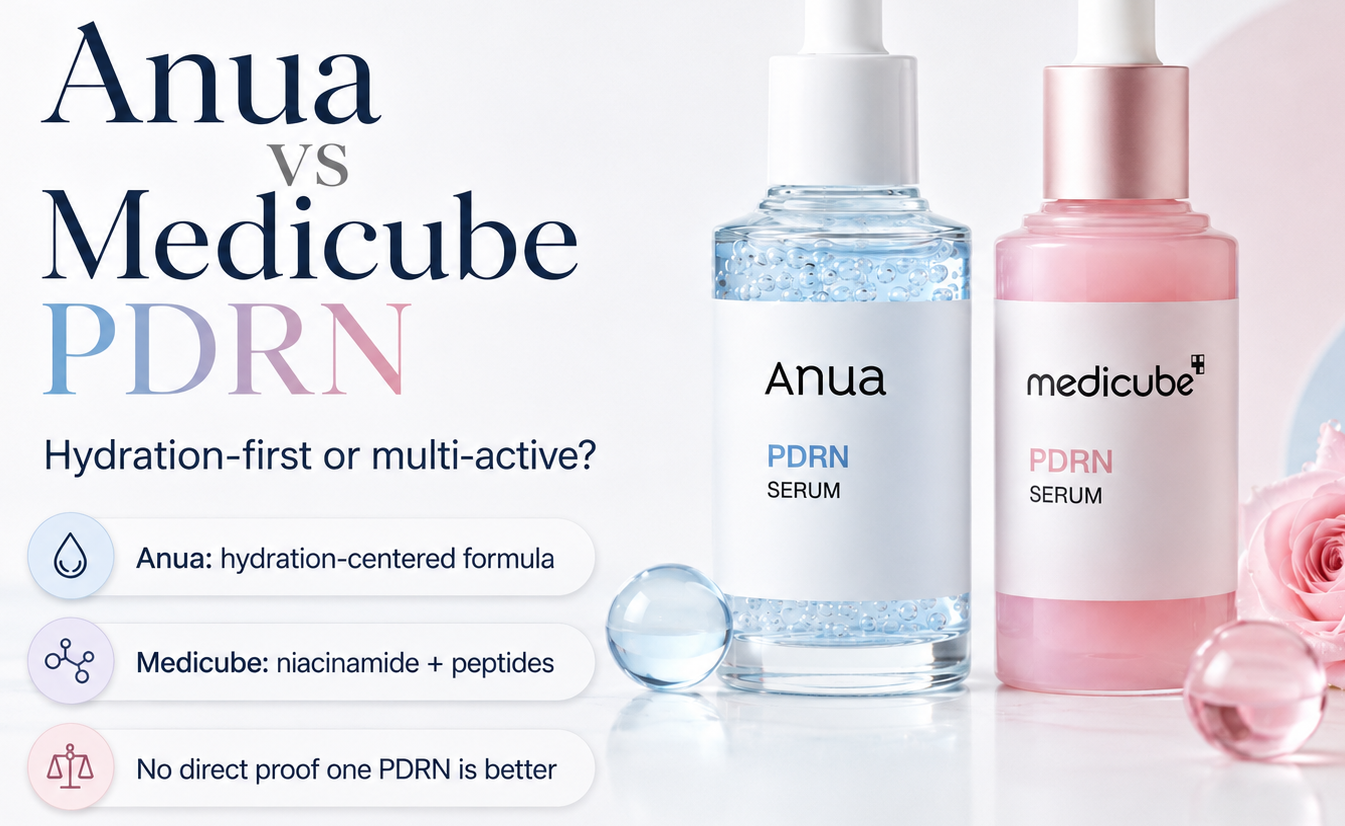
Anua PDRN vs Medicube PDRN: Quick Comparison
| Feature | Anua PDRN Hyaluronic Acid Capsule 100 Serum | Medicube PDRN Pink Peptide Serum |
|---|---|---|
| Brand-site listed price checked Aug. 21, 2026 | $30 | $26 |
| Size | 30 mL | 30 mL |
| PDRN positioning | Salmon DNA-derived Sodium DNA | Salmon DNA PDRN or Rose PDRN (Vegan) option |
| Formula emphasis | PDRN + multiple HA forms + collagen | PDRN + niacinamide + peptide complex |
| Main positioning | Hydration, moisture plumping, glow | Hydration, glow, uneven tone, firmness |
| Use | Morning and night | Morning and night |
| Brand-reported testing | Immediate hydration measurements, low-irritation, non-comedogenic | Dermatologist-tested, low-irritating, fine-line/brightening functionality |
| Directly standardized PDRN comparison | Not available | Not available |
| Formula-based pick | Hydration-first routine | Broader multi-active routine |
The most important row is the second-to-last one.
There is no good scientific basis for choosing between these serums simply by asking which one “has more PDRN.”
The same problem appears with hydrogel masks: our Medicube vs COSRX PDRN mask comparison explains why COSRX’s “5 PDRN” label should not be read as a five-times-stronger score.
The current brand pages do not present a clearly standardized, directly comparable PDRN concentration and molecular specification for both serums.
Some retailer listings may show ingredient ppm figures, but those figures should not be treated as a controlled comparison of usable PDRN across different finished formulas.
What Exactly Are We Comparing?
This article compares two specific products:
Anua PDRN Hyaluronic Acid Capsule 100 Serum
and
Medicube PDRN Pink Peptide Serum.
It does not compare every PDRN product made by Anua with every PDRN product made by Medicube.
That matters because both brands now sell broader PDRN ranges.
If you’re considering Anua’s spray format rather than a conventional dropper serum, read our Anua PDRN Mist Review for a closer look at its 2,000ppm PDRN claim, oil-capsule formula, makeup use, and whether the $25 mist is worth buying.
So when someone asks, “Is Anua PDRN better than Medicube PDRN?” the more useful question is:
Which of these two formulas better matches what your skin actually needs?
What Is in the Anua PDRN Serum?
Anua positions its serum around what the brand calls a Triple Revitalizing Complex combining PDRN, hyaluronic acid and collagen.
The current official ingredient list includes:
- Glycerin
- Hydrolyzed hyaluronic acid
- Niacinamide
- Glutathione
- Hydrolyzed collagen
- Sodium hyaluronate
- Adenosine
- Sodium DNA
- Hyaluronic acid
- Hydrolyzed sodium hyaluronate
- Hydroxypropyltrimonium hyaluronate
- Potassium hyaluronate
- Sodium hyaluronate crosspolymer
- Sodium acetylated hyaluronate
Anua specifically identifies the product’s Sodium DNA as salmon DNA-derived.
The brand also describes the formula as lightweight and fast-absorbing and positions it strongly around hydration, moisture plumping and a luminous finish.
Anua Contains Niacinamide Too
One potential oversimplification is:
Anua = hyaluronic acid
Medicube = niacinamide
That is not accurate.
Anua also contains niacinamide relatively early in its ingredient list.
The real difference is that Anua’s formula architecture and marketing place much greater emphasis on a PDRN + multiple-hyaluronic-acid + collagen hydration system.
What Does Anua’s Product Testing Show?
Anua currently reports:
- 8.93% improvement in temporary hydration and moisture plumping after one use
- 24.64% improvement in temporary deep-skin hydration after one use
- Non-comedogenic testing
- Low-irritation testing
- No artificial color
These are useful product-specific data points.
But they are brand-reported testing results.
They should not be compared numerically with Medicube claims as if the two companies conducted one standardized head-to-head trial.
What Is in the Medicube PDRN Serum?
Medicube uses a broader multi-active positioning.
Its current U.S. product page lets shoppers choose between:
Salmon DNA PDRN
and
Rose PDRN (Vegan)
as labeled by the brand.
The current Salmon DNA version lists ingredients including:
- Glycerin
- Isopropyl Myristate
- Niacinamide
- Sodium DNA
- Milt Extract
- Adenosine
- Sodium Hyaluronate
- Hydrolyzed Collagen
- Ubiquinone
- Palmitoyl Pentapeptide-4
- Palmitoyl Tripeptide-1
- Palmitoyl Tetrapeptide-7
- Copper Tripeptide-1
- Acetyl Hexapeptide-8
- Salmon Egg Extract
Medicube therefore has a particularly visible PDRN + niacinamide + peptide story.
The Salmon version should obviously not be considered vegan.
What About Rose PDRN?
Medicube separately markets another option as:
Rose PDRN (Vegan).
Its ingredient list is different and includes Rosa Damascena Extract, Sodium DNA, niacinamide and several peptides.
The important wording is:
Medicube markets this option as Rose PDRN (Vegan).
We should not turn that marketing description into a claim that Rose PDRN has been independently proven scientifically equivalent to traditional salmon-derived PDRN.
That would require stronger comparative evidence than a brand product page provides.
The Biggest Formula Difference
The simplest way to separate the two products is this:
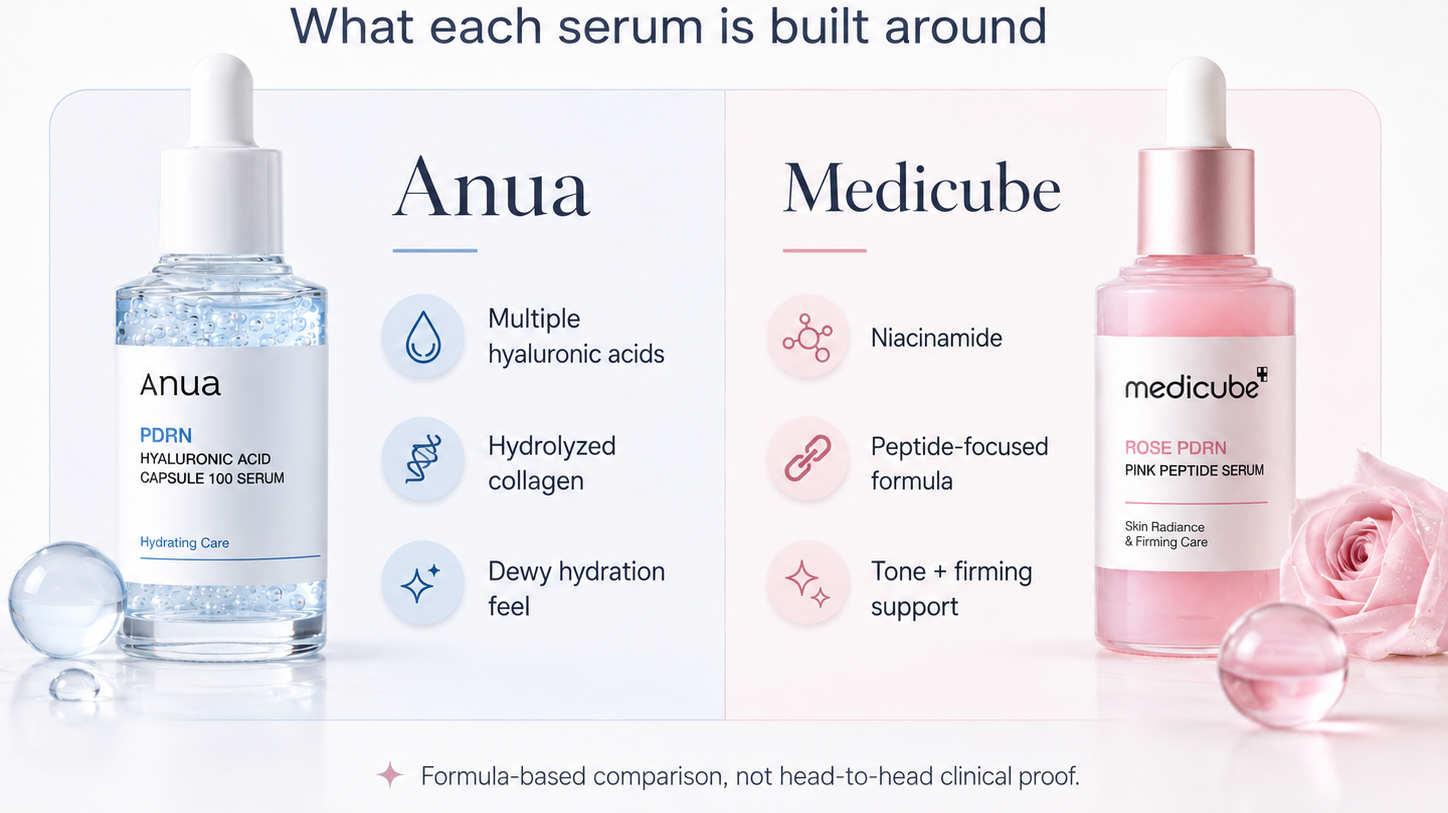
Anua: Hydration-Centered Formula Architecture
Think:
PDRN + multiple forms of hyaluronic acid + collagen
Anua’s product is strongly positioned around hydration, moisture plumping and a dewy appearance.
Medicube: More Explicitly Multi-Active
Think:
PDRN + niacinamide + multiple peptides
Medicube is positioned more broadly around hydration, glow, uneven-looking tone and firmness.
That does not mean Anua cannot help skin look brighter or firmer.
And it does not mean Medicube cannot hydrate.
The formulas overlap.
The difference is mainly what the supporting formula is designed to emphasize around the PDRN.
Which Serum Has More PDRN?
We cannot make a reliable apples-to-apples conclusion.
The current brand pages do not give consumers a clearly standardized combination of:
- PDRN concentration
- Molecular specification
- Fragment characteristics
- Delivery system
- Finished-formula bioavailability
for both products in a directly comparable format.
That means a retailer claim such as “X ppm” should not automatically become:
“This serum has 100 times more effective PDRN.”
That conclusion would go beyond the available evidence.
Even ingredient-list position cannot tell us the exact usable amount reaching skin.
PDRN quantity is not the same thing as proven finished-product performance.
If you are new to the ingredient itself, read our full guide to what PDRN skincare is and what the evidence actually shows.
Does the 2026 PDRN Study Prove Anua or Medicube Works?
No.
This is one of the most important points in this entire comparison.
A randomized 2026 study published in PLOS ONE compared a specific 0.1% PDRN-850K eye cream with a 0.1% retinol eye cream over 28 days.
The study reported promising results for that PDRN-850K formulation.
It did not test Anua PDRN Hyaluronic Acid Capsule 100 Serum.
It did not test Medicube PDRN Pink Peptide Serum.
And it did not establish that every cosmetic containing Sodium DNA will perform like the experimental PDRN-850K formulation.
So it would be misleading to say:
“Clinical research proves Anua works.”
or:
“The 2026 study proves Medicube works.”
The study increases the scientific interest around topical PDRN.
It does not transfer automatically to unrelated retail formulas.
For the direct PDRN-versus-retinol evidence, read our full PDRN vs retinol comparison.
Anua vs Medicube for Hydration
Formula-Based Pick: Anua
If your main goal is:
- Dehydrated skin
- Moisture plumping
- A dewy finish
- A hydration-heavy routine
Anua is the more logically targeted formula.
The serum contains glycerin plus several forms of hyaluronic acid, alongside hydrolyzed collagen and Sodium DNA.
Anua also publishes product-specific immediate hydration measurements.
This is a formula-based pick, not proof from a controlled Anua-vs-Medicube clinical trial.
Anua vs Medicube for Dull or Uneven-Looking Skin
Formula-Based Pick: Medicube
Medicube combines PDRN with niacinamide and multiple peptides and explicitly positions the serum around dullness, uneven tone and loss of firmness.
That makes it the more logical choice for someone who wants one serum to take a broader multi-active approach rather than focusing primarily on hydration.
Again:
This is a formula-based recommendation, not head-to-head clinical proof.
Anua vs Medicube for Fine Lines and Firm-Looking Skin
This comparison is closer.
Anua contains adenosine, hydrolyzed collagen and a hydration-heavy supporting system.
Medicube contains adenosine plus a more extensive explicitly listed peptide complex.
If your decision is based on supporting anti-aging ingredients beyond PDRN, Medicube has the more obviously peptide-focused formula.
However, a longer ingredient list does not automatically make a product more effective.
Concentration, stability, formulation, delivery and skin tolerance all matter.
Which Is Better for Sensitive Skin?
No Universal Winner
Anua currently describes its serum as low-irritation and non-comedogenic.
Medicube describes its serum as dermatologist-tested and tested to be low-irritating, and lists sensitive skin among its intended skin types.
But sensitive-skin shoppers should notice one unusual detail on Medicube’s current U.S. page.
Medicube’s Current Fragrance Information Does Not Fully Match
Medicube currently has a FORMULATED WITHOUT section that includes:
“Fragrances.”
However, on the same official product page, the displayed ingredient list for the Salmon DNA PDRN formula includes:
Fragrance
and the Rose PDRN formula also includes:
Fragrance.
This does not prove that the product is unsafe or mislabeled.
Web pages and formulas can also be updated at different times.
But if avoiding fragrance is important to you:
Check the ingredient list on the exact product packaging you are purchasing, or confirm the current formula directly with Medicube before buying.
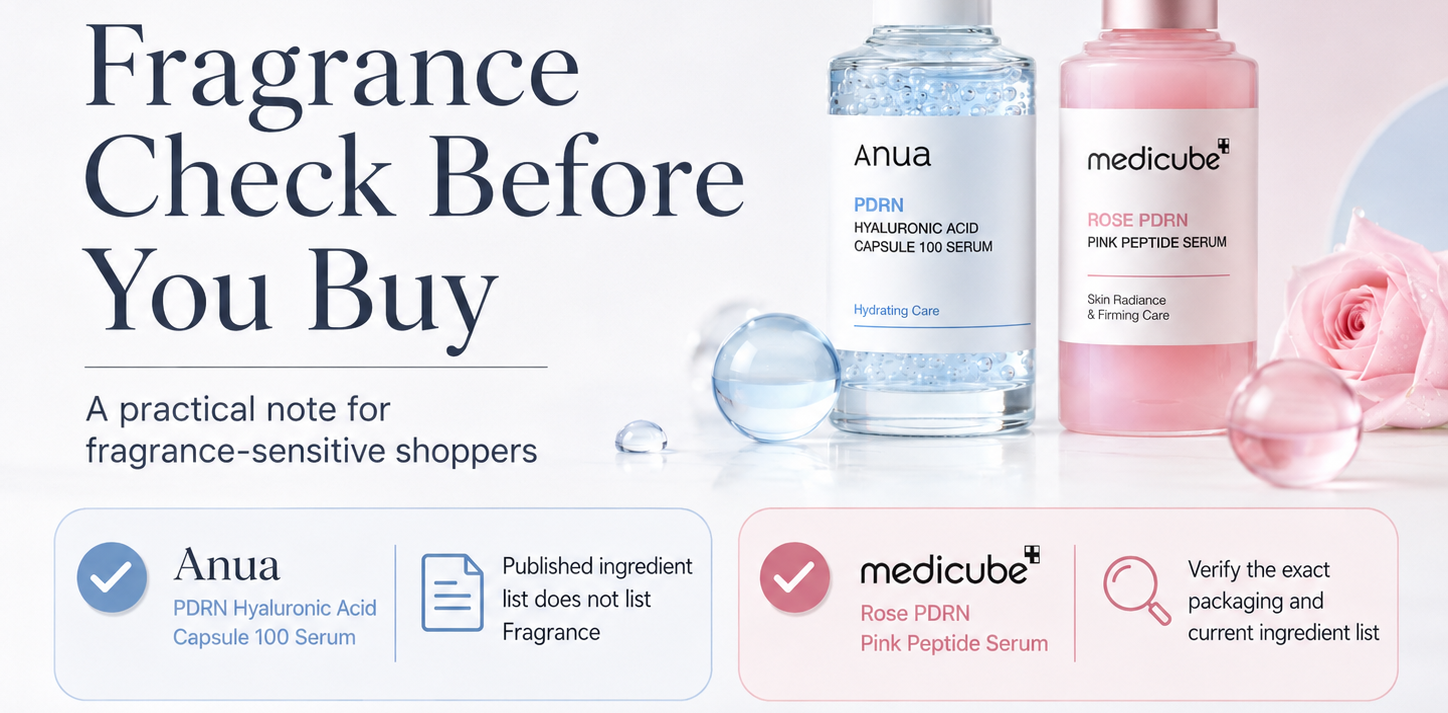
Anua’s current published ingredient list does not list Fragrance.
That is a meaningful practical difference for fragrance-sensitive shoppers.
What About Acne-Prone Skin?
Anua currently reports that its serum has undergone non-comedogenic testing.
Medicube’s current ingredient lists also place Isopropyl Myristate relatively high in both the Salmon and Rose formulas.
That does not mean Medicube will cause breakouts for everyone.
Ingredient behavior depends on the entire formula and the individual using it.
However, acne-prone shoppers who already know their skin reacts poorly to richer ester-based formulas may want to patch test first.
And remember:
“Non-comedogenic” does not mean a product is guaranteed never to cause a breakout.
Which Has the Better Texture?
Both brands position these serums as lightweight enough for regular use.
Anua calls its capsule-serum system fast-absorbing and lightweight.
Medicube describes its serum as lightweight and highly moisturizing.
We have not conducted our own controlled hands-on comparison of these exact products.
So we are not going to invent sensory claims such as:
“Medicube is definitely stickier.”
or:
“Anua absorbs twice as fast.”
Those kinds of claims require actual side-by-side use.
For this comparison, our conclusions are based on published formulas, official product information and available evidence, not fabricated personal experience.
Is Medicube Better Value?
At the brand-site prices checked on August 21, 2026:
Anua: $30 / 30 mL
Medicube: $26 / 30 mL
So Medicube currently has the lower listed purchase price.
But the difference is only $4 at the prices checked.
Promotions, bundles, retailer sales and subscription discounts can change that comparison quickly.
Check the current price on the day you purchase.
A small price difference should not override a major formula preference.
Who Should Buy Anua PDRN?
Choose Anua PDRN Hyaluronic Acid Capsule 100 Serum if:
- Hydration is your first priority
- You want a formula built heavily around multiple forms of hyaluronic acid
- Moisture plumping and a dewy appearance are key goals
- Non-comedogenic testing matters to you
- You want a current published ingredient list without
Fragrance - You prefer the more hydration-centered formula architecture
Anua identifies the serum’s Sodium DNA as salmon DNA-derived, so this serum should not be considered vegan.
The current ingredient list also contains hydrolyzed collagen.
Who Should Buy Medicube PDRN?
Choose Medicube PDRN Pink Peptide Serum if:
- You want PDRN plus a prominent peptide complex
- Niacinamide is an ingredient you actively want
- Dullness or uneven-looking tone is a priority
- You prefer a broader multi-active formula
- You want the choice between Salmon DNA PDRN and the brand’s Rose PDRN (Vegan) option
- Its current lower brand-site price appeals to you
If fragrance avoidance is important, verify the exact product packaging because the current U.S. product page contains the discrepancy discussed above.
Our Verdict: Anua PDRN vs Medicube PDRN
There is no universal winner.
Best Formula Direction for Hydration: Anua
Anua has the more hydration-centered formula architecture, with PDRN positioned alongside numerous hyaluronic-acid forms and collagen.
Best Multi-Active Direction: Medicube
Medicube has the more explicitly multi-active, peptide-focused formula, combining PDRN with niacinamide and several peptides.
Lowest Current Brand-Site Price: Medicube
At the prices checked on August 21, 2026, Medicube is $26 versus Anua at $30.
For Fragrance Avoidance: Anua Has the Clearer Current INCI
Anua’s current published ingredient list does not list Fragrance.
Medicube’s current U.S. page should be verified against the exact packaging because its fragrance-related marketing text and ingredient lists do not currently match.
Which Has Better PDRN?
We cannot establish that from the information currently available.
Neither brand provides enough directly comparable technical data and direct clinical testing to prove that the PDRN in one serum delivers scientifically superior performance.
That is the most important conclusion.
Can You Use Anua or Medicube PDRN With Retinol?
Potentially.
Neither serum should automatically be treated as incompatible with a retinol routine.
But adding several unfamiliar active products at the same time can make it difficult to identify the cause if irritation develops.
If you already use retinol:
- Keep your existing routine stable.
- Introduce the new serum gradually.
- Monitor how your skin responds.
- Reduce frequency or stop if persistent irritation develops.
We also would not claim that either Anua or Medicube has been clinically proven to prevent retinol irritation.
Read our PDRN vs retinol evidence comparison for a closer look at what topical PDRN research actually shows.
Frequently Asked Questions
Is Anua PDRN Better Than Medicube PDRN?
Not universally.
Anua has the more hydration-centered formula architecture.
Medicube has the more explicitly multi-active formula with niacinamide and multiple peptides.
The better choice depends on your goal and tolerance.
Which Is Better for Dry or Dehydrated Skin?
Anua is our formula-based pick for hydration-first routines.
Its formula places particular emphasis on multiple forms of hyaluronic acid alongside PDRN and collagen.
Medicube is also positioned as moisturizing, so this is not evidence that Anua will hydrate every person’s skin more effectively.
Which Is Better for Dull-Looking Skin?
Medicube is our formula-based pick if you specifically want PDRN alongside niacinamide and multiple peptides in a broader glow-and-firmness formula.
Which Is Better for Sensitive Skin?
There is no universal sensitive-skin winner.
Both brands make low-irritation-related claims.
Fragrance-sensitive shoppers should pay particular attention to the Medicube labeling discrepancy discussed above and verify the exact packaging before use.
Is Anua PDRN Vegan?
No.
Anua states that the product’s Sodium DNA is salmon DNA-derived.
The current ingredient list also contains hydrolyzed collagen.
Is Medicube PDRN Vegan?
It depends on the version.
Medicube offers a Salmon DNA PDRN version and separately markets another option as Rose PDRN (Vegan).
Do not assume the two PDRN sources have identical independent clinical evidence simply because they share the PDRN label.
Which Serum Has More PDRN?
There is no sufficiently standardized brand-page information to make a scientifically meaningful direct comparison.
Retailer ppm claims alone do not establish which finished formula provides better usable topical PDRN performance.
Is Medicube Cheaper Than Anua?
At the brand-site prices checked on August 21, 2026, yes.
Medicube was listed at $26 and Anua at $30.
Prices can change.
Does Medicube Contain Fragrance?
The current Medicube U.S. page is internally inconsistent.
Its FORMULATED WITHOUT section includes fragrances, while the ingredient lists currently displayed for both Salmon and Rose versions contain Fragrance.
If this matters to you, check the exact package before purchasing.
Did the 2026 PDRN Study Test Anua or Medicube?
No.
The 2026 study tested a specific experimental 0.1% PDRN-850K eye cream against a 0.1% retinol eye cream.
It did not test either retail serum.
Bottom Line
If you are choosing between Anua PDRN vs Medicube PDRN, do not start with which brand is more viral.
Start with what you want the rest of the formula to do.
Choose Anua if your priority is a hydration-centered PDRN serum built around multiple forms of hyaluronic acid, collagen and a dewy finish.
Choose Medicube if you want a more multi-active formula combining PDRN with niacinamide and a larger visible peptide complex.
But neither product currently provides enough directly comparable technical PDRN information or direct clinical testing to prove that its PDRN is scientifically superior.
The better choice depends on:
- Your main skin goal
- Formula tolerance
- Fragrance preference
- Breakout history
- Current price
- The exact product version you are buying
That answer may be less exciting than declaring one viral serum the winner.
But it is a much more useful way to choose skincare.
Product information, formulas and U.S. brand-site prices last checked: August 21, 2026.
Prices, ingredient lists, product versions and brand claims can change. Always check the current product packaging before purchasing. This article is for educational purposes and is not medical advice.
References
- Anua US. PDRN Hyaluronic Acid Capsule 100 Serum.
- Anua US. Environmental Info — PDRN Hyaluronic Acid Capsule 100 Serum 30ml.
- Medicube US. PDRN Pink Peptide Serum.
- Ye R, Wang Q, Du L, Li L, Hu F. Topical medium-length PDRN enhances dermal extracellular matrix repair in photodamaged skin via PI3K–Akt/TGF-β–regulated pathways. PLOS ONE. 2026;21(7):e0350905.