NAD+ skincare has moved quickly from longevity research language into K-beauty.
In 2026, NAD+-related ingredients are appearing in serums, creams, and treatment-style products, including formulas that combine NAD-related positioning with ingredients such as PDRN.
The biology behind NAD+ is real.
The skincare conclusions are less simple.
NAD+ is essential to cellular energy metabolism and is also used by enzymes involved in processes such as DNA repair and cellular stress responses.
But that does not mean every cosmetic labeled “NAD+” has been shown to raise NAD+ levels inside human skin or reverse visible skin aging.
The more useful question is:
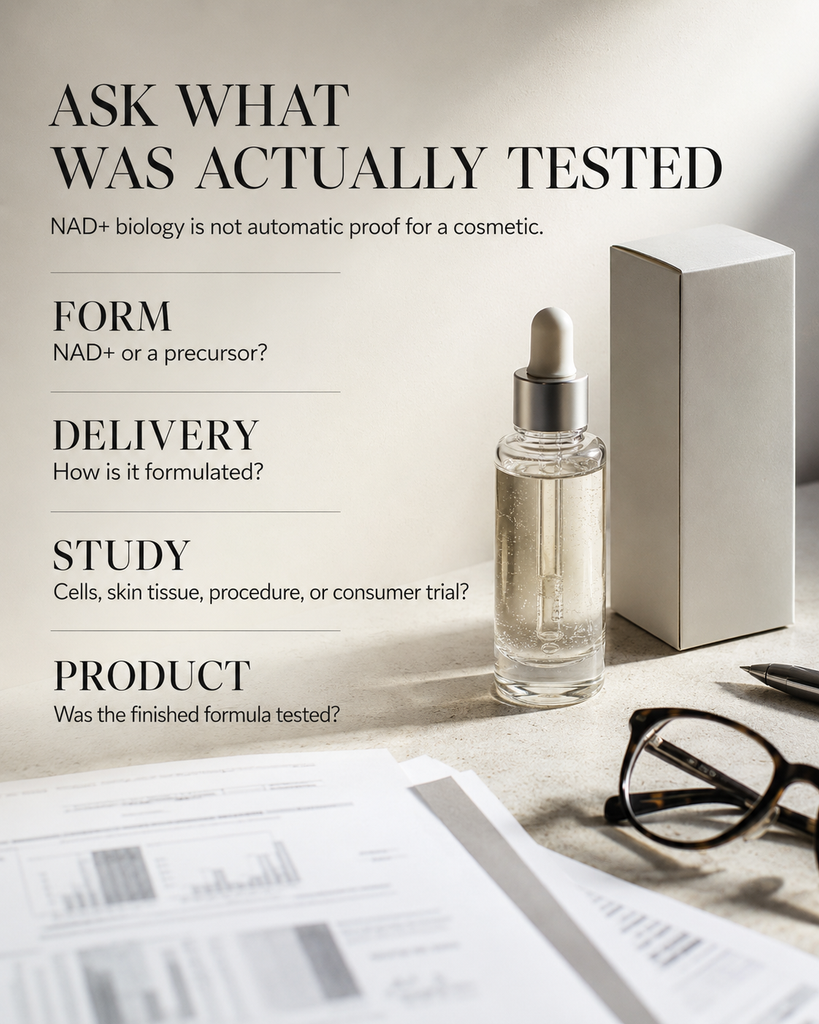
What form is in the product, how is it delivered, and what was actually tested?
That distinction matters more than the trend itself.
Quick Answer: What Is NAD+ Skincare?
NAD+ stands for nicotinamide adenine dinucleotide.
It is a coenzyme involved in cellular metabolism and multiple NAD+-dependent biological processes.
In skincare, NAD-related positioning may refer to:
- NAD+ itself
- NAD+ precursors such as NMN or NR
- proprietary NAD+-related complexes
- encapsulated or lipid-based delivery systems
- formulas combining NAD-related ingredients with PDRN, peptides, retinoids, or other actives
These should not automatically be treated as interchangeable.
Early laboratory and skin-tissue research makes topical NAD+ delivery scientifically interesting.
However, evidence for ordinary consumer NAD+ skincare is still developing.
The most important rule for shoppers is:
Do not treat NAD+ biology as automatic proof for an NAD+ cosmetic.
What Does NAD+ Actually Do?
NAD+ exists naturally in living cells.
It participates in redox reactions that help cells convert nutrients into usable energy.
It also acts as a substrate for enzymes involved in processes including:
- DNA repair
- cellular signaling
- stress responses
- mitochondrial function
- sirtuin activity
This is one reason NAD+ has become important in aging research.
But there is a major distinction between:
NAD+ being important inside a cell
and
a cosmetic successfully delivering NAD+ to relevant skin tissue in a way that produces a meaningful visible benefit.
Those are separate questions.
How Does NAD+ Metabolism Change With Age?
Age-related changes in NAD+ metabolism have been reported in some tissues and experimental systems.
However, the pattern is not identical across all tissues, people, or conditions.
A scientific review examining the common claim that NAD+ universally declines with age concluded that human evidence remains limited and tissue-specific.
That matters because the familiar phrase:
“NAD+ declines with age”
can become much broader in skincare marketing than the underlying evidence supports.
Even if age-related NAD+ changes are biologically important, that does not establish that applying an NAD+ cosmetic restores youthful cellular function in human skin.
This is another reason broad longevity claims should not be transferred directly to a topical serum.
NAD+ vs NMN vs NR vs Niacinamide
These names are often grouped together in longevity and skincare marketing.
They are not the same ingredient.
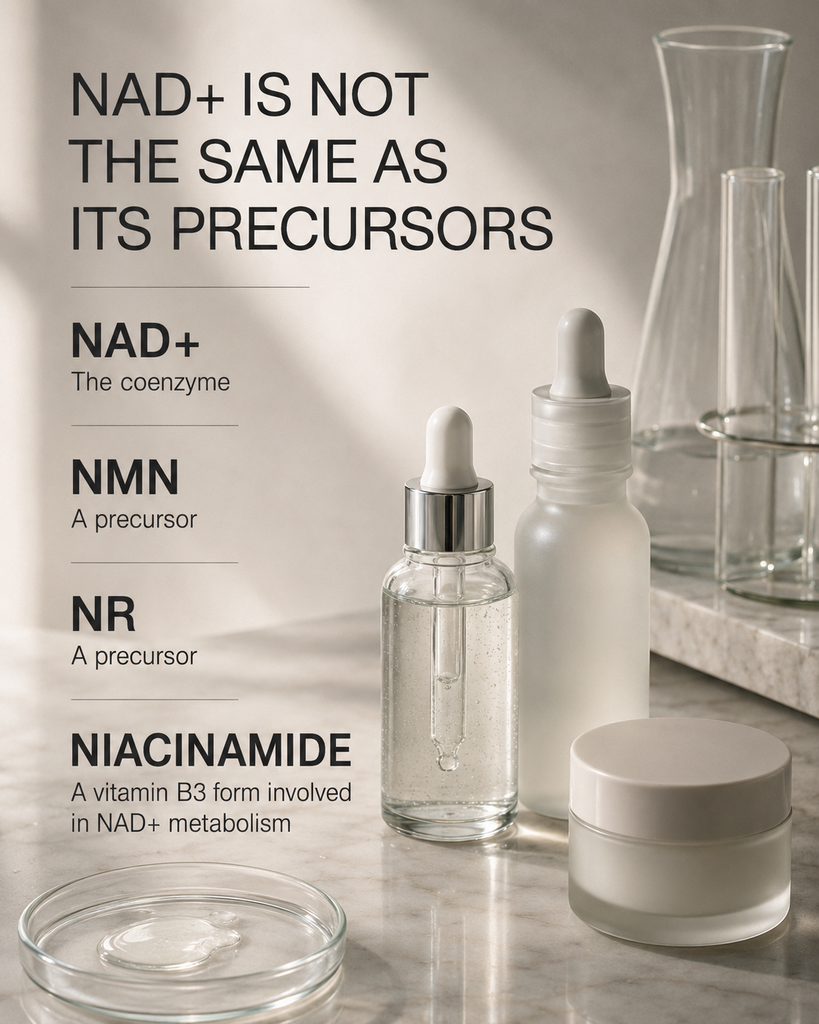
NAD+
Nicotinamide adenine dinucleotide is the coenzyme itself.
NMN
Nicotinamide mononucleotide is a precursor involved in NAD+ biosynthesis.
NR
Nicotinamide riboside is another NAD+ precursor.
Niacinamide
Niacinamide, also called nicotinamide, is a vitamin B3 form that participates in NAD+ metabolism.
Niacinamide also has a much longer history of topical skincare use than direct NAD+.
This creates an important evidence rule:
Research on one NAD+-related ingredient should not automatically be assigned to another.
An NMN study is not automatically an NAD+ study.
An NR study is not automatically an NMN study.
And established niacinamide research does not prove a direct NAD+ serum works the same way.
The ingredient form matters.
So does the delivery system.
Why Is NAD+ Suddenly Appearing in K-Beauty?
The rise of NAD+ fits a broader move from conventional “anti-aging” language toward skin longevity.
Instead of discussing only wrinkles, brands increasingly use concepts such as:
- cellular energy
- resilience
- recovery
- senescence
- longevity pathways
- mitochondrial function
NAD-related language has now entered commercial K-beauty.
MISSHA currently markets a PDRN NAD collection in the United States that includes a serum, cream, and peel-style product.
That is useful evidence that the trend has moved from research discussion into consumer skincare.
It is not evidence that the collection has been clinically proven to deliver all of the biological effects associated with NAD+.
Its existence also does not prove synergy between PDRN and NAD-related ingredients.
Brand pages can confirm:
- what products are being sold
- how they are positioned
- what ingredients or proprietary systems the brand describes
They should not be treated as independent efficacy evidence.
The Biggest Problem With Topical NAD+: Delivery
This is where NAD+ skincare becomes more interesting.
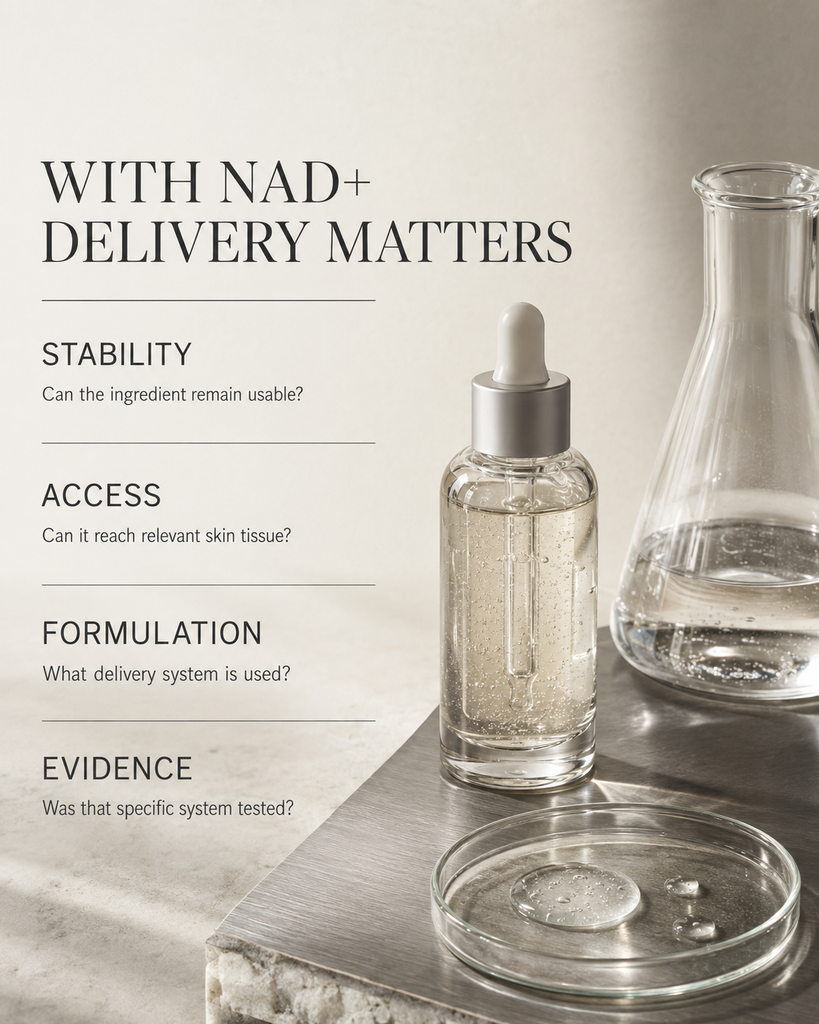
Researchers have identified stability and tissue accessibility as challenges for delivering NAD+ through skin.
That means seeing NAD+ on an ingredient list does not answer the most important question:
Does meaningful NAD+ reach relevant skin tissue?
In 2026, researchers from LG Household & Health Care, GIST, and collaborating institutions published a study of an ion-coupled NAD+ transfersome platform called ICoN.
The 2026 Materials Today Bio study was supported in part by LG Household & Health Care R&D Center and included multiple company-affiliated researchers.
That financial and employment relationship matters when interpreting the commercial relevance of the findings.
It does not make the research invalid.
But the findings should be read as promising research on a specific delivery platform, not independent proof for every NAD+ cosmetic.
The ICoN system was designed to improve NAD+ stability and tissue delivery.
Researchers reported improved NAD+ access in porcine and human skin explants compared with free NAD+ or precursor conditions, along with changes in several experimental markers associated with cellular stress and senescence.
That is meaningful formulation research.
But it is evidence for ICoN, not for the entire NAD+ skincare category.
What Does the 2026 ICoN Study Actually Show?
The ICoN study used several experimental systems, including:
- cultured cells
- porcine skin explants
- human skin explants
- UV-stressed skin models
- transcriptomic analysis
- C. elegans experiments
Researchers reported improved tissue-accessible NAD+ and changes in biological signatures associated with cellular stress and senescence.
What Is a Human Skin Explant?
Human skin explants are pieces of human skin studied outside the body.
That distinction is critical.
They are more biologically relevant to real skin than a simple isolated cell experiment.
But they are not a clinical trial of people applying a retail skincare product at home.
Seeing the words “human skin” in a study does not automatically mean a human consumer trial was performed.
What the ICoN Study Does Not Prove
It does not establish that:
- every NAD+ serum penetrates human skin effectively
- a conventional water-based serum behaves like ICoN
- every liposome or encapsulation system works the same way
- every proprietary NAD+ complex uses the studied technology
- an ordinary cosmetic reverses visible aging in consumers
- a retail product produces clinically meaningful wrinkle reduction
A useful evidence progression is:
Cell study → skin-tissue study → human-use study → controlled finished-product clinical trial
The closer the evidence gets to real consumers using the actual product in the intended way, the stronger the consumer conclusion becomes.
What About Human NAD+ Skin Studies?
There is early human research involving NAD+ and skin.
A 2026 study published in Aesthetic Plastic Surgery examined NAD+ in the treatment of melasma.
The study involved 36 Korean women and followed participants for 21 weeks.
Participants received repeated microneedling sessions followed by topical application of a sterile NAD+ booster.
The researchers reported a reduction in mean Melasma Area and Severity Index, or MASI, from 16.8 at baseline to 6.9 at week 21—a reported 59.2% improvement.
That result sounds impressive.
The treatment context is just as important as the number.
This was a prospective single-center case series using:
microneedling + sterile NAD+ booster
It was not a randomized trial of an ordinary retail NAD+ serum used on intact skin.
The researchers themselves called for future controlled studies.
The study also examined melasma management.
It did not establish NAD+ as a general daily anti-aging treatment.
So this conclusion would be misleading:
“A NAD+ serum reduced skin aging by 59.2%.”
That is not what the study tested.
The appropriate evidence rule is:
Microneedling + sterile NAD+ treatment ≠ an at-home NAD+ serum.
Is There Evidence for Direct NAD+ on Skin Cells?
Yes.
But much of it remains preclinical.
A 2024 study published in Cells investigated exogenous NAD+ using human fibroblast models and examined experimental systems related to intrinsic and UV-associated cellular aging.
Researchers reported biological effects connected with mechanisms including mitochondrial function and sirtuin-related pathways.
However, the study was conducted primarily in vitro.
Several authors were affiliated with LG Household & Health Care, and the study was funded by LG H&H.
This type of research is useful for understanding:
- biological plausibility
- cellular mechanisms
- formulation concepts
- future research directions
It does not establish:
- clinical wrinkle reduction
- skin tightening in consumers
- superior performance versus retinoids
- effectiveness of every retail NAD+ serum
What About NMN Research?
NMN research is another reason consumers need to separate NAD-related terms.
A 2025 study of NMN in human skin fibroblasts reported changes in cellular NAD+ levels, mitochondrial function, stress responses, and other experimental aging-related pathways.
But that research involved NMN.
It should not be converted into evidence for direct NAD+.
The study was also an in-vitro fibroblast study rather than a clinical cosmetic trial.
The broader point is simple:
NAD+ and its precursors may interact with related metabolic pathways, but their skincare evidence is not interchangeable.
Does NAD+ Skincare Increase Collagen?
This claim requires caution.
NAD+-dependent metabolism can influence pathways connected with fibroblast function and cellular homeostasis.
Some experimental research also examines extracellular-matrix and collagen-related pathways.
But that does not mean every topical NAD+ cosmetic has clinically demonstrated increased collagen production in human users.
If a finished product improves the appearance of firmness, that effect may also be influenced by:
- hydration
- humectants
- emollients
- peptides
- film-forming ingredients
- silicones
- other actives in the formula
Do not automatically assign every visible benefit of a multi-ingredient product to NAD+.
Can NAD+ Skincare Reverse Skin Aging?
That wording outruns the current consumer evidence.
Terms such as:
- age reversal
- reverse aging
- cellular rejuvenation
- cellular reset
- longevity activation
sound powerful because NAD+ is connected to legitimate aging research.
But skincare evidence should be judged by what was actually measured.
Ask:
Was this a human cosmetic trial?
Was the finished retail product tested?
Were wrinkles, elasticity, pigmentation, or another visible endpoint measured?
Was there a control group?
Was the product applied to intact skin?
Or was a procedure used to enhance delivery?
Without those distinctions, biological research can be turned into a much stronger cosmetic claim than it supports.
Does Delivery Technology Matter More Than NAD+ Percentage?
It can matter substantially.
A large percentage printed on a package looks impressive.
But concentration alone does not tell you:
- stability
- bioavailability
- tissue accessibility
- release profile
- chemical form
- delivery efficiency
- finished-product performance
This is especially important for NAD+ because delivery itself is a major formulation question.
A more useful question is:
Percentage of what, delivered how?
A lower amount in one delivery platform could theoretically behave differently from a larger amount in another formula.
But the opposite mistake should also be avoided.
A proprietary delivery system is not automatically clinically superior simply because it has a scientific-sounding name.
The delivery system itself needs evidence.
What Does “NAD+ Complex” Mean?
There is no single universal cosmetic formula called an NAD+ complex.
Depending on the brand, the phrase may refer to:
- direct NAD+
- NAD+ combined with other ingredients
- an NAD+ precursor
- encapsulated NAD+
- fermented materials
- proprietary blends
- several longevity-positioned ingredients grouped together
Two products that display NAD prominently on the front label may therefore use very different systems.
Before comparing percentages or marketing claims, identify:
- the actual NAD-related ingredient
- the delivery technology
- supporting actives
- directions for use
- evidence for the finished formula
Why Are K-Beauty Brands Pairing PDRN and NAD+?
PDRN and NAD+ currently fit into the same larger regenerative and skin-longevity marketing trend.
But they are not the same ingredient.
PDRN generally refers to DNA-derived materials or newer PDRN-branded cosmetic ingredient systems.
NAD+ is a cellular coenzyme.
Their:
- biological roles
- raw materials
- evidence
- formulation challenges
- terminology
are different.
If you are unfamiliar with PDRN, start with our guide to what PDRN skincare is before assuming that PDRN + NAD+ represents one standardized anti-aging technology.
A cosmetic containing both may still be a useful formula.
But the combination itself does not prove synergy unless the actual combination has been tested.
NAD+ vs PDRN: Which Has Better Evidence?
There is no clean one-word winner.
Both categories suffer from a similar evidence problem:
The scientific literature often studies something different from the exact consumer cosmetic sitting on the shelf.
For PDRN, evidence may involve:
- medical PDRN
- injectable treatments
- wound-healing models
- specific topical formulations
For NAD+, evidence may involve:
- basic NAD+ biology
- precursors such as NMN or NR
- specialized delivery platforms
- cells
- skin explants
- microneedling procedures
The useful question is therefore not:
Which ingredient has more impressive biology?
It is:
Which finished product has evidence relevant to how you plan to use it?
NAD+ vs Retinol
NAD+ skincare and retinoids should not currently be treated as evidence-equivalent anti-aging categories.
Topical retinoids have decades of dermatologic use and substantially more direct human evidence relating to photoaging and skin structure.
NAD+ skincare is newer.
Its current scientific interest comes mainly from:
- cellular biology
- formulation research
- delivery technology
- early skin-tissue evidence
- limited early human procedural evidence
That makes NAD+ worth watching.
It does not make it a proven replacement for retinoids.
For a broader comparison involving another regenerative skincare category, see our PDRN vs retinol guide.
Can You Use NAD+ and Retinol Together?
Potentially.
But the answer depends on the finished formulas.
NAD+ itself should not be assumed to behave like retinol simply because both are marketed for aging concerns.
An NAD+-positioned product may also contain:
- retinoids
- exfoliating acids
- vitamin C derivatives
- fragrance
- peptides
- other treatment ingredients
Check the entire ingredient list.
If your NAD+ product already contains retinol, adding another retinoid may unnecessarily duplicate an active.
If you are introducing multiple treatments, change one product at a time.
Is NAD+ Skincare Good for Sensitive Skin?
There is no universal answer.
“NAD+” on the front label does not tell you whether the finished product will suit reactive skin.
Evaluate:
- fragrance
- exfoliating acids
- retinoids
- supporting botanicals
- alcohol content
- texture
- frequency
- directions
The hero ingredient is only one part of the formula.
A product marketed around skin longevity can still contain ingredients your skin does not tolerate.
How Do You Use NAD+ Skincare?
Follow the directions for the finished product.
A simple serum-style NAD+ cosmetic will often fit before moisturizer.
For example:
Cleanse → optional toner or essence → NAD+ serum → moisturizer
Morning routines should finish with sunscreen.
But NAD-related products can also appear as:
- creams
- ampoules
- eye products
- peel-style treatments
- retinol combinations
So the word NAD+ does not determine routine placement.
For a full layering framework, see our Korean skincare routine order guide.
How Often Should You Use NAD+ Skincare?
There is no universal NAD+ frequency.
A simple serum may be formulated for daily use.
A product containing retinoids, exfoliating ingredients, or other stronger actives may require a slower introduction.
Use frequency should depend on:
- the finished product’s directions
- the rest of the formula
- the other treatments in your routine
- your skin’s tolerance
Do not choose frequency based on NAD+ marketing alone.
How to Shop for NAD+ Skincare
Ready to compare actual formulas? See our best NAD+ Korean skincare products guide to compare NAD+ formats, supporting actives, prices, and who each product may suit.
1. Identify the Actual NAD-Related Ingredient
Is the product using:
- NAD+
- NMN
- NR
- niacinamide
- a proprietary complex
Do not treat them as synonyms.
2. Ask About Delivery
Does the company explain how the ingredient is stabilized or delivered?
A delivery claim is not proof.
But with NAD+, delivery is a legitimate scientific question.
3. Identify the Study Type
Was the evidence based on:
- isolated cells
- skin tissue outside the body
- a procedure
- consumers applying the cosmetic normally
Those are very different evidence levels.
4. Look for Finished-Product Evidence
The strongest product evidence is evidence generated on the product you are actually considering.
Useful questions include:
- How many people participated?
- Was there a control or comparator?
- How long was the study?
- What was actually measured?
- Was the tested product identical to the one being sold?
- Was the study brand-sponsored?
5. Read the Full Formula
An NAD+ serum may produce much of its immediately visible cosmetic effect through familiar ingredients such as:
- glycerin
- hyaluronic acid
- niacinamide
- peptides
- emollients
- silicones
That does not make it a bad product.
It means the product should be evaluated as a finished formula, not as one hero ingredient.
6. Be Skeptical of Longevity Language That Outruns the Data
Claims such as:
- cellular reset
- DNA rejuvenation
- reverse aging
- age reversal
deserve scrutiny.
Ask:
What was actually measured?
Is NAD+ Skincare Worth Trying?
Possibly—if you understand what you are buying.
NAD+ is not a scientifically meaningless trend.
There is legitimate biological rationale and increasingly sophisticated research into topical delivery.
But consumer cosmetic evidence is still much younger than the marketing language surrounding the category.
NAD+ skincare may make sense for someone who:
- enjoys emerging skincare technology
- understands that the evidence is still developing
- evaluates the complete formula
- does not expect a cosmetic to reproduce an IV or procedure
- does not replace better-established skincare basics with a longevity trend
It makes much less sense if the only reason for buying it is a promise of “cellular age reversal.”
What Matters More Than NAD+?
For most routines:
- sunscreen
- tolerable cleansing
- adequate moisturization
- appropriate evidence-based treatment for a real skin concern
still matter more than owning the newest longevity ingredient.
NAD+ can be an optional skincare category.
It is not a replacement for the basics.
The Bottom Line
NAD+ skincare is one of the most interesting emerging K-beauty ingredient trends of 2026.
The underlying biology is scientifically important.
The delivery challenge is real.
And recent research suggests that a specifically engineered delivery platform can improve NAD+ access to skin tissue in experimental models.
But that is not the same as proving every NAD+ serum works.
Remember the evidence chain:
NAD+ biology ≠ topical delivery
Topical delivery ≠ clinical benefit
One proprietary delivery study ≠ proof for every NAD+ cosmetic
Microneedling + NAD+ ≠ an at-home NAD+ serum
The smartest way to judge the trend is not to ask whether NAD+ sounds scientifically impressive.
Ask:
What form was used, how was it delivered, and what was actually tested?
NAD+ is scientifically interesting, but the most important question is not whether NAD+ sounds impressive—it is what form was used, how it was delivered, and what was actually tested.
Frequently Asked Questions
What Is NAD+ in Skincare?
NAD+ is nicotinamide adenine dinucleotide, a coenzyme involved in cellular metabolism and multiple NAD+-dependent biological processes.
Cosmetics may use direct NAD+ or different NAD-related ingredients and proprietary systems, so products should not be assumed to be equivalent.
Does NAD+ Skincare Work?
Early laboratory and skin-tissue research is scientifically interesting, especially for specialized delivery approaches.
However, current evidence does not justify assuming that all retail NAD+ skincare produces the same biological or visible effects.
Can NAD+ Penetrate the Skin?
Delivery is a major formulation challenge.
A 2026 study demonstrated improved tissue access using a specialized ion-coupled transfersome system.
That does not establish equivalent penetration for every conventional NAD+ serum.
Is Human Skin Explant Research a Human Clinical Trial?
No.
A human skin explant is human skin tissue studied outside the body.
It can provide useful tissue-level evidence, but it is not the same as consumers applying a retail skincare product in a clinical trial.
Is NAD+ the Same as NMN?
No.
NMN is a precursor involved in NAD+ biosynthesis.
NMN evidence should not automatically be assigned to direct NAD+.
Is NAD+ the Same as NR?
No.
NR is another precursor involved in NAD+ metabolism.
It should be evaluated as its own ingredient.
Is NAD+ the Same as Niacinamide?
No.
Niacinamide is a vitamin B3 form involved in NAD+ metabolism and has a much longer history of topical cosmetic use.
Is NAD+ Better Than Retinol?
Current evidence does not support treating NAD+ as a proven replacement for retinoids.
Retinoids have substantially more direct human evidence for photoaging.
Is NAD+ Better Than PDRN?
There is no universal winner.
The categories differ in biology, formulation, delivery, and evidence.
Finished-product evidence matters more than trend-level comparisons.
Can I Use NAD+ With Retinol?
Potentially.
Check whether the NAD+ product already contains a retinoid or other potentially irritating actives and introduce new treatments gradually.
Can Sensitive Skin Use NAD+?
Possibly.
Tolerance depends on the entire formulation rather than NAD+ alone.
When Should I Use NAD+ Serum?
Most serum-style products will generally be used before moisturizer, but the directions for the specific finished product take priority.
Sources & References
- Ion-coupled transfersome complexes for enhanced transdermal NAD+ repletion and mitigation of cellular senescence signatures — Materials Today Bio, 2026
- Efficacy and Safety of a Topical Nicotinamide Adenine Dinucleotide Skinbooster for the Treatment of Melasma — Aesthetic Plastic Surgery, 2026
- Novel Approach to Skin Anti-Aging: Boosting Pharmacological Effects of Exogenous Nicotinamide Adenine Dinucleotide (NAD+) by Synergistic Inhibition of CD38 Expression — Cells, 2024
- Distinctive Gene Expression Profiles and Biological Responses of Skin Fibroblasts to Nicotinamide Mononucleotide — Biomedicines, 2025
- Age-Dependent Decline of NAD+—Universal Truth or Confounded Consensus? — Nutrients, 2022
- MISSHA PDRN NAD Collection — Official MISSHA U.S.