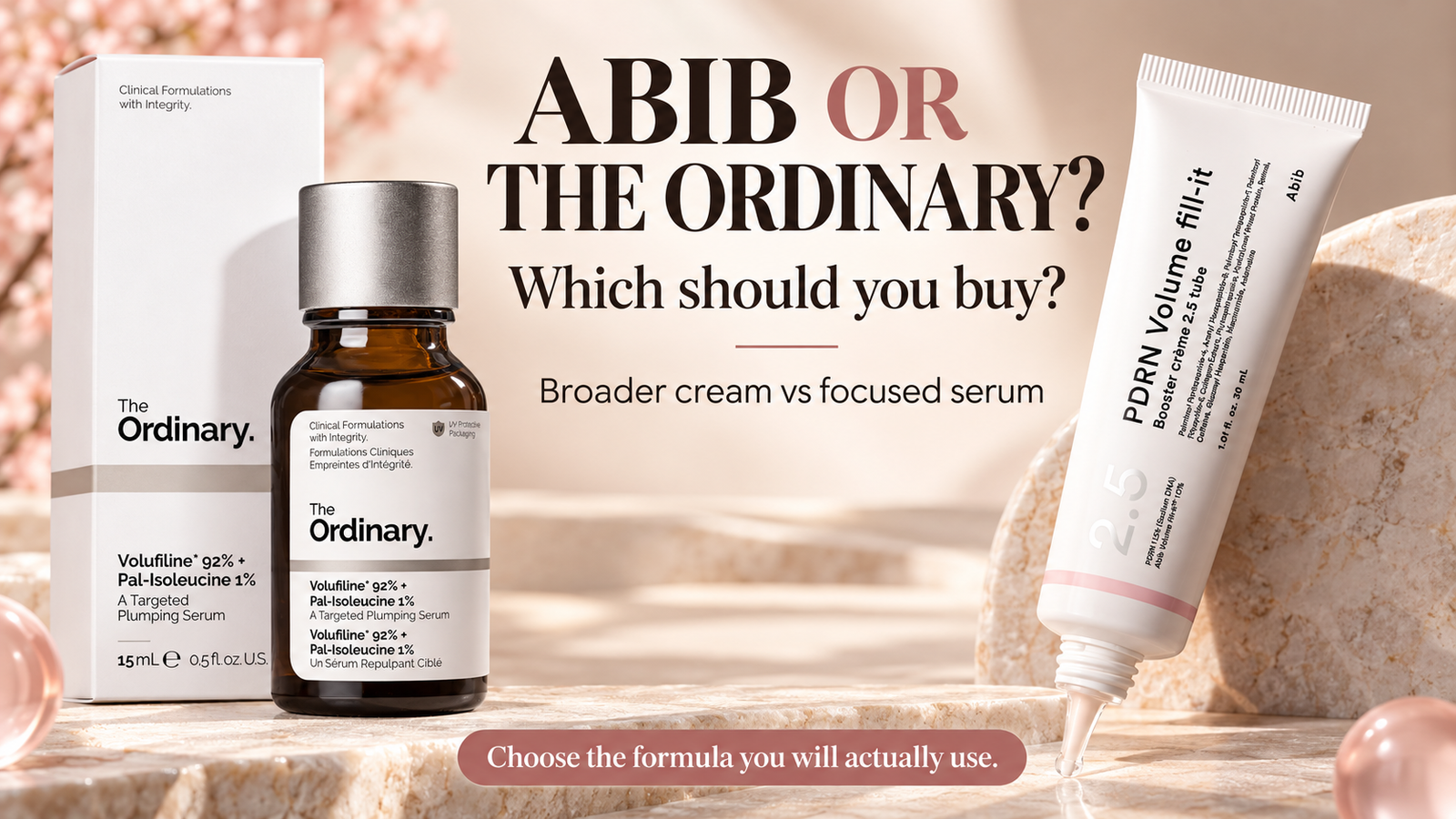
If you’re comparing Abib PDRN vs The Ordinary Volufiline, the numbers on the labels can make this look like an easy strength comparison.
It isn’t.
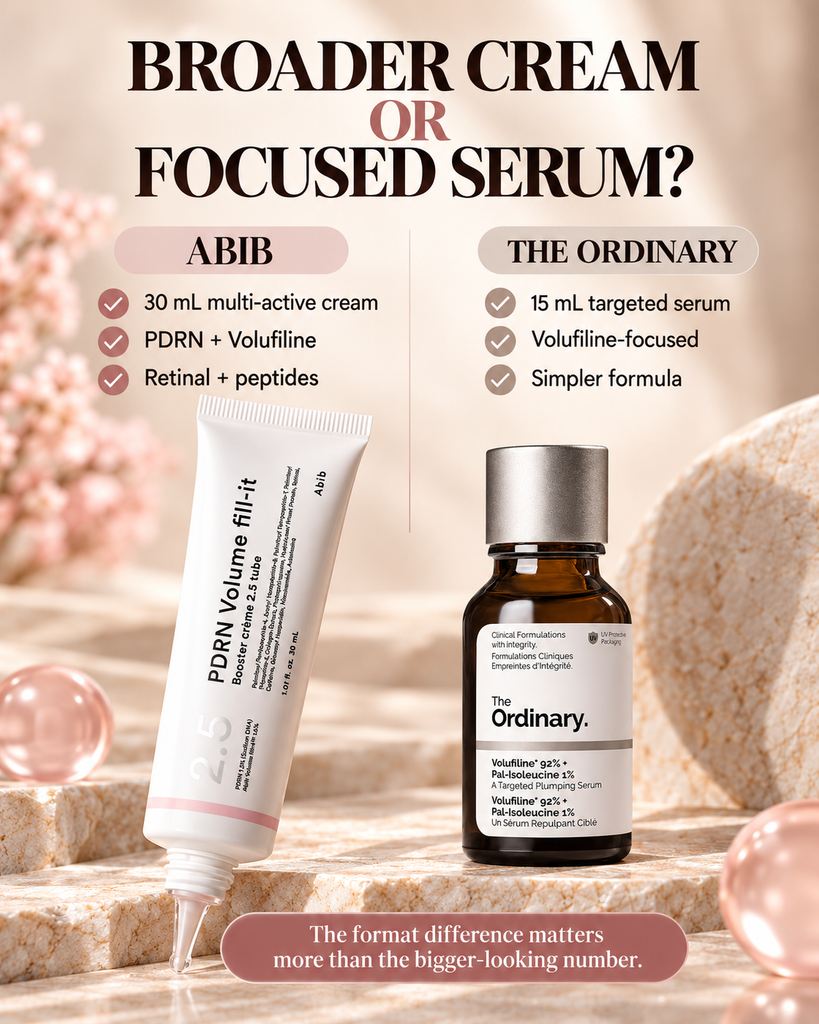
Abib gives you PDRN, Volufiline, retinal and peptides in a 30mL cream.
The Ordinary puts a much bigger Volufiline number on a 15mL targeted serum.
But the biggest number on the label is probably the least useful way to decide between them.
If I were standing at checkout choosing one, I would ask a simpler question:
Do I want a broader multi-active moisturizing cream, or do I specifically want to try a Volufiline-focused add-on?
That question separates these products much more clearly than 10,000ppm versus 92%.
As checked on October 8, 2026, Abib’s U.S. product page displayed a regular price of $28, a sale price of $23.80, and a sold-out status for the 30mL PDRN Volume Fill-It Booster Cream.
The Ordinary’s U.S. page listed Volufiline 92% + Pal-Isoleucine 1% at $21.40 for 15mL.
Those are official-site price snapshots. Amazon pricing, stock and sellers can differ.
Affiliate disclosure: This article contains affiliate links. If you buy through them, K-Beauty Clarity may earn a commission at no additional cost to you. As an Amazon Associate I earn from qualifying purchases.
Abib PDRN vs The Ordinary Volufiline: Quick Verdict
My buying logic is straightforward:
Choose The Ordinary if Volufiline itself is what you want to test.
Consider Abib if you prefer a broader cream formula that combines its Volufiline positioning with PDRN/Sodium DNA, retinal, niacinamide, caffeine, moisturizing ingredients and multiple peptides.
Neither product has evidence showing that it can recreate injectable filler or reliably rebuild lost facial volume.
And a larger Volufiline number does not automatically prove better visible results.
| Abib PDRN Volume Fill-It | The Ordinary Volufiline 92% | |
|---|---|---|
| Format | Multi-active cream | Targeted anhydrous serum |
| Size | 30mL | 15mL |
| Official U.S. price checked | $23.80 sale / $28 regular | $21.40 |
| Official-site status checked | Sold out | Add to cart |
| Volufiline disclosure | 10,000ppm | 92% |
| PDRN positioning | 15,000ppm brand disclosure; INCI includes Sodium DNA | No |
| Retinal | Yes | Not listed |
| Peptides | Multiple peptides | 1% Palmitoyl Isoleucine, not a multi-peptide blend |
| Best fit | Broader cream formula | Focused Volufiline add-on |
The important word in that table is disclosure.
The percentages and ppm figures are brand-published formulation numbers. They are not clinical-effect scores.
The 92% vs 10,000ppm Comparison Is Easy to Misread
On a simple concentration conversion, 10,000ppm equals 1%.
So it is tempting to look at:
The Ordinary: 92%
versus:
Abib: 10,000ppm
and decide that The Ordinary must be dramatically stronger.
That conclusion goes too far.
The Ordinary is disclosing 92% of the Volufiline ingredient system in its finished serum.
Volufiline itself is not 100% pure sarsasapogenin. Croda Beauty identifies the ingredient system as Hydrogenated Polyisobutene and Anemarrhenae Asphodeloides Root Extract.
Abib, meanwhile, publishes a 10,000ppm Volufiline figure for its finished cream.
Those numbers tell us something about how the brands formulate and position the products.
They do not establish:
- equivalent raw-material specifications
- equivalent delivery into facial skin
- pure sarsasapogenin concentration
- a proportional difference in visible results
- a 92-times difference in effectiveness
So I would not spend money based on the percentage alone.
For a deeper breakdown of why 5%, 50,000ppm, 92% and “100% Volufiline” can be misleading when compared without context, see our best Volufiline Korean skincare products guide.
What Are You Really Buying With Abib?
Abib’s PDRN Volume Fill-It Booster Cream is a 30mL multi-active cream, not a minimalist Volufiline concentrate.
The brand publishes:
- PDRN at 15,000ppm
- Volufiline at 10,000ppm
Its ingredient list also includes Sodium DNA, retinal, niacinamide, caffeine, squalane, Ceramide NP and multiple peptides.
That broader formula is the real reason I would consider Abib.
Not because more ingredients automatically mean better results.
And not because the cream has been proven to replace a dedicated retinoid, peptide serum or moisturizer.
The public ingredient list does not give us enough directly comparable concentration and performance data to make that claim.
The advantage is simpler than that:
Abib gives someone who prefers multi-active formulas several ingredient categories in one cream.
If your routine is already crowded with a retinoid, peptide serum, moisturizer and other targeted treatments, that may actually make Abib less attractive.
If you prefer a more consolidated routine and want a moisturizing cream with PDRN, Volufiline and retinal positioning in the same product, it becomes more interesting.
Abib also describes the finished formula as clinically tested for the appearance of wrinkles and firmness.
That should be read as brand-provided finished-product testing, not independent evidence that Abib is superior to The Ordinary or that Volufiline alone caused the results.
If PDRN is one of the main reasons you are considering Abib, read our guide to what PDRN skincare actually is before treating a PDRN number as a guarantee of performance.
What Are You Really Buying With The Ordinary?
The Ordinary takes the opposite approach.
Its current U.S. formula lists only seven ingredients:
- Hydrogenated Polyisobutene
- Caprylyl Glycol
- Polyglyceryl-3 Stearate
- Palmitoyl Isoleucine
- Anemarrhena Asphodeloides Root Extract
- Rhus Succedanea Fruit Wax
- Tocopherol
The product is water-free and built around a brand-disclosed 92% Volufiline ingredient system plus 1% Palmitoyl Isoleucine.
There is no PDRN story.
No retinal.
No long peptide blend.
No attempt to be a full-face moisturizer.
That narrower formula is exactly why The Ordinary makes sense if the question in your head is:
“I keep hearing about Volufiline. What is the most direct way to try a finished Volufiline-focused product?”
This is the cleaner experiment.
The Ordinary instructs users to shake the bottle well and apply it after moisturizer directly to the target areas.
It does not require mixing with an oil or another product.
The brand also advises patch testing, applying only to unbroken skin and stopping use if irritation occurs.
If you want the more detailed formula and evidence breakdown, see our The Ordinary Volufiline review.
Which Makes More Sense for Under-Eyes?
Both products are marketed for areas associated with visible lines or volume loss, including the under-eye region.
But this is where I would ignore TikTok-style “filler in a bottle” expectations.
True under-eye hollowness can involve anatomy that a cosmetic moisturizer or serum should not be assumed to reconstruct.
The practical difference is the formula.
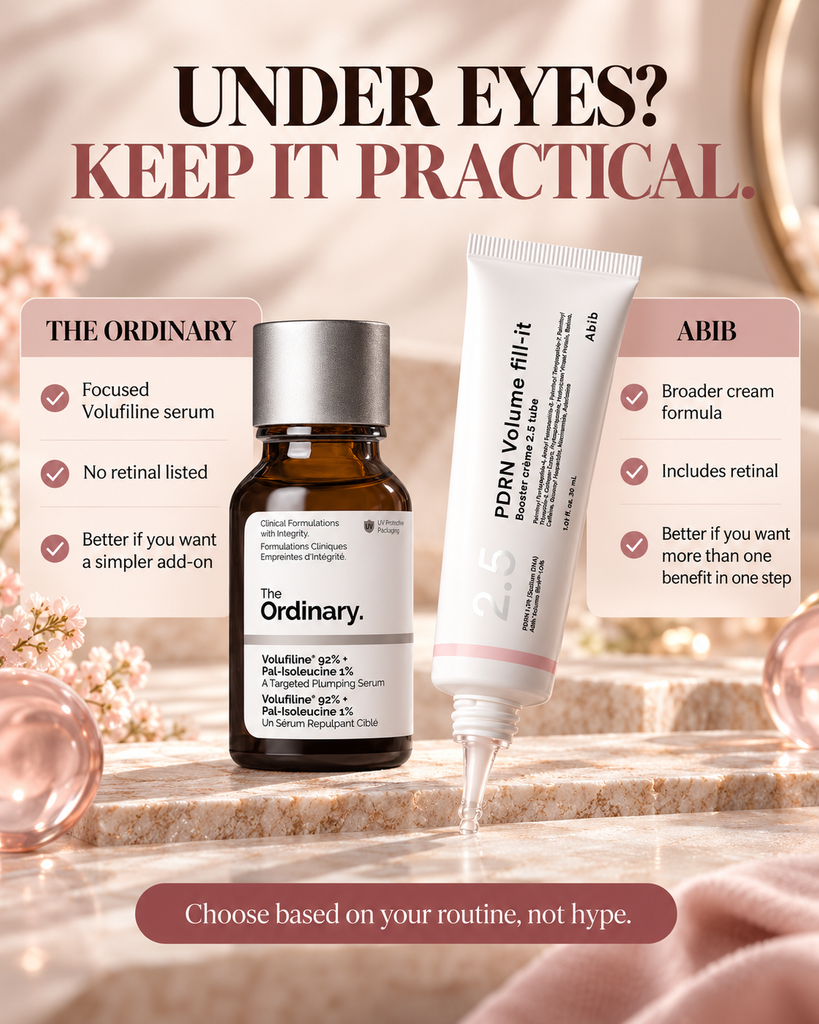
The Ordinary has fewer listed ingredients and no listed retinoid.
Abib contains retinal and a much broader ingredient mix.
That does not prove The Ordinary is safer or better tolerated around sensitive eyes.
A shorter ingredient list is not a tolerance study.
What it does mean is that The Ordinary makes it easier to keep your retinoid and other active steps separate.
With Abib, retinal is already part of the product.
If your eye area reacts easily, introduce either product cautiously and follow the exact label directions.
The Ordinary specifically advises patch testing and stopping use if irritation occurs.
What If You Already Use Retinol or Retinal?
This is one of the more practical reasons to separate the products.
If you already use a retinoid, The Ordinary does not add another listed retinoid to that targeted step.
Abib contains retinal.
That does not mean Abib cannot fit into a routine that already contains a retinoid.
It means you need to think about product overlap, placement and frequency rather than automatically layering everything because each ingredient sounds useful.
This is a formula-management issue, not proof that one combination is universally safe or irritating.
If I already had a retinoid routine I was happy with and only wanted to investigate Volufiline, The Ordinary would make more sense to me.
Which Makes More Sense for Smile Lines or the Neck?
Abib becomes more interesting when you want to use the product more broadly.
It is a 30mL cream rather than a 15mL targeted serum.
The formula is also designed to give you moisturizing and conditioning value beyond the Volufiline headline.
That makes it easier to justify for someone who wants one cream for several targeted areas.
But I would still avoid saying it “replaces” separate treatments.
The useful question is whether you actually want those ingredient categories in the same product.
If you do, Abib has the more logical format.
If you already love your moisturizer and treatment routine and just want to add Volufiline to selected areas, The Ordinary remains the more focused purchase.
Which Gives You Better Value?
This is where the current prices become interesting.
On October 8, 2026:
Abib: $23.80 displayed sale price for 30mL, down from $28, but sold out on the official product page.
The Ordinary: $21.40 for 15mL on the official U.S. site.
The displayed difference is only $2.40.
But I would not declare Abib the value winner simply because it gives you twice the nominal volume for slightly more money.
One is a cream.
One is a targeted anhydrous serum.
They are intended to be used differently.
The better value is the one whose role you actually need.
If you only want Volufiline, paying for Abib’s broader formula may add ingredients you were not looking for.
If you want a broader cream anyway, The Ordinary’s minimalist formula may leave you buying other products around it.
That is the kind of value comparison that matters after the first week of excitement is gone.
Where Should You Buy Them?
Abib’s official U.S. product page was sold out when checked on October 8, 2026.
Abib currently lists Amazon among its U.S. authorized retail channels, but that does not mean every marketplace seller is automatically authorized.
Before purchasing through Amazon, check the exact product, size, “Sold by” seller, fulfillment details and return terms.
Check the current Amazon listing for Abib PDRN Volume Fill-It Booster Cream →
The Ordinary was available on its official U.S. site when checked.
Amazon availability may differ by seller and date.
Check the current Amazon listing for The Ordinary Volufiline 92% →
Who Should Buy Abib?
Abib makes more sense if:
- you want a broader multi-active moisturizing cream
- you specifically like the idea of PDRN/Sodium DNA plus Volufiline
- retinal and peptides fit what you want from the formula
- you want a 30mL cream rather than a small targeted serum
- you would still see value in the cream even if Volufiline produces only a subtle visible effect
I would be less interested in Abib if I already had every one of those categories covered in a routine I liked.
More ingredients do not automatically make the purchase more necessary.
Who Should Buy The Ordinary?
The Ordinary makes more sense if:
- Volufiline itself is the reason you are shopping
- you want the higher brand-disclosed Volufiline-system percentage
- you prefer a short ingredient list
- you already have a moisturizer and treatment routine you like
- you want a targeted add-on rather than another multi-active cream
- you want to keep retinal or retinol out of this particular product
The smaller bottle makes more sense once you remember that the product is intended for targeted use rather than as a conventional all-over serum.
For another direct comparison involving this serum, see our Medicube vs The Ordinary Volufiline comparison.

Final Verdict: Abib or The Ordinary?
If I were buying specifically because I wanted to see whether a Volufiline-focused formula had a place in my routine, I would choose The Ordinary.
The formula is narrower, the reason for buying it is easier to define and it does not add another listed retinoid.
If I wanted a broader moisturizing cream and liked the combination of PDRN/Sodium DNA, Volufiline, retinal, niacinamide, caffeine, ceramide and peptides, I would consider Abib.
But I would not buy Abib because I believed more ingredients automatically made it stronger.
And I would not buy The Ordinary because 92% automatically means dramatically better visible results.
The most useful distinction is:
Abib = broader multi-active cream.
The Ordinary = focused Volufiline serum.
Neither product has established itself as a topical substitute for injectable filler.
Choose the finished formula you will actually use after the trend stops feeling new.
Sources & Product Verification
Abib — PDRN Volume Fill-It Booster Crème 2.5 Tube
The Ordinary — Volufiline 92% + Pal-Isoleucine 1%
Prices, stock, retailer listings and formulas can change. Product information and official-site prices were rechecked on October 8, 2026.