Spicules may sound like another futuristic K-beauty ingredient, but they are better understood as a skincare delivery technology.
They are microscopic, needle-like structures used in some topical formulas to physically interact with the outer layers of the skin.
You may have seen products containing them described as “liquid microneedling,” “micro-needle skincare,” or through names such as Reedle Shot.
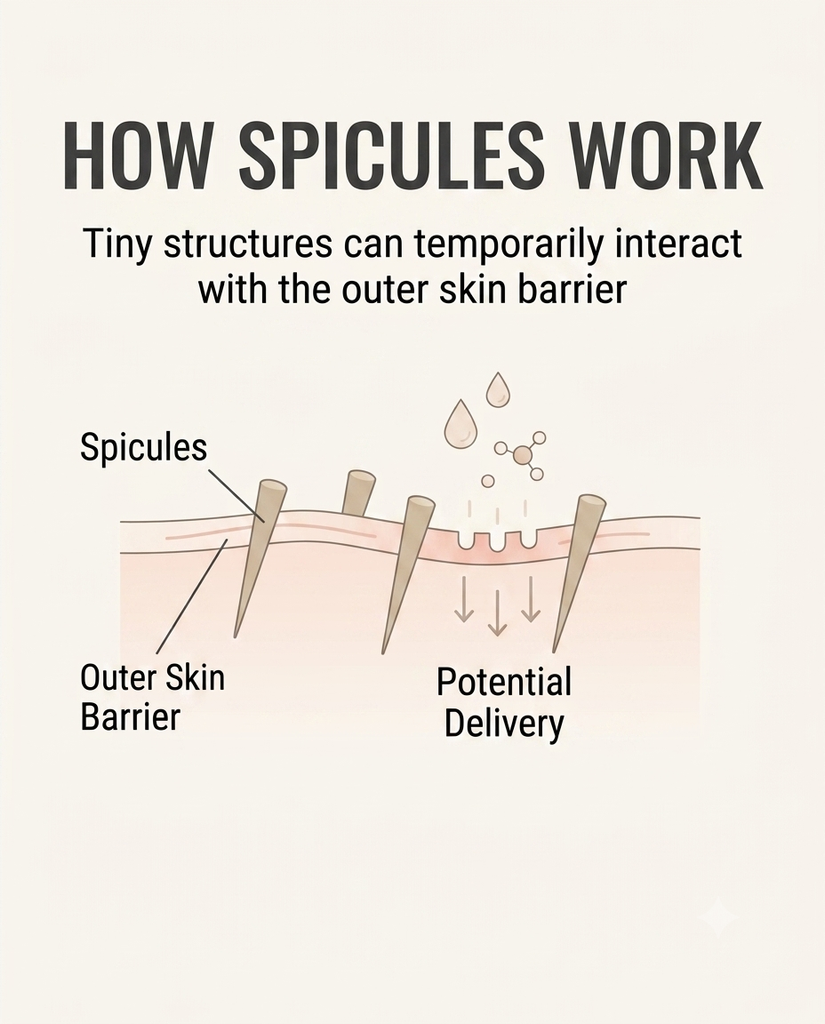
The basic idea is that these tiny structures can temporarily disturb parts of the skin’s outer barrier, potentially making it easier for certain ingredients to move into the skin.
But there is an important distinction from the start:
Spicule skincare is not professional microneedling in a bottle.
There is real research behind sponge-spicule delivery systems, but much of that evidence comes from specific experimental platforms rather than ordinary consumer serums.
Here is what the science actually tells us in 2026.
What Are Spicules in Skincare?
In skin-delivery research, many studied spicules are tiny needle-like structures obtained from marine or freshwater sponges.
Many sponge spicules studied for skin delivery are siliceous structures, meaning they are largely composed of silica.
Their size, shape, purity, surface characteristics, and behavior can vary depending on the sponge source and how the material is processed.
That variation matters.
For example, a 2017 study published in Molecular Pharmaceutics investigated sharp, rod-shaped siliceous spicules from Haliclona sponge species as a topical delivery system for hydrophilic biomacromolecules.
A separate 2022 study published in the Journal of Cosmetic Dermatology examined natural siliceous spicules as a dermal delivery platform.
These were specific research materials—not universal specifications for all cosmetic spicules.
When appropriately applied in experimental systems, spicules can physically disrupt portions of the stratum corneum, the outermost layer of the skin barrier.
Researchers are interested in this effect because the stratum corneum is highly effective at limiting the penetration of many substances.
In other words, spicules are interesting not simply because they feel prickly, but because they may function as a physical delivery-enhancing technology.
Why Do Spicule Products Feel Prickly?
The unusual tingling or prickling sensation is one of the first things many users notice.
Unlike the cooling effect of menthol or the chemical sting sometimes associated with exfoliating acids, spicule products can feel prickly because microscopic physical structures are interacting with the outer skin.
The intensity can vary considerably.
Two products marketed as “spicule skincare” may contain different spicule systems, concentrations, supporting formulas, and usage instructions.
Some brands describe tingling as an expected sensation with certain products.
However:
More pain does not mean better results.
A strong burning sensation, persistent redness, swelling, worsening rash, skin cracking, or other significant irritation should not be treated as evidence that the product is “working harder.”
How Do Spicules Work?
The most scientifically established rationale for spicules is their potential to alter skin permeability.
In laboratory and preclinical research, specific sponge-spicule systems have been shown to create microscopic channels or temporarily disrupt portions of the outer skin barrier.
A 2019 study published in Biomaterials Science combined sponge spicules with flexible liposomes to improve the delivery of hyaluronic acid.
Researchers observed microscopic channels after spicule treatment that gradually closed over time, while the combined system increased hyaluronic acid absorption and deposition in experimental skin models.
The important phrase here is:
in that particular experimental system.
Those findings do not establish a universal penetration depth, channel number, or absorption rate for commercial spicule skincare.
A separate 2022 dermal-delivery study tested natural siliceous spicules loaded with a model active ingredient and evaluated penetration using porcine skin and a Franz diffusion-cell system.
Again, the results support the broader idea that spicules can function as a dermal delivery platform.
They do not prove that every consumer serum produces the same result.
What Are the Potential Benefits of Spicule Skincare?
The most defensible potential benefits fall into three categories.
1. Enhanced Delivery of Certain Ingredients
This is where the scientific rationale is strongest.
Researchers have tested sponge-spicule delivery systems with substances including:
- hyaluronic acid
- hydrophilic biomacromolecules
- peptides
- model cosmetic actives
- experimental regenerative materials
The mechanism makes sense because the skin barrier normally limits penetration.
Temporarily disrupting that barrier can change how certain substances move through or into the skin.
But ingredient delivery depends on much more than the presence of spicules.
Molecule size, formulation, vehicle, concentration, coating technology, spicule geometry, dose, and application method all matter.
That is why “contains spicules” is not enough information to predict how well a finished product will deliver another ingredient.
2. Smoother-Looking Skin Texture
Some users may notice that their skin feels smoother or looks more refined after using spicule products.
Mechanical interaction with superficial skin layers may contribute to changes in texture and surface appearance.
Some formulas also combine spicule systems with moisturizing, soothing, exfoliating, or barrier-supporting ingredients.
That makes it difficult to separate the effect of the spicules from the effect of the entire formula.
3. A Brighter or More Refined Appearance
If a formula improves hydration, surface smoothness, or delivery of compatible active ingredients, the skin may temporarily appear brighter or more luminous.
This fits well with the K-beauty focus on smooth, refined, glass-like skin.
However, a better-looking glow should not automatically be interpreted as evidence of deep structural skin remodeling.
What Does a 2025 Spicule Study Tell Us?
A 2025 study published in the International Journal of Molecular Sciences evaluated a specific nano-encapsulated secretome system coated onto marine sponge-derived spicules.
The researchers reported greater penetration than an uncoated comparison formula.
The study also included a single-arm clinical evaluation examining several skin measurements.
These findings are promising for that particular delivery system.
They do not establish that ordinary consumer spicule serums produce the same penetration, collagen-related effects, wrinkle changes, pore changes, or pigmentation results.
That distinction is important because the study combined several technologies:
- a specific secretome
- nanoencapsulation
- marine sponge-derived spicules
- a defined formulation system
The results should therefore be interpreted as evidence for that specific platform, not for the entire spicule skincare category.
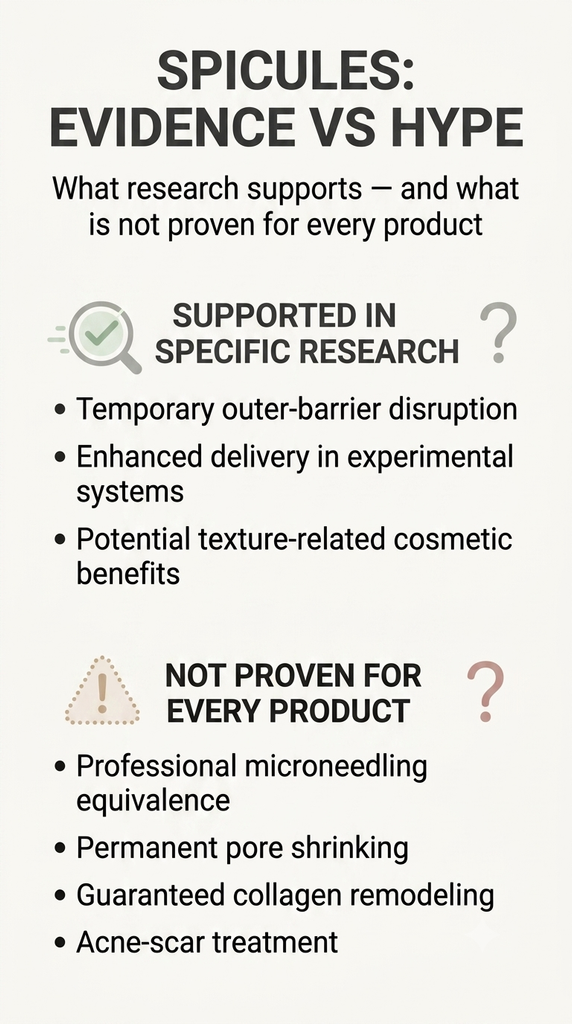
What Spicule Skincare Has Not Been Proven to Do
Marketing claims can move much faster than clinical evidence.
You should not automatically assume that a topical spicule product can:
- reproduce professional microneedling
- produce the same collagen remodeling as a clinical procedure
- erase acne scars
- permanently shrink pores
- deliver every active ingredient into deeper skin layers
- replace lasers
- replace injectable treatments
- replace medical resurfacing procedures
The phrase “liquid microneedling” can help consumers visualize the prickly sensation and barrier interaction.
Scientifically, however, it can also create confusion.
A topical cosmetic containing microscopic spicule structures is not the same procedure as inserting controlled needles with a microneedling device.
Spicules vs Professional Microneedling
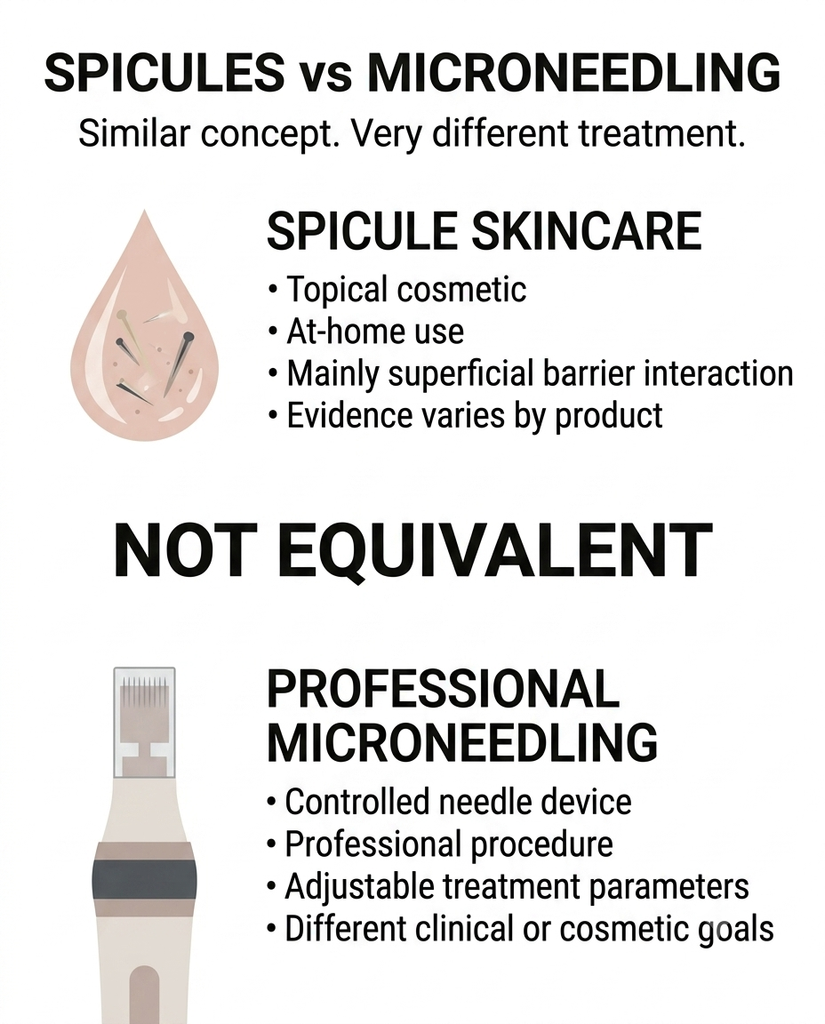
Spicule skincare and professional microneedling both involve physical interaction with the skin.
But they are fundamentally different approaches.
Spicule Skincare
- applied as a topical cosmetic
- generally designed for at-home use
- primarily interacts with the superficial skin barrier
- may cause tingling or prickling
- evidence varies significantly by product and spicule system
Professional Microneedling
- uses physical needles in a controlled device
- usually performed in a professional setting
- treatment parameters can be adjusted
- can target different depths depending on the procedure
- evidence depends on the device, depth, indication, and protocol
The simplest way to remember the difference is:
Similar concept. Very different treatment.
They should not be treated as equivalent.
Are Spicules Safe?
A simple “yes” or “no” is not a useful answer.
Specific spicule systems have been studied for topical delivery, and experimental research has shown that barrier disruption from some systems can recover over time.
But deliberately altering skin permeability creates an obvious trade-off:
A more permeable or mechanically disrupted barrier may also be more vulnerable to irritation.
A 2026 editorial in the Journal of the American Academy of Dermatology specifically called attention to potential risks associated with cosmetic silica-spicule use for transdermal delivery.
This does not mean every spicule product is unsafe.
It means that products designed to alter barrier permeability deserve more careful safety evaluation than an ordinary hydrating serum.
The editorial should also not be interpreted as proof that every possible adverse effect occurs with every commercial product.
Product formulation, spicule characteristics, frequency of use, skin condition, and individual tolerance all matter.
Who Should Be More Cautious With Spicule Skincare?
Extra caution is reasonable when the skin is already irritated or compromised.
Consider postponing a new spicule product—or discussing it with a qualified dermatologist if appropriate—if you currently have:
- open wounds or broken skin
- a significantly damaged skin barrier
- active severe irritation
- an eczema flare
- a rosacea flare
- recent aggressive exfoliation
- recent professional microneedling
- recent laser or resurfacing treatment
- unusually reactive skin
Product-specific manufacturer warnings also matter.
For example, VT Cosmetics’ official Reedle Shot information includes product-specific application guidance and precautions.
Those instructions apply to the specific product.
They should not automatically be copied onto every other spicule formula.
The broader rule is:
Follow the directions and warnings for the exact product you own.
How to Use Spicule Skincare
There is no universal routine that applies to every spicule product.
Always prioritize the instructions for your exact formula.
For someone trying a leave-on spicule product for the first time, a conservative routine may look like this:
Step 1: Cleanse Gently
Use a mild cleanser.
Avoid scrubbing, cleansing brushes, or abrasive exfoliation before applying the spicule formula.
Your skin should feel clean, not stripped.
Step 2: Apply the Spicule Product as Directed
Use the amount recommended by the manufacturer.
Some products are intended to be patted in gently, while others may provide different application instructions.
Do not assume that harder rubbing will produce better results.
Step 3: Add Simple Hydration
Follow with a simple hydrating or moisturizing product if compatible with the manufacturer’s instructions.
Common barrier-supportive ingredients may include:
- glycerin
- panthenol
- ceramides
- hyaluronic acid
- centella asiatica
Step 4: Keep the Routine Simple
A first-time spicule night is not the ideal time to experiment with several unfamiliar high-strength active products.
Reducing variables makes it easier to see how your skin responds.
Step 5: Use Sunscreen During the Day
Daily sunscreen is already a core part of a good skincare routine.
It becomes especially sensible when using products that intentionally interact with the skin’s outer barrier.
How Often Should You Use Spicule Skincare?
There is no single frequency that applies to the entire category.
Some brands position lower-intensity products for more frequent use and stronger products for less frequent use.
The exact recommendation can vary by:
- product
- formulation
- market
- product version
- strength
- manufacturer instructions
Do not apply the schedule of one spicule product to a completely different formula.
Always follow the directions on the exact version you own.
If persistent irritation develops, using the product more frequently is unlikely to be the solution.
Can You Use Spicules With Retinol?
Possibly, but starting both aggressively at the same time can make irritation harder to manage.
A conservative starting approach is to separate a new spicule product from a retinoid until you understand how your skin responds.
For example:
Night 1: Spicule product + simple moisturizer
Night 2: Recovery-focused routine
Later night: Retinoid, if the skin feels normal and the product directions allow it
This is a conservative starting approach, not a universal medical rule.
If your product directions specifically allow or prohibit a combination, follow those instructions.
If you use a prescription retinoid or have a skin condition, advice from your own clinician takes priority over a general skincare routine.
What About AHAs, BHAs, and Strong Exfoliants?
Similar caution makes sense with exfoliating acids.
Potentially irritating combinations include:
- glycolic acid
- lactic acid
- salicylic acid
- peeling solutions
- exfoliating pads
Combining several strong products may increase irritation without necessarily improving results.
When introducing spicules, consider keeping stronger exfoliation on a different night until you understand your tolerance.
Again, this is a conservative routine strategy rather than a universal medical rule.
Your exact product directions should take priority.
What About High-Strength Vitamin C?
Not every vitamin C formula is equally irritating.
However, if you already know that a low-pH or high-strength vitamin C serum causes stinging on your skin, introducing it at the same time as a new spicule treatment can make irritation harder to troubleshoot.
Beginners may prefer to introduce one potentially stimulating product at a time.
Can You Use Spicules With PDRN?
This is an increasingly relevant combination in K-beauty.
Spicules and PDRN play different roles.
Spicules are primarily used as a physical delivery or surface-interaction technology.
PDRN is used as an active skincare ingredient.
If you are unfamiliar with PDRN itself, read our guide to what PDRN skincare is before evaluating products that combine the two technologies.
You may increasingly encounter formulas combining spicule-style delivery systems with:
- PDRN
- peptides
- exosome-related ingredients
- growth-factor-style cosmetic ingredients
- regenerative skincare actives
The combination may be technologically interesting.
But one principle remains unchanged:
A promising delivery mechanism does not prove that every finished product delivers a clinically meaningful amount of an active ingredient to a specific skin depth.
Finished-product evidence matters.
Is Tingling Normal?
Mild temporary tingling or prickling is commonly described with some spicule products.
That does not mean every level of discomfort should be ignored.
Stop using the product and reassess if you experience:
- intense burning
- persistent redness
- swelling
- significant itching
- a worsening rash
- skin cracking
- weeping skin
- irritation that continues rather than settling
If symptoms are severe or persistent, seek appropriate medical evaluation.
Skincare does not need to hurt to work.
If you are considering Medicube specifically, our Medicube Exosome Shot 2000 review explains the MILD 2000 tier, what the prickling sensation means, and how to interpret the product’s irritation warnings before buying.
Are Spicules Good for Sensitive Skin?
Spicules are not the most obvious starting category for highly reactive skin.
Some brands offer lower-intensity products, but even a mild formula may still create mechanical stimulation.
If your skin frequently reacts to exfoliating acids, retinoids, fragrance, physical exfoliation, or unfamiliar active ingredients, introduce spicule products carefully.
A patch test may help identify an obvious reaction.
However, a patch test cannot guarantee that repeated full-face use will remain irritation-free.
What Should Beginners Look for in a Spicule Product?
For your first spicule product, stronger is not automatically better.
For a real-world example, see our Medicube Exosome Shot 2000 vs VT Reedle Shot 100 comparison, which compares two popular spicule products by formula, brand strength system, routine fit, and current value.
Look for:
- clear manufacturer instructions
- transparent ingredient labeling
- realistic cosmetic claims
- warnings and precautions
- a reputable manufacturer
- beginner-oriented positioning if available
- supportive moisturizing ingredients
- clear frequency and application instructions
Be more skeptical when a topical cosmetic claims that it can reproduce:
- medical microneedling
- injections
- professional laser treatments
- deep scar remodeling
Spicule technology is scientifically interesting enough without exaggerating what it can do.
What Does the Science Actually Say?
The evidence is easiest to understand in three levels.
Reasonably Supported in Specific Research Systems
Spicule systems can disrupt portions of the outer skin barrier and improve topical delivery under experimental conditions.
Research published in 2017, 2019, and 2022 supports this general mechanism using specific sponge-spicule delivery systems.
Promising but Still Developing
More advanced spicule-based delivery systems may improve certain skin measurements when paired with specific active materials.
The 2025 nano-encapsulated secretome study is one example.
But it evaluated a particular platform and included a single-arm clinical component.
It cannot be generalized to all commercial spicule products.
Not Established Across the Consumer Category
It has not been established that every consumer spicule product:
- creates identical microchannels
- reaches identical skin depths
- produces significant collagen remodeling
- permanently reduces pore size
- treats acne scars
- reproduces professional microneedling
- delivers every active ingredient equally well
This is the most important scientific distinction in the article.
Are Spicules Just a K-Beauty Trend?
The technology itself is older than the current beauty trend.
Researchers were investigating sponge spicules for dermal and transdermal delivery well before they became popular in consumer K-beauty.
What has changed is mainstream visibility.
Spicule products have become much easier for international consumers to encounter, particularly through Korean skincare brands and retailers.
So the underlying scientific idea is not new.
The consumer trend is.
The Bottom Line
Spicules are microscopic needle-like structures used in some skincare products to physically interact with the outer skin barrier and potentially improve the delivery of certain ingredients.
There is legitimate research supporting the general delivery concept.
But there is a major difference between evidence for an experimental spicule platform and proof for every consumer serum sold with spicule-related marketing.
Spicule skincare is also not equivalent to professional microneedling.
For beginners, the most sensible approach is straightforward:
- choose a clearly labeled product
- follow the exact manufacturer’s instructions
- introduce it gradually
- keep the surrounding routine simple
- avoid treating pain as proof of effectiveness
- pay attention to persistent irritation
- do not assume that stronger automatically means better
The best summary is:
Spicule skincare is not professional microneedling in a bottle. It is a variable cosmetic delivery technology whose benefits and risks depend on the exact spicule system and formula.
Frequently Asked Questions
Are Spicules the Same as Microneedles?
No.
Cosmetic spicules are microscopic structures incorporated into topical skincare systems.
Professional microneedling uses a controlled device with physical needles and can target different depths depending on the device, treatment parameters, and clinical goal.
They should not be treated as equivalent procedures.
Do Spicules Dissolve in the Skin?
Do not assume that all spicules dissolve.
Many sponge spicules studied in skin-delivery research are siliceous structures.
That is different from dissolving microneedle patches made from materials specifically designed to dissolve.
Commercial technologies vary, so check the information for the exact product.
Why Does Spicule Skincare Sting?
The prickling sensation can result from microscopic physical structures interacting with the outer skin.
Intensity varies by formula, spicule system, application method, and individual skin sensitivity.
Can I Use Spicules Every Day?
Only if the exact product is designed for that frequency and your skin tolerates it.
Different formulas may be designed for very different usage schedules.
Do not copy the schedule from another product.
Should I Use Spicules Before or After Serum?
Follow the manufacturer’s directions.
Some spicule products are designed as an early skincare step before additional products, but this is not a universal rule for the category.
Can Spicules Permanently Shrink Pores?
There is not strong evidence that ordinary cosmetic spicule products permanently change anatomical pore size.
Changes in hydration, texture, oil appearance, or surface smoothness may make pores appear less noticeable.
Are Spicules Worth Trying?
They may be worth considering if you are interested in active K-beauty formulations, tolerate stimulating products reasonably well, and understand the limitations of the evidence.
They are less suitable for someone expecting an at-home serum to reproduce professional microneedling or medical resurfacing.
Sources & References
- Marine Sponge Spicules for Skin Delivery — Molecular Pharmaceutics, 2017
- Sponge Spicules + Hyaluronic Acid Delivery — Biomaterials Science, 2019
- Natural Spicules for Cosmetic & Therapeutic Delivery — Journal of Cosmetic Dermatology, 2022
- Nano-Encapsulated Spicule System & Skin Rejuvenation — International Journal of Molecular Sciences, 2025
- Potential Risks of Cosmetic Silica Spicules — Journal of the American Academy of Dermatology, 2026
- VT Reedle Shot 100 — Official Product Information — VT Cosmetics