Sensitive skin usually needs fewer variables, not more skincare steps.
If your skin often stings, burns, becomes red, feels itchy, or reacts after you introduce new products, starting a complicated K-beauty routine can make it harder to figure out what your skin actually tolerates.
A better starting point is simple:
Gentle cleanse → moisturize → protect.
Then add one targeted product only when your skin is comfortable and you can explain exactly what that product is supposed to do.
If you are unsure where products belong, our Korean skincare routine order guide explains why a modern routine does not require a fixed 10-step system.
Quick Answer: A Korean Skincare Routine for Sensitive Skin
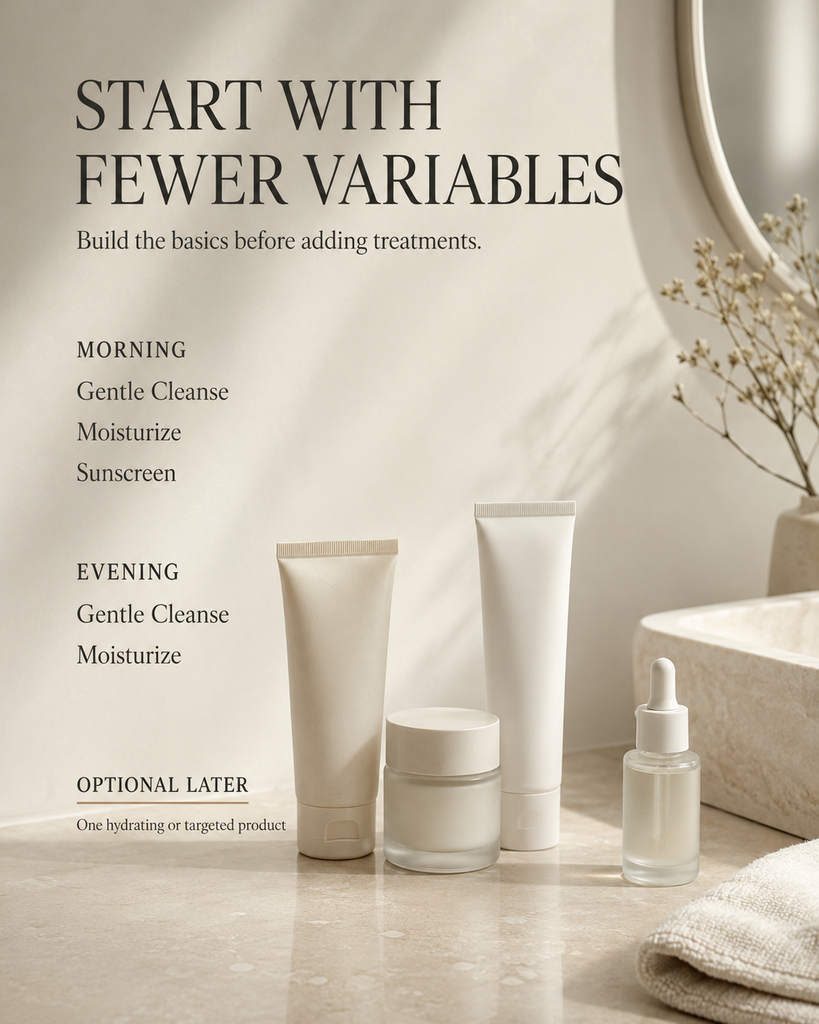
Morning
- Gentle cleanse or rinse if appropriate
- Moisturizer
- Sunscreen
Evening
- Gentle cleanser
- Moisturizer
Optional Later
Once your basic routine is working:
- hydrating toner
- essence
- one serum
- one targeted treatment
Introduce them individually rather than all at once.
The goal is not to build the longest routine your skin can survive.
It is to build the smallest routine that consistently keeps your skin comfortable.
What Does “Sensitive Skin” Actually Mean?
“Sensitive skin” can describe different experiences.
The American Academy of Dermatology notes that sensitive skin may sting or burn after product use.
But those symptoms do not automatically identify the cause.
Sensitive skin is a description of how skin reacts, not a diagnosis by itself.
Stinging, burning, redness, or itching can have many causes, including irritant reactions, allergic contact dermatitis, eczema, rosacea, acne treatments, or another underlying skin condition.
Skin discomfort can also be influenced by:
- a particular cosmetic ingredient
- fragrance
- over-cleansing
- excessive exfoliation
- several new products introduced together
- an underlying skin condition
- a reaction to a cosmetic formula
That is why this article focuses on routine management rather than self-diagnosis.
Persistent rash, swelling, severe burning, worsening redness, or recurring reactions deserve professional evaluation rather than endless product experimentation.
Start by Simplifying Your Routine
When skin feels reactive, it is tempting to buy something new to “calm” it.
Sometimes the better first step is removing unnecessary variables.
Temporarily ask whether every product has a necessary job.
Your routine may currently contain:
- exfoliating toner
- hydrating toner
- essence
- ampoule
- serum
- retinol
- exfoliating pads
- sheet masks
- sleeping mask
- moisturizer
Each product can look reasonable on its own.
The problem is that when irritation appears, it becomes difficult to identify the cause.
A simpler baseline makes your skin’s response easier to interpret.
A Useful Baseline
Think:
Cleanser → moisturizer → sunscreen in the morning
and
Cleanser → moisturizer at night
Then build from there.
Step 1: Choose a Gentle Cleanser
Cleansing should remove what needs to be removed without turning washing into an exfoliation treatment.
The AAD recommends gentle, non-abrasive cleansing and advises against aggressive scrubbing.
For sensitive skin, pay attention to how your face feels after cleansing.
Warning signs that your current cleansing routine may be too aggressive include:
- persistent tightness
- stinging
- burning
- excessive dryness
- a strong urge to immediately apply several soothing products
Do You Need to Double Cleanse?
Not automatically.
Double cleansing generally means:
oil-based cleanser or cleansing balm → water-based cleanser
It can be useful when you are removing:
- substantial makeup
- difficult-to-remove sunscreen
- heavier cosmetic layers
But sensitive skin does not benefit from double cleansing simply because double cleansing is associated with Korean skincare.
If one gentle cleansing process removes what you need, stop there.
If makeup or sunscreen remains, use a removal method suited to that formula instead of rubbing or scrubbing harder.
Step 2: Make Moisturizer a Core Step
Moisturizer is one of the first categories to stabilize before experimenting with more treatments.
AAD guidance for dry and eczema-prone skin commonly emphasizes regular moisturization and gentle, fragrance-free products.
You do not need the moisturizer with the longest ingredient list.
You need one that:
- feels comfortable
- does not consistently sting
- provides enough moisture
- works with your sunscreen
- can be used reliably
Cream, Lotion, or Gel?
Texture preferences vary.
A richer cream may be more comfortable for dry skin.
A lighter lotion or gel-cream may work better for someone who dislikes heavy textures.
Do not assume that “sensitive skin” requires one universal texture.
The finished formula matters more.
Step 3: Use Sunscreen Every Morning
Sensitive skin still needs sun protection.
But finding a sunscreen you will actually use can take some trial and error.
If one formula consistently burns, stings, pills, or makes you avoid sunscreen altogether, it is not a good practical fit for you.
What Does “Sensitive Skin” Mean on a Sunscreen Label?
Do not treat the words as a guarantee.
AAD guidance notes that the FDA does not define the term “sensitive skin” for sunscreen labeling.
When a sunscreen says “sensitive skin,” it often—but not always—uses zinc oxide, titanium dioxide, or both, and may avoid fragrance or certain chemical UV filters.
The label is still not a guarantee, so check the current formula, directions, and how your skin responds.
The front of the package cannot make that decision for you.
Do You Need Toner?
No.
Toner is optional even in Korean skincare.
If your skin is comfortable with:
cleanser → moisturizer → sunscreen
there is no obligation to insert toner.
A hydrating toner can be useful if it provides comfortable lightweight hydration.
But an exfoliating toner is a very different product.
Do not judge both simply because they share the word “toner.”
Sensitive Skin Rule
Product function matters more than product category.
What About Essence?
Essence is also optional.
An essence may provide:
- hydration
- soothing ingredients
- fermented ingredients
- barrier-support ingredients
- additional actives
But it can also duplicate what your toner or serum already does.
For sensitive skin, adding both toner and essence only makes sense when each has a clear purpose and both are well tolerated.
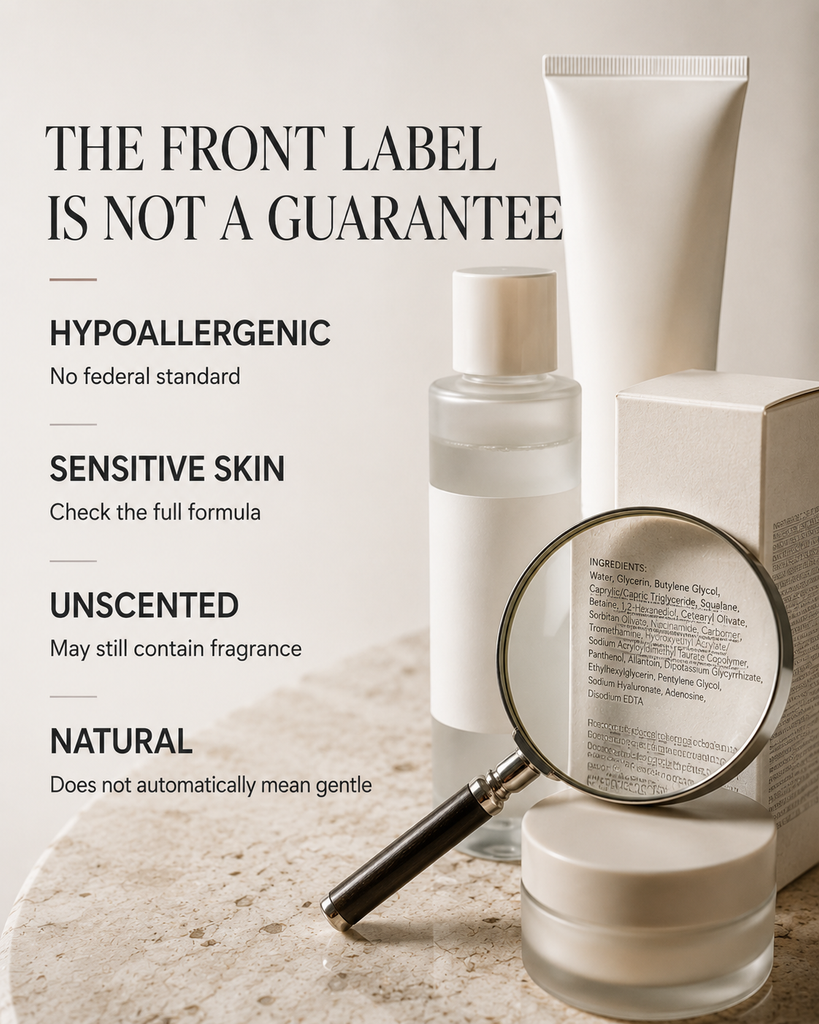
“Fragrance-Free” vs “Unscented”
This distinction matters.
Dermatology guidance commonly recommends fragrance-free products for people who know fragrance causes irritation or flares.
Products labeled “unscented” may still contain ingredients used to mask odor.
The FDA identifies fragrance as one of the common categories of cosmetic allergens, and fragrance mixtures can contain multiple individual components.
If fragrance has triggered your skin before, fragrance-free is a sensible starting filter.
It is still not a guarantee of tolerance because a formula can contain other potential irritants or allergens.
Read the full ingredient list and pay attention to your own reaction.
“Hypoallergenic” Does Not Mean Reaction-Proof
This is one of the most important label traps.
A brand can use the term, but that does not mean the product has been proven incapable of causing irritation or an allergic reaction.
Therefore:
hypoallergenic ≠ guaranteed safe for your skin
Treat the word as packaging language, not as a substitute for the ingredient list or product testing.
Does “Natural” Mean Better for Sensitive Skin?
No.
Plant-derived and botanical ingredients can be useful cosmetic ingredients, but “natural” does not automatically mean non-irritating.
Botanical ingredients can also cause irritation or allergic reactions in some people.
Sensitive skin shopping should not become:
synthetic = bad
natural = good
That is too simplistic.
Evaluate the actual finished formula.
What Ingredients Should Sensitive Skin Avoid?
There is no universal blacklist that applies to everyone.
That is important.
One person may tolerate an ingredient perfectly while another reacts to it.
The FDA lists several common classes of cosmetic allergens, including:
- fragrances
- preservatives
- dyes
- certain metals
- natural rubber
But that does not mean every person with sensitive skin must eliminate every ingredient in those categories.
If you already know what triggers your skin, avoid it.
If you repeatedly react and cannot identify the cause, professional allergy or dermatology evaluation may be more useful than randomly eliminating dozens of ingredients.
What About Acids and Exfoliants?
Sensitive skin does not automatically mean you can never use exfoliating ingredients.
But aggressive exfoliation is a poor place to start when your skin is already uncomfortable.
Products may contain:
- glycolic acid
- lactic acid
- salicylic acid
- exfoliating blends
- peeling systems
- abrasive particles
The more useful question is not:
“Is this ingredient allowed for sensitive skin?”
It is:
“Does my skin currently tolerate this formula, concentration, frequency, and combination?”
If your skin is already burning or peeling, adding another exfoliating product usually makes troubleshooting harder.
What About Retinol?
Retinol can cause dryness and irritation, especially when someone is new to it or uses too much too quickly.
AAD guidance notes that ingredients such as retinol and glycolic acid can cause temporary irritation, particularly in sensitive skin.
If irritation becomes persistent, severe, or progressively worse, stop using the product and seek professional advice.
That does not mean every person with sensitive skin must permanently avoid retinoids.
It means retinol deserves more caution than a basic moisturizer.
If you are choosing between trend-focused treatments, our PDRN vs retinol guide explains why the two categories have different evidence, functions, and irritation considerations.
Do not introduce retinol at the same time as several new acids, exfoliating pads, and serums.
One change at a time gives you much more useful information.
What About PDRN?
PDRN is currently one of the biggest K-beauty ingredient trends.
But “PDRN” on a label does not automatically make a formula appropriate for sensitive skin.
Different products can use:
- different PDRN-related materials
- different supporting ingredients
- different concentrations
- different fragrance systems
- different textures
- additional actives
If you are considering the category, first understand what PDRN skincare is rather than assuming PDRN means soothing or irritation-proof.
The finished product still matters.
How to Test a New Skincare Product
If your skin frequently reacts to new products, do not make your entire face the first test site.
Apply the normal amount to a quarter-sized area on the underside of the arm or in the bend of the elbow, twice a day for seven to 10 days.
For a cleanser or another wash-off product, rinse it after the normal use time or according to the label directions.
If you develop redness, itching, swelling, or another concerning reaction, stop using the product.
Important: Home Product Testing Is Not Medical Patch Testing
The term “patch test” is often used casually online.
But professional patch testing is a medical procedure used to help identify contact allergens.
Testing a cosmetic on a small area at home is not the same thing.
If reactions are persistent or difficult to identify, a dermatologist may recommend formal testing.
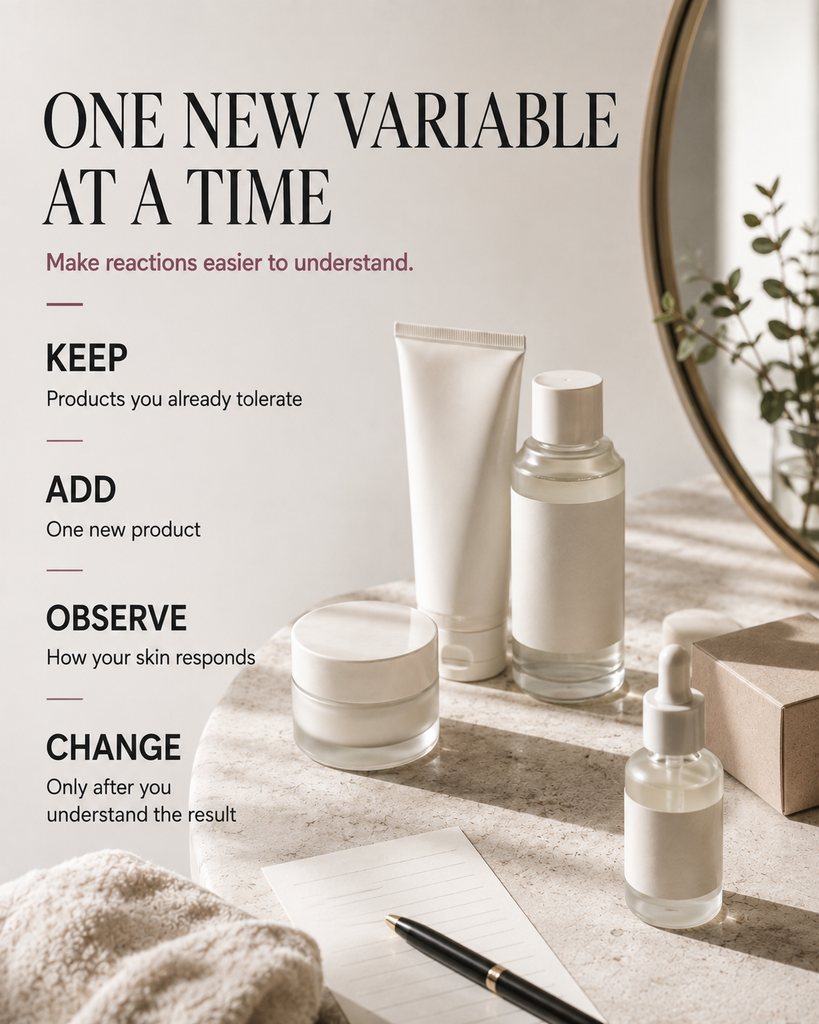
Introduce One New Product at a Time
This may be the most useful practical rule in the article.
Imagine you begin using:
- a new cleanser
- a new toner
- a new PDRN serum
- a new moisturizer
on Monday.
By Thursday, your skin burns.
Which product caused the problem?
You do not know.
Now imagine your established routine works and you add only one toner.
If irritation begins shortly afterward, troubleshooting becomes much easier.
Sensitive-Skin Buying Rule
One new variable at a time.
How Long Should You Test Before Adding Another Product?
There is no universal countdown that guarantees a product is compatible with your skin.
Some irritation occurs quickly.
Some reactions take repeated exposure.
AAD’s small-area product testing guidance uses seven to 10 days before broader use when no reaction appears.
After you begin facial use, give yourself enough time to understand how the product behaves before introducing several more variables.
The goal is not speed.
It is clarity.
What Should You Do When Your Skin Suddenly Feels Irritated?
Do not automatically respond by adding five “soothing” products.
First consider simplifying.
A temporary minimalist approach may mean returning to products you already know you tolerate.
Avoid introducing additional:
- acids
- scrubs
- strong actives
- fragranced experiments
- multiple new serums
If you think a product caused a reaction, gently wash it off as soon as possible and stop using it.
For mild discomfort, a cool compress or plain petroleum jelly may sometimes help support comfort.
Severe, persistent, spreading, or worsening symptoms need professional medical advice.
When Sensitive Skin May Need a Dermatologist
Skincare advice cannot determine why your skin is repeatedly reacting.
See a qualified healthcare professional or dermatologist when you have concerns such as:
- persistent rash
- significant swelling
- severe burning
- cracking or bleeding
- recurring reactions to many products
- symptoms that continue after stopping suspected products
- eye or lip involvement
- symptoms that interfere with normal daily life
Conditions such as rosacea, eczema, and contact dermatitis can require diagnosis and management that a cosmetic routine cannot provide.
The goal should not be to find a serum strong enough to overpower a medical skin problem.
How to Shop Korean Skincare for Sensitive Skin
K-beauty shopping becomes easier when you stop looking for one magic label.
1. Start With the Missing Routine Step
Do you need:
- cleanser
- moisturizer
- sunscreen
- hydration
- treatment
Do not buy a product merely because it is viral.
2. Read the Full Formula
Do not judge a product only by:
- centella
- ceramides
- PDRN
- heartleaf
- rice
- peptides
- probiotics
A hero ingredient does not represent the entire formula.
3. Ignore “Sensitive Skin” as a Guarantee
Use it as an initial category signal only.
The FDA notes that marketing terms such as “hypoallergenic” do not have a federal definition that guarantees lower reaction risk.
4. Check Fragrance If It Matters to You
If you know fragrance triggers your skin, check the current ingredient list rather than relying only on front-label language.
5. Buy One New Product
Not an entire routine.
This is the same shopping principle behind our Olive Young K-Beauty Edit at Sephora guide:
Fill a routine gap instead of collecting trends.
A Minimal Korean Skincare Routine for Sensitive Skin
Morning
1. Gentle cleanse or rinse
Choose based on how your skin feels and what needs removing.
2. Moisturizer
Use enough to keep skin comfortable.
3. Sunscreen
Broad-spectrum protection should be a consistent daytime step.
Evening
1. Gentle cleanser
Remove the day’s sunscreen, makeup, oil, and debris without aggressive scrubbing.
2. Moisturizer
Keep the routine boring if boring works.
Once Your Skin Is Comfortable
Consider adding:
one optional hydrating or targeted product
Then evaluate.
You do not receive extra points for turning three steps into ten.
Common Sensitive-Skin Mistakes
Mistake 1: Changing the Entire Routine at Once
This makes reactions difficult to trace.
Mistake 2: Assuming “Natural” Means Gentle
Botanical ingredients can also be irritating or allergenic for some people.
Mistake 3: Trusting “Hypoallergenic” as a Guarantee
The term has no federal U.S. standard that guarantees a product will not cause a reaction.
Mistake 4: Treating Fragrance-Free and Unscented as Identical
They are not necessarily the same.
Mistake 5: Exfoliating Skin Because It Is Flaking
Flaking can tempt people to scrub harder.
That may make irritated skin less comfortable.
Mistake 6: Buying Multiple “Barrier” Products at Once
Even products marketed as soothing can introduce additional ingredients and variables.
Mistake 7: Using Trends Before Basics
Your skin does not need PDRN, exosomes, spicules, toner pads, or five serums simply because K-beauty is discussing them.
Basic tolerance comes first.
The Bottom Line
Korean skincare for sensitive skin does not need to be complicated.
Start with:
gentle cleansing → moisturizer → daytime sun protection
Then add optional products slowly.
Do not assume that:
- hypoallergenic means reaction-proof
- natural means gentle
- sensitive-skin labeling guarantees compatibility
- more soothing products automatically soothe more
Read the finished formula.
Test unfamiliar products carefully.
Introduce one variable at a time.
And when your skin is already unhappy, resist the urge to solve the problem by buying another five products.
For sensitive skin, fewer variables make your routine easier to understand.
Frequently Asked Questions
Is Korean Skincare Good for Sensitive Skin?
It can be.
Korean skincare includes many textures and formula types, but K-beauty itself does not guarantee gentleness.
Evaluate the individual product rather than the country of origin.
What Is a Good Korean Skincare Routine for Sensitive Skin?
A practical starting routine is gentle cleansing, moisturizer, and sunscreen in the morning, with gentle cleansing and moisturizer at night.
Optional products can be added gradually.
Do Sensitive Skin Types Need Toner?
No.
Toner is optional.
Use one only if the specific formula serves a useful purpose and your skin tolerates it.
Is Fragrance Bad for Sensitive Skin?
Fragrance can trigger irritation or allergic reactions in some people.
If fragrance has caused problems for you, fragrance-free products are a sensible starting filter.
Is Unscented the Same as Fragrance-Free?
Not necessarily.
Products labeled unscented may contain ingredients used to mask odors.
Does Hypoallergenic Mean a Product Cannot Cause a Reaction?
No.
The FDA states that there is no federal standard or definition governing the term “hypoallergenic” for cosmetics.
Should Sensitive Skin Avoid Retinol?
Not automatically.
Retinol can cause irritation, so product choice, frequency, tolerance, and directions matter.
If irritation is persistent or severe, stop experimenting and seek professional advice.
Is PDRN Good for Sensitive Skin?
PDRN is not one standardized finished skincare formula.
A PDRN-labelled product may also contain many other ingredients.
Evaluate the whole formula rather than assuming PDRN makes the product soothing.
How Should I Test New Skincare?
AAD guidance suggests testing the normal amount on a quarter-sized area on the underside of the arm or bend of the elbow twice daily for seven to 10 days before broader use if no reaction develops.
Follow the specific product directions during testing.
When Should I See a Dermatologist?
Consider professional evaluation for severe, persistent, recurring, or unexplained reactions, significant swelling, cracking, bleeding, or symptoms that do not improve after stopping suspected products.
Sources & References
- A Dermatologist’s Guide to Skincare — American Academy of Dermatology
- How to Test Skin Care Products — American Academy of Dermatology
- Dermatologists’ Tips for Relieving Dry Skin — American Academy of Dermatology
- How to Decode a Sunscreen Label — American Academy of Dermatology
- Allergens in Cosmetics — U.S. Food and Drug Administration
- Fragrances in Cosmetics — U.S. Food and Drug Administration
- Cosmetics Safety Q&A: Hypoallergenic — U.S. Food and Drug Administration