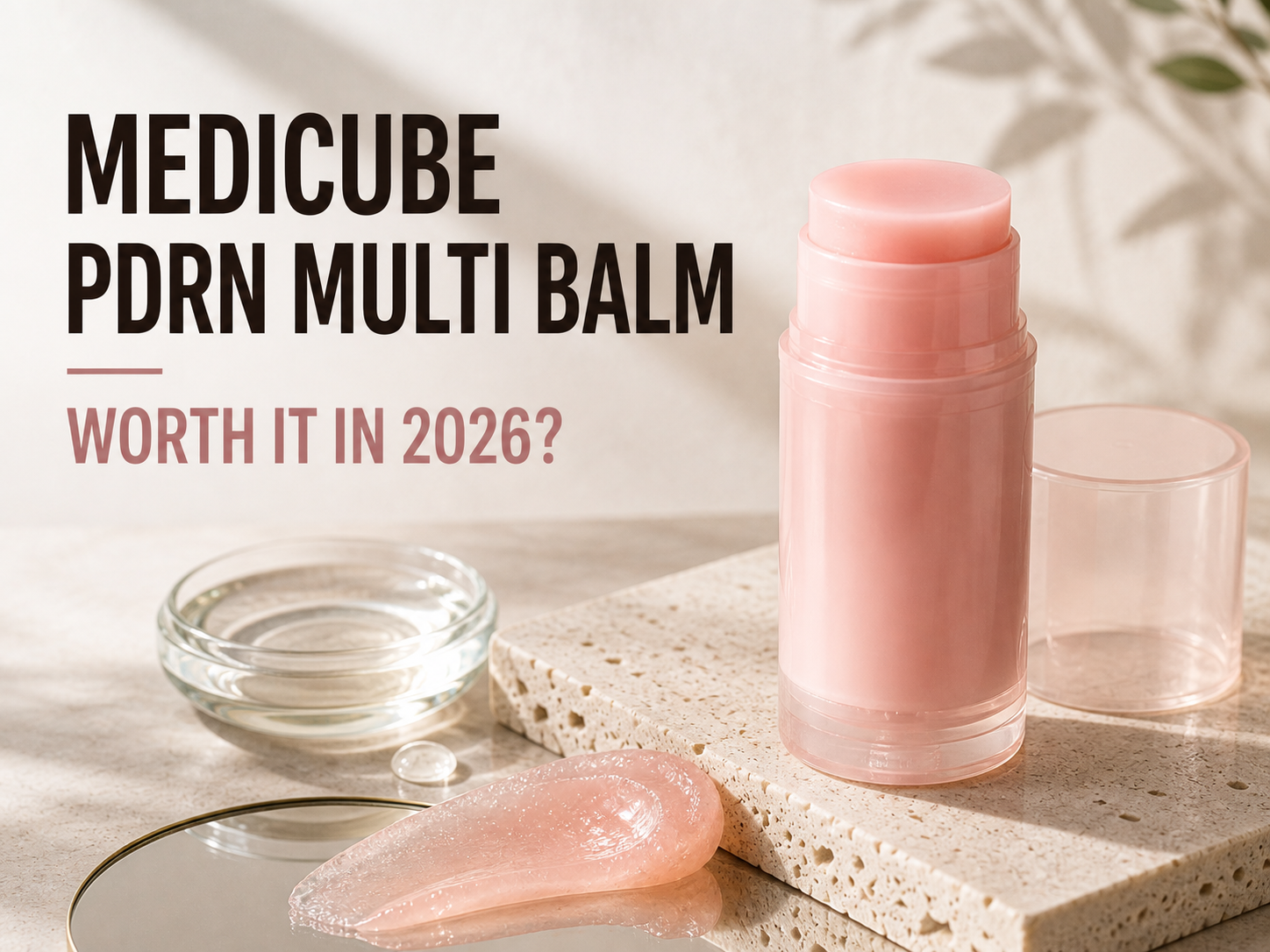
In this Medicube PDRN Pink Collagen Volume Multi Balm review, the most important question is not whether the ingredient list looks impressive.
It does.
The 0.35 oz balm combines 5% Volufiline with Sodium DNA, collagen, NAD, NMN, retinol, caffeine, hyaluronic acid, elastin, and multiple peptides.
The more useful question is:
Is this finished balm actually worth about $22 for what you want it to do?
Quick verdict: yes, for the right buyer.
The Medicube balm makes the most sense as a rich, targeted stick for dry or crepey-looking areas, lips, smile lines, and under-eye contours that benefit from extra moisture and a dewy finish.
It makes much less sense if you are buying it because you expect a topical skincare stick to reliably restore lost facial fat or work like injectable filler.
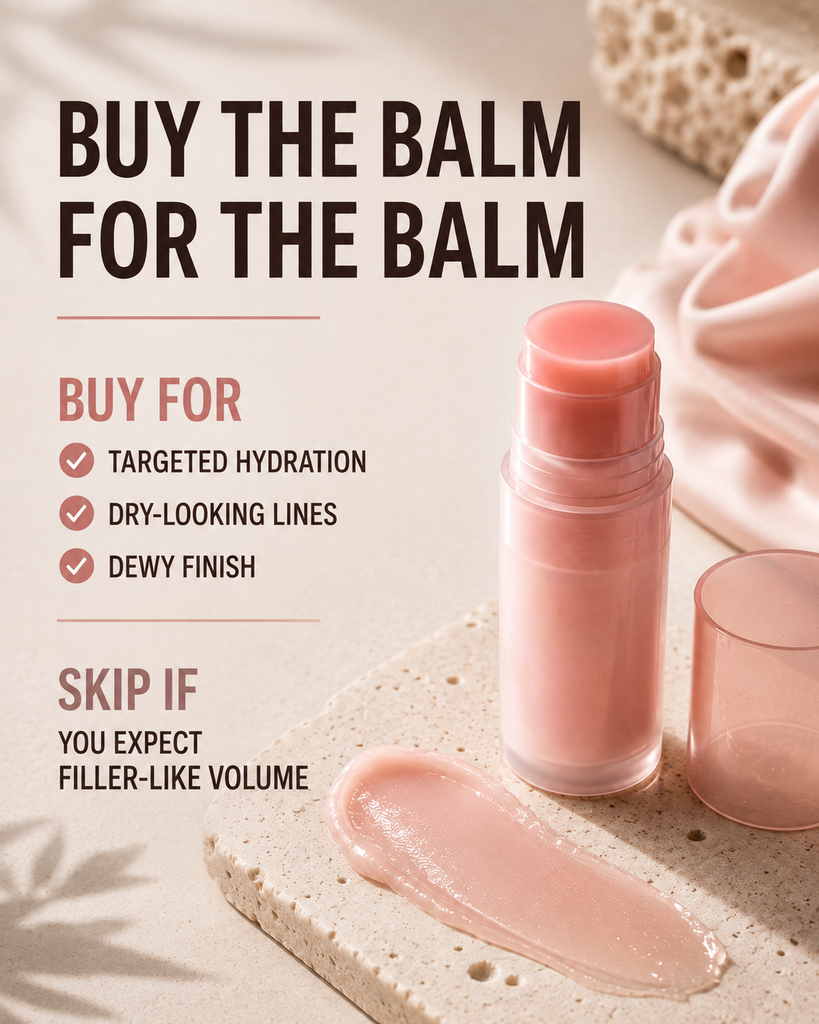
Buy the balm for the balm. Treat any meaningful longer-term Volufiline effect as a possible bonus—not a guaranteed result.
This is an evidence-based buying review based on the current formula, brand claims, retailer information, published research, and third-party buyer and editorial feedback. K-Beauty Clarity did not personally test this product.
Prices, stock, and retailer review data were checked on August 28, 2026 and can change.
Medicube PDRN Pink Collagen Volume Multi Balm Review: Quick Facts
Size: 0.35 oz, approximately 10g
Medicube U.S. price when checked: $22
Medicube U.S. availability when checked: Sold out
Ulta price when checked: $21.90
Ulta availability when checked: In stock for shipping
Ulta rating when checked: 3.3/5 from 21 reviews
Disclosed Volufiline level: 5%
Other notable listed ingredients: Sodium DNA, collagen, NAD, NMN, retinol, caffeine, hyaluronic acid, elastin, and multiple peptides
Best for: Targeted hydration, dry-looking lines, portable touch-ups, lips, smile lines, and people who enjoy a rich dewy balm
Think twice if: You dislike balm textures, have very oily skin, react easily around the eyes, tend to dislike rich occlusive products, or expect filler-like facial volume restoration
Is the Medicube PDRN Multi Balm Worth It?
At roughly $22, I think the answer is yes if you would still want this product without a dramatic Volufiline result.
That is the simplest buying test.
The balm base itself gives the product a clear practical role.
Its ingredient list starts with multiple emollients and waxes designed to coat, soften, reduce surface dryness, and leave a cushioned finish.
On dehydrated or crepey-looking skin, that can make fine lines appear smoother and the area look temporarily fuller.
The stick format also makes it easy to target a smile line, dry lip contour, neck line, or small under-eye area without applying a heavy product over the entire face.
If that sounds useful, the price is reasonable.
If your only goal is to refill a deep tear trough, restore lost cheek fat, or achieve structural volume changes similar to filler, the value proposition is much weaker.
What Does 5% Volufiline Actually Mean?
This is the most important label claim to understand before buying.
Ulta currently lists Volufiline 5% among the balm’s key ingredients.
But:
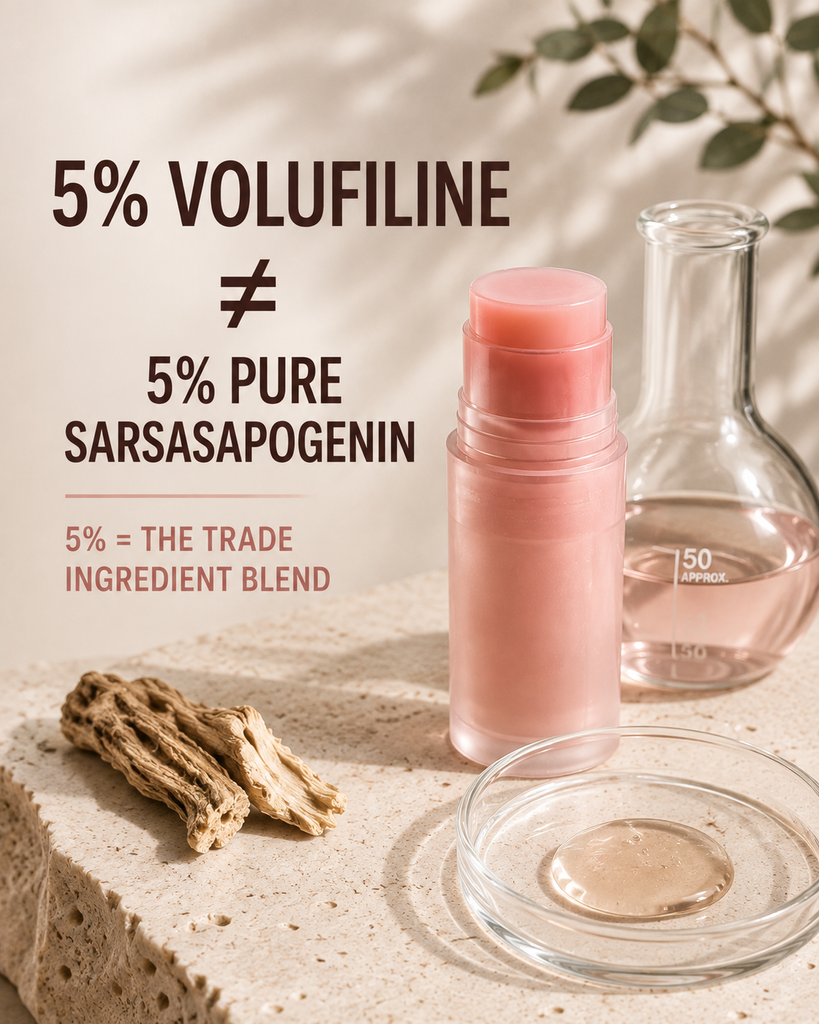
5% Volufiline does not mean 5% pure sarsasapogenin.
Volufiline is a branded cosmetic ingredient from Croda.
Croda lists its INCI as:
Hydrogenated Polyisobutene + Anemarrhenae Asphodeloides Root Extract
and describes Volufiline as a cosmetic ingredient rather than a finished product.
So the useful interpretation is:
5% Volufiline = 5% of the Volufiline trade ingredient system in the finished formula.
Not:
5% pure sarsasapogenin.
This matters because social-media comparisons often rank Volufiline products using the headline percentage alone.
A shortcut such as:
100% > 5% > 1%
does not tell you which finished product is actually better.
You still need to ask:
- What exactly is the percentage measuring?
- What is the product format?
- What else is in the formula?
- Where are you applying it?
- Would the product still make sense if Volufiline produces only subtle visible plumping?
If you are comparing different formats, our best Volufiline Korean skincare products guide explains why 5%, 50,000ppm, and “100% Volufiline” should not be treated as simple pure-active rankings.
Does Volufiline Really Restore Facial Volume?
Current evidence does not justify treating an ordinary topical Volufiline product as a predictable substitute for injectable filler.
Croda describes Volufiline as a cosmetic active intended to support a fuller-looking appearance and has recently repositioned the ingredient around growing consumer interest in facial volume.
That is useful information about the ingredient and its intended cosmetic role.
It is not the same as having large, independent facial clinical trials proving that a 5% Volufiline balm can reliably rebuild tear-trough fat pads, restore cheek anatomy, or create injectable-like structural volume.
A more realistic expectation is:
- richer surface hydration
- softer-looking dry lines
- smoother surface texture
- increased shine and light reflection
- temporary cosmetic plumping
- possible incremental appearance changes with continued use
These benefits can still matter.
They are simply different from reconstructing lost facial volume.
What Is Actually in the Formula?
The current Medicube U.S. INCI shows that this is first and foremost a balm-based finished formula.
Early ingredients include:
- Cetyl Ethylhexanoate
- Synthetic Wax
- Polyglyceryl-2 Triisostearate
- Diisostearyl Malate
- Microcrystalline Wax
- Hydrogenated Polyisobutene
- Octyldodecanol
- Caprylic/Capric Triglyceride
- Candelilla Wax
That structure helps explain the product’s everyday strengths:
slip, cushioning, moisture retention, shine, and targeted application.
The current INCI also confirms ingredients including:
- Anemarrhena asphodeloides root extract
- Sodium DNA
- adenosine
- caffeine
- collagen
- sodium hyaluronate
- retinol
- nicotinamide mononucleotide (NMN)
- nicotinamide adenine dinucleotide (NAD)
- hydrolyzed elastin
- Acetyl Hexapeptide-8
- Copper Tripeptide-1
- Palmitoyl Pentapeptide-4
- Acetyl Tetrapeptide-5
- Palmitoyl Tetrapeptide-7
- Palmitoyl Tripeptide-1
That is an ambitious ingredient list.
But an ingredient appearing on an INCI list does not tell you its exact concentration or how much it contributes to the finished result.
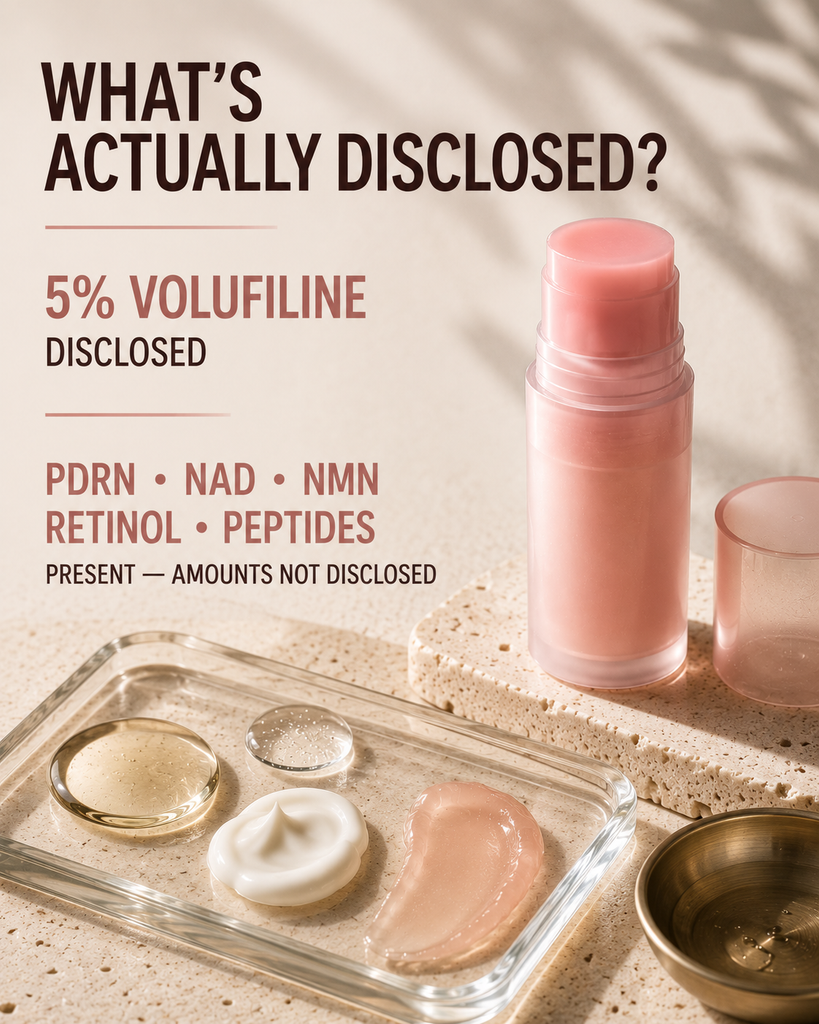
Medicube and Ulta specifically disclose:
5% Volufiline.
Comparable percentages for Sodium DNA/PDRN, retinol, NAD, NMN, and the individual peptides are not disclosed on the current U.S. product pages.
So do not mentally turn this ingredient list into several full-strength treatments packed into one stick.
What About the PDRN?
The ingredient list contains Sodium DNA, an INCI name commonly seen in cosmetics marketed as PDRN skincare.
PDRN itself has a much broader scientific history than social-media skincare trends suggest.
Topical research is also developing.
A 2026 randomized, double-blind, split-face study evaluated a specific 0.1% medium-length PDRN eye cream against a 0.1% retinol eye cream over 28 days.
That is interesting evidence.
But it does not prove that every cosmetic listing Sodium DNA will produce the same result.
The study tested a defined PDRN material, concentration, delivery system, and finished product.
The current Medicube Multi Balm page does not disclose the Sodium DNA/PDRN percentage.
So I would treat PDRN as a potentially useful supporting part of this formula—not as evidence that the balm recreates injectable or clinic-based PDRN treatments.
For the larger evidence picture, see our guide to what PDRN skincare actually is.
NAD, NMN, Retinol and Peptides: Good Ingredient Story, Unknown Doses
The ingredient list also confirms both:
Nicotinamide Adenine Dinucleotide
and
Nicotinamide Mononucleotide.
Retinol and multiple peptides are present as well.
The problem is concentration.
The current U.S. product information does not disclose percentages for NAD, NMN, retinol, or the individual peptides.
That means you should not compare this balm with a dedicated retinol treatment or concentration-led active serum simply because the ingredient names appear on the label.
If NAD and NMN are part of the reason you are considering the balm, our guide to what NAD+ skincare actually does explains why biological importance inside cells does not automatically prove meaningful topical cosmetic performance.
The same formula-first rule applies to retinol.
Our PDRN vs retinol comparison explains why research on one defined PDRN formula or one retinoid product should not be generalized across entire skincare categories.
One practical point: the formula does contain retinol.
ACOG generally recommends avoiding topical retinoids during pregnancy. If you are pregnant, planning pregnancy, or unsure about retinoid use, check with your healthcare professional rather than assuming a multi-balm is retinoid-free.
What Do Medicube’s Clinical Numbers Actually Show?
Medicube publishes finished-product visible-result percentages for several areas.
The current U.S. page lists:
- Under-eye hollowness: +25.7%
- Crow’s feet: +10.7%
- Lip line: +12.1%
- Neck line: +5.6%
- Frown line: +6.2%
- Forehead line: +3.3%
Medicube attributes the testing to the “Global Institute of Dermatological Sciences” and notes that individual results may vary.
These numbers are more relevant than quoting generic raw-ingredient biology because they concern the finished multi-ingredient balm.
But they still require context.
These are brand-published finished-product results.
They are not independent proof that Volufiline alone caused the measured changes.
The balm contains a rich emollient system plus Sodium DNA, collagen, caffeine, retinol, peptides, NAD, NMN, and other ingredients.
Hydration, occlusion, surface smoothing, light reflection, and the rest of the finished formula can all contribute to appearance-related measurements.
The public product page also does not provide enough methodological detail to treat the percentages like a fully independently assessable clinical evidence base.
The defensible conclusion is therefore:
Medicube publishes finished-product testing supporting cosmetic appearance claims.
Not:
5% Volufiline has independently been proven to rebuild 25.7% of lost under-eye fat.
Those are very different statements.
Does It Work for Under-Eye Hollows?
It depends on why your under-eye area looks hollow.
If dryness, crepiness, fine surface lines, and dehydration are making the area look more sunken, a rich balm may make it look better.
Hydration and emollience can soften surface texture.
A dewy finish can also reflect light differently and make a dehydrated area appear less shadowed.
If your hollowing is primarily structural—related to tear-trough anatomy, bone structure, facial fat distribution, or substantial age-related volume loss—I would not expect a topical balm to reliably correct the underlying anatomy.
This is why “filler in a stick” is not a useful buying standard.
The balm may improve how the area looks.
That is not the same as replacing missing structural volume.
Can You Use It Directly Under the Eyes?
Medicube specifically markets the balm for the under-eye area.
The brand says the formula has been low-irritation tested and advises avoiding direct contact with the eyes.
There is also an important label nuance.
Medicube says the product is free from artificial colorants and fragrance.
However, the current full INCI includes:
- Pelargonium Graveolens Flower Oil
- Cananga Odorata Flower Oil
- Citrus Aurantium Bergamia (Bergamot) Fruit Oil
- Rosa Damascena Flower Oil
So:
“Free from artificial fragrance” should not be interpreted as “contains no aromatic botanical oils.”
That does not mean the formula will irritate everyone.
But eyelid skin is particularly sensitive, and fragrance or essential-oil components can trigger contact dermatitis in susceptible users.
If your eye area reacts easily:
- start with a very thin amount
- keep it away from the lash line
- avoid direct eye contact
- stop if you develop persistent stinging, redness, swelling, or irritation
What About Milia, Congestion and Greasiness?
The same wax-and-emollient base that makes this product useful for dry skin can be a drawback for someone who dislikes rich occlusive textures.
Current Ulta feedback shows that split clearly.
One of the most helpful critical reviews says the balm mainly helped with moisture retention, describes a greasy film, raises concern about milia around the under-eye area, and reports pilling when too much product was used.
That is an individual buyer experience.
It does not prove that the product causes milia.
But it is still useful purchase information.
If rich under-eye products regularly give you bumps or you already know you dislike waxy finishes, use a very small amount rather than repeatedly coating the area.
What Does the Balm Feel Like?
Medicube describes the texture as smooth, melting, lightweight, and non-sticky.
Real-world feedback is more subjective.
Some buyers describe a healthy glow and cushioning effect.
Others describe the finish as greasy.
Both reactions can be true because:
one person’s dewy finish is another person’s oily film.
If your skin is normal, dry, or dehydrated and you enjoy glossy K-beauty finishes, the texture is more likely to make sense.
If your skin gets shiny quickly or you prefer a matte complexion, it may feel heavier than you want.
Does It Work Over Makeup?
Medicube says the balm can be reapplied during the day and used around makeup.
I would still use it conservatively.
A rich stick can disturb foundation or concealer if you repeatedly drag it across the face.
Current buyer feedback also includes pilling after overapplication.
If you want to use it over makeup, a safer technique is:
- Pick up a tiny amount with a clean fingertip.
- Press it gently onto the dry area.
- Avoid repeated swiping over foundation or concealer.
The balm is likely easier to use on bare skin or light makeup than on a full matte base.
What Are Current Buyers Saying?
Ulta’s current review pool is still small, but it is unusually polarized.
When checked on August 28, 2026, the product had:
3.3/5 from 21 reviews.
The current distribution is:
- 10 five-star reviews
- 1 four-star review
- 0 three-star reviews
- 5 two-star reviews
- 5 one-star reviews
That is more interesting than the average score alone.
Positive buyer feedback includes reports of:
- more hydrated-looking skin
- improvements in the appearance of under-eyes, smile lines, or neck areas
- easy targeted use
- convenient portability
- a dewy finish
- better results after consistent use
Critical feedback includes:
- little or no visible volumizing effect
- greasiness
- pilling when too much is applied
- concern about rich product buildup around the eyes
- disappointment after buying into filler-like hype
With only 21 reviews, this is not enough to declare the product objectively good or bad.
The more useful pattern is:
satisfaction appears strongly tied to texture preference and expectation level.
What Do Current Editorial Reviews Say?
Recent hands-on editorial coverage lands in a similar place.
NewBeauty’s May 2026 reviewer liked the balm for portable hydration, glow, and convenient touch-ups, particularly for skin that becomes dry during the day.
Crave’s August 2026 hands-on review described it as useful for hydration, glow, and temporarily fresher-looking dehydrated skin while explicitly warning that it will not restore lost facial volume or replace filler.
Vogue’s July 2026 Volufiline coverage also framed topical Volufiline as a more subtle cosmetic-plumping category rather than a true substitute for injectable filler.
The most useful consensus is therefore:
Convenient targeted balm: yes.
Useful for dry or crepey-looking areas: potentially yes.
Predictable filler replacement: no.
Who Should Buy It?
Buy It If You:
- have normal, dry, or dehydrated skin
- like richer balm textures
- enjoy a dewy finish
- want a portable product for targeted dry areas
- want extra cushioning around smile lines, lips, neck lines, or outer under-eye contours
- are curious about Volufiline but prefer a finished multi-ingredient formula
- would still use the product if the long-term Volufiline effect is subtle
Skip It If You:
- expect it to replace under-eye or cheek filler
- have very oily skin and dislike shine
- regularly dislike rich eye balms
- tend to develop bumps from heavier eye-area products
- are sensitive to aromatic botanical oils
- want a dedicated high-strength retinol treatment
- want a PDRN formula with a clearly disclosed PDRN percentage
- only care about the Volufiline number and do not value the balm format
Where Should You Buy It?
The Medicube U.S. official product page is the first place I would check.
When this review was finalized, the official U.S. page showed the product at $22 but sold out.
Ulta Beauty listed the 0.35 oz balm at $21.90 and showed it as in stock and ready to ship when checked.
Medicube’s official counterfeit and authorized-seller guidance currently lists authorized U.S. channels including:
- Amazon
- TikTok Shop
- Ulta Beauty
- Target
- Nordstrom
- Walmart
- Oliveyoung US
That does not mean this specific balm is always in stock at every listed retailer.
Because Medicube also warns about fraudulent websites and unauthorized channels, I would prioritize an authorized seller over saving a few dollars through an unfamiliar storefront.
Medicube Multi Balm vs a Regular Eye Cream
Choose the Medicube balm if you want:
portability + targeted application + rich texture + glossy finish + multi-zone use.
Choose a conventional eye cream if you want:
lighter texture + easier layering + a formula designed specifically around the eye area.
The balm is more flexible.
A dedicated eye cream can be more predictable under makeup and easier for people who dislike waxy textures.
Neither format automatically wins.
Medicube Multi Balm vs Other Volufiline Products
The Medicube balm’s strongest advantage is not that its 5% number automatically beats another product’s percentage.
Its advantage is the targeted stick format.
If you want to apply product precisely around:
- one smile line
- a dry lip contour
- one neck line
- a small crepey patch
- an outer under-eye contour
a balm stick can be convenient.
If you want all-over facial use, a serum, cream, or spray may offer better spreadability and value per application.
Our full Volufiline buying guide compares those formats and explains why the finished formula matters more than a headline percentage alone.
Final Verdict: Is the Medicube PDRN Pink Collagen Volume Multi Balm Worth It?
Yes—for targeted hydration, portability, smoother-looking dry lines, and a dewy finish.
Maybe—for subtle longer-term improvement in the appearance of lined or hollow-looking areas.
No—as a dependable substitute for injectable filler or a proven way to rebuild lost facial fat.
The 5% Volufiline disclosure is meaningful.
But it needs to be interpreted correctly:
it refers to the Volufiline trade ingredient system, not 5% pure sarsasapogenin.
The formula is also genuinely more complex than a basic balm.
It contains Sodium DNA, collagen, caffeine, retinol, NAD, NMN, hyaluronic acid, elastin, and multiple peptides.
But most of those ingredients do not come with disclosed percentages in this product.
At roughly $22, the Medicube PDRN Pink Collagen Volume Multi Balm is a reasonable purchase for someone who likes rich targeted skincare and understands those limits.
If you prefer a long-wear hydrogel format rather than a targeted balm, our Medicube PDRN Pink Collagen Gel Mask review explains when the mask makes sense for hydration and glow—and when the PDRN marketing should be treated more cautiously.
If the entire reason you want it is the promise of “filler in a stick,” I would skip it.
Bottom line: buy the balm for the balm—not for filler hype.
Sources & Product Verification
Medicube U.S. — PDRN Pink Collagen Volume Multi Balm
Ulta Beauty — Medicube PDRN Pink Collagen Volume Multi Balm
Medicube U.S. — Authorized Sellers & Counterfeit Guidance
Croda — Volufiline 2026 Update
PubMed — 2026 Topical Medium-Length PDRN Study
ACOG — Skin Conditions During Pregnancy
DermNet — Eyelid Contact Dermatitis
NewBeauty — Medicube Multi Balm Hands-On Review