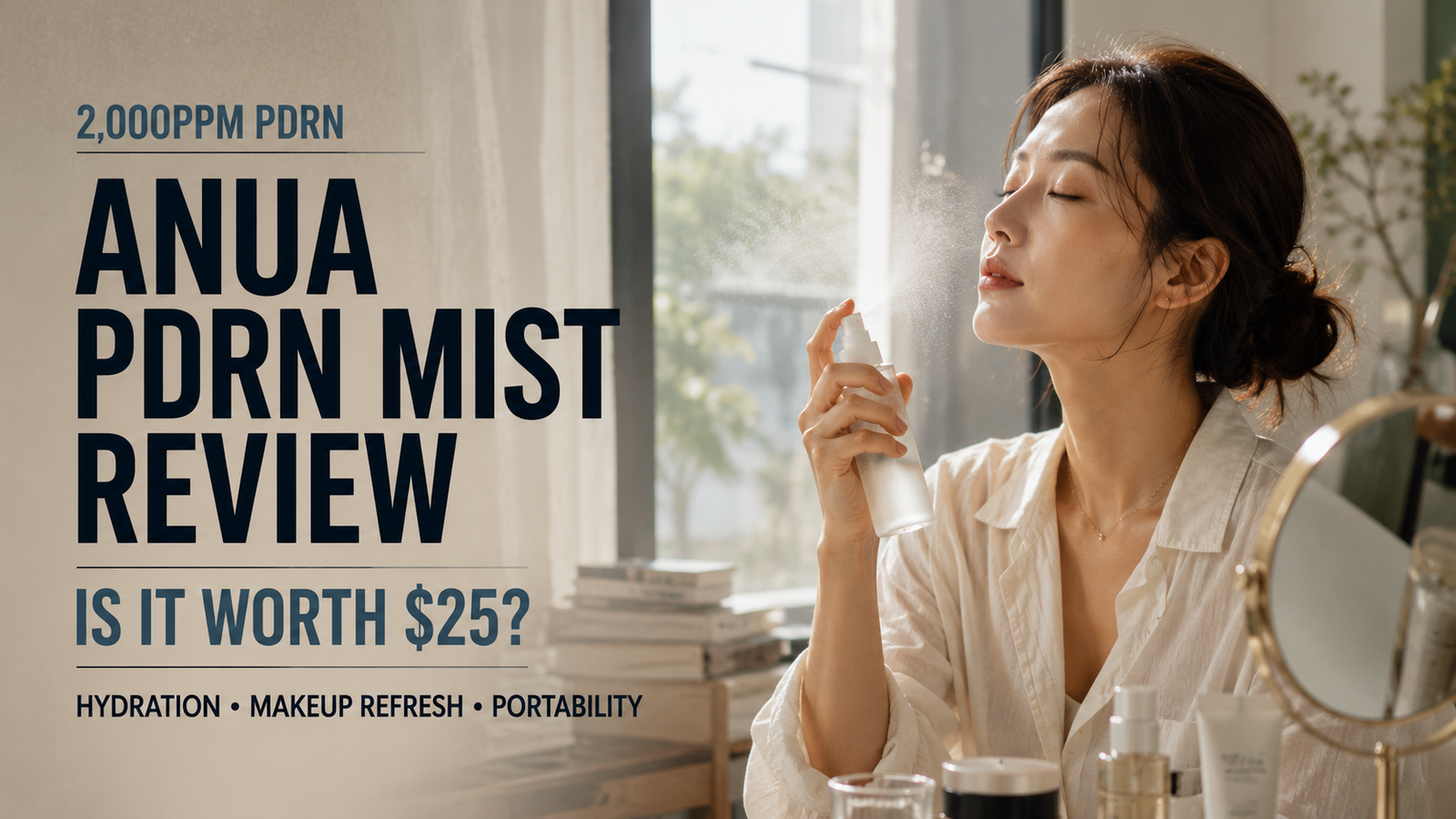
This Anua PDRN mist review starts with a question that matters more than the ingredient trend:
Is the $25 PDRN Collagen Glow Facial Serum Spray actually useful enough to justify buying—or is it mainly a dewy hydration mist with a PDRN headline?
The answer is more practical than dramatic.
Anua currently markets the 100mL mist with 2,000ppm PDRN, hyaluronic acid, collagen, and fine oil capsules. The full ingredient list also includes Sodium DNA, panthenol, allantoin, multiple hyaluronic-acid forms, emollients, oils, silicones, Ceramide NP, adenosine, and Copper Tripeptide-1.
It can be used after cleansing, before makeup, over makeup, or whenever skin feels dry.
That flexibility is its strongest selling point.
My evidence-based verdict is:
Worth it if you want a hydrating, dewy, portable serum mist that you will actually use.
Much less compelling if you are buying it mainly because 2,000ppm PDRN sounds like proof of a high-performance anti-aging treatment.
This is an evidence-based product analysis based on the current formula, official product information, brand-provided finished-product testing, published research, published third-party editorial experience, and public consumer feedback. K-Beauty Clarity did not personally test this product.
Prices and product information were checked on August 31, 2026 and can change.
Anua PDRN Mist Review: Quick Facts
Official product name: PDRN Collagen Glow Facial Serum Spray
Full size: 100mL
Official U.S. price checked: $25
Mini: 30mL
Official mini price checked: $14
PDRN claim: 2,000ppm
PDRN-related ingredient listed in the current INCI: Sodium DNA
Other notable listed ingredients: Panthenol, allantoin, glycerin, multiple hyaluronic-acid forms, hydrolyzed collagen, Ceramide NP, adenosine, Copper Tripeptide-1, silicones, emollients, and several botanical oils
Format: Lightweight watery essence spray with fine oil capsules
Official uses: Toner alternative, skincare prep, before makeup, after makeup, and on-the-go hydration
Official directions: Spray when skin feels dry; Anua says it can be used over makeup and does not need to be shaken
Brand labeling: Anua currently labels the product non-comedogenic
Best reason to buy: Hydration, glow, portable reapplication, and makeup refresh
Weakest reason to buy: Assuming 2,000ppm alone proves superior PDRN delivery or treatment-level anti-aging results
Is the Anua PDRN Mist Worth $25?
It can be.
But I would buy it primarily for what the finished product does as a serum mist, not simply for the PDRN number on the label.
The product can fill several practical roles:
- lightweight hydration after cleansing
- a toner alternative
- pre-makeup hydration
- a midday facial mist
- over-makeup refresh
- a portable dry-skin touch-up
That makes it more versatile than a conventional serum.
The key buying question is:
Would you still want this product if the front of the bottle simply said “hydrating serum mist”?
If the answer is yes, the Anua mist makes sense.
If the answer is no—and 2,000ppm PDRN is the only reason you want it—the value proposition becomes much weaker.
What Does 2,000ppm PDRN Actually Mean?
Anua prominently markets this mist with 2,000ppm PDRN.
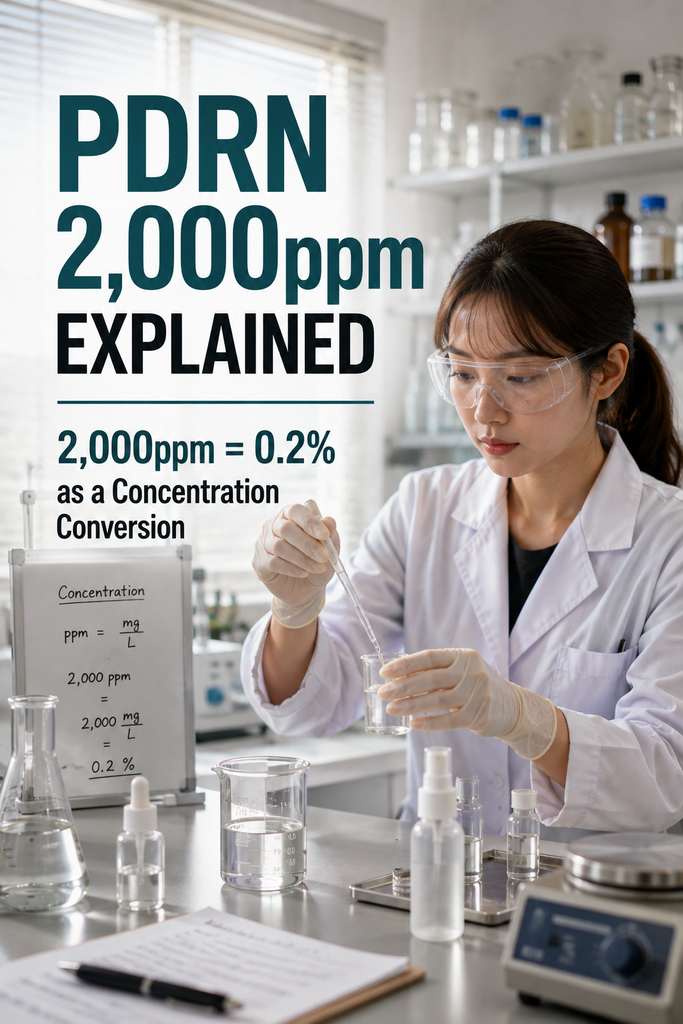
As a concentration conversion:
2,000ppm corresponds to 0.2%.
That conversion is simple.
The interpretation is not.
A concentration number alone does not tell us:
- the molecular characteristics of the PDRN material
- how the finished formula behaves on skin
- how efficiently a particular material is delivered
- how much reaches relevant skin layers
- whether 2,000ppm performs better than another product with a lower or higher number
- whether the mist will reproduce results from an unrelated clinical PDRN formulation
The current full INCI clearly lists Sodium DNA.
What we should not do is turn that into:
“2,000ppm means this is automatically a clinically strong PDRN treatment.”
It does not.
And we should not assume that a 2,000ppm cosmetic mist is automatically twice as effective as a 1,000ppm product or 20 times as effective as a 100ppm product.
Those comparisons would require much more than the front-label concentration.
If you are new to the ingredient, our guide to what PDRN skincare actually is explains why source, molecular characteristics, delivery, finished formula, and clinical testing matter alongside concentration.
Does Topical PDRN Have Any Real Evidence?
Yes, but this is where product-specific limits matter.
Topical PDRN research is developing.
A 2026 randomized, double-blind, split-face study evaluated a specific 0.1% medium-length PDRN-850K eye cream against a 0.1% retinol eye cream over 28 days.
That study is relevant because it shows that defined topical PDRN formulations can be investigated for skin delivery and visible skin outcomes.
It does not prove that every product listing Sodium DNA produces the same result.
The Anua mist is not the PDRN-850K eye cream used in that study.
The material, formula, supporting ingredients, delivery system, application pattern, and product format are different.
So the practical conclusion is:
Topical PDRN is scientifically interesting. Anua’s 2,000ppm label is not, by itself, proof that this mist reproduces results from a different clinical formula.
That distinction matters more than simply saying that PDRN has “research behind it.”
What Is Actually Doing the Hydrating?
The finished formula gives us several reasons to expect the product to behave differently from a simple water spray.
The current ingredient list begins with:
Water, Diphenyl Dimethicone, Dipropylene Glycol, Pentylene Glycol, 1,2-Hexanediol, Glycereth-26, Propanediol, Streptococcus Thermophilus Ferment, Butylene Glycol, and Panthenol.
It also includes ingredients such as:
- Caprylic/Capric Triglyceride
- Sodium DNA
- Hydroxyethyl Urea
- Allantoin
- glycerin
- Sodium Hyaluronate
- Hydrolyzed Hyaluronic Acid
- Hyaluronic Acid
- Hydrolyzed Collagen
- Ceramide NP
- Copper Tripeptide-1
- multiple botanical oils
- silicones and other emollient components
Several of these are commonly used in hydration-focused or emollient skincare formulas.
That matters because the immediate dewy appearance of a mist can come from the finished formula as a whole, not from one headline ingredient alone.
Humectant-focused ingredients, oil-phase ingredients, silicones, and emollients can all influence how moisturized, smooth, reflective, or cushioned the surface looks.
The ingredient list also tells us what we cannot conclude.
The presence of hydrolyzed collagen does not prove that the product rebuilds dermal collagen.
The presence of Ceramide NP does not by itself prove a measurable barrier-repair outcome for this finished mist.
Copper Tripeptide-1 is listed, but the current public page does not disclose its concentration or isolate its contribution to the product’s performance.
That is why the formula should be judged as one finished mist rather than as a collection of individually proven high-strength treatments.
What Do Anua’s Product Tests Actually Show?
Anua publishes product-specific testing on the current U.S. page.
The brand cites testing by P&K Skin Research Center involving 20 adult women aged 20 to 59.
The specific footnoted claim describes 24-hour “inner skin hydration” persistence.
That is useful information because the test concerns this finished product rather than an unrelated ingredient.
But it still needs to be described accurately.
This is brand-provided finished-product testing.
It supports the mist’s hydration-focused positioning.
It does not prove:
- that PDRN alone caused the hydration result
- that the product rebuilds collagen
- that it produces structural skin rejuvenation
- that every user will get 24 hours of the same subjective hydration
- that the formula outperforms another PDRN product
The product page also uses language around smoother-looking texture, fresh makeup, glow, and firmer-looking skin.
Those are brand product-positioning claims.
The clearest product-specific evidence visible on the page is still the finished-product hydration-persistence test.
What Are the Oil Capsules?
Anua describes the formula as a lightweight, watery essence containing fine oil capsules.
That format helps explain why this feels conceptually closer to a serum mist than a basic water spray.
The oil and emollient phase may contribute to a dewier surface finish and help the mist feel less fleeting than a plain water mist.
Anua’s current directions also say:
No need to shake.
That is worth following rather than assuming every visible capsule formula should be vigorously mixed.
There is, however, a practical issue worth watching.
Recent public reviews include both users who like the fine, even spray and users who report visible separation, capsule material accumulating toward the bottom, or the spray becoming less fine over time.
These are user-reported experiences.
They do not prove a universal packaging or formulation defect.
But because spray quality is central to the value of any face mist, they are relevant purchase information.
Is It Actually a Fine Mist?
For many users, yes.
Recent Hwahae reviews include positive reports describing:
- fine and even distribution
- easy reapplication
- comfortable use over makeup
- convenient daytime spraying
- good hydration
But the feedback is not uniform.
Other users report:
- the mist becoming less fine over time
- visible capsule buildup
- formula separation
- excess surface oil
- inconsistent spraying
- occasional pilling or buildup depending on how it is used
These experiences should not be treated as proof that every bottle will develop the same issue.
They are practical consumer signals.
If the spray starts landing in heavier droplets, applying from slightly farther away and using a lighter layer may be more comfortable than repeatedly saturating the face.
Does It Work Over Makeup?
This is one of the strongest reasons to choose the Anua mist over a conventional PDRN serum.
Anua explicitly says the product can be used before or after makeup.
Recent editorial and consumer feedback also supports this as a common real-world use.
Glamour named the Anua PDRN Collagen Glow Facial Serum Spray its Best Overall Korean facial mist in an August 2026 roundup, while emphasizing hydration and glow as the main reasons for the pick.
An InStyle editor has also described using the spray as a lightweight hydrating product before makeup and for daytime refreshing.
Those are editorial experiences—not controlled efficacy studies.
The same distinction applies to consumer reviews.
Some users report that it refreshes dry-looking foundation without disturbing makeup.
Others report excess glow, oiliness, buildup, or pilling.
So the safest expectation is:
The format is designed to work over makeup, but compatibility will still depend on your sunscreen, foundation, powder, application amount, skin type, and climate.
Start with a light layer.
Do not assume that soaking the face will produce a better result.
Is It Better Before Makeup or After Makeup?
It can make sense in both positions.
Before Makeup
The product can provide a lightweight hydration layer before base makeup.
This may be particularly appealing when skin feels tight or foundation tends to catch on dry-looking surface texture.
You do not necessarily need a mist plus toner plus essence plus several serums.
If this product already gives you the lightweight hydration you want, it can simply take the place of another optional hydration step.
After Makeup
The goal changes.
Here the product functions more like a surface refresh.
A light mist may bring back some dewiness when powder or long-wear makeup starts looking flat or dry.
Again, more is not necessarily better.
If you prefer matte makeup or use a base that is easily disturbed, start conservatively.
Who Is Most Likely to Enjoy the Finish?
I would not divide this into a simplistic “dry skin good, oily skin bad” rule.
The formula contains both hydration-focused ingredients and an emollient/oil phase.
That means preference matters.
This mist may be more appealing if:
- your skin often feels dehydrated
- your makeup becomes dull or dry-looking
- you enjoy dewy finishes
- you like emollient-leaning facial mists
- you want to reapply hydration without touching your face
People with oily skin are not automatically excluded.
Recent reviews include positive experiences from multiple skin types.
But if your skin becomes shiny quickly or you strongly prefer matte finishes, begin with a light application and judge the result before layering more.
Skin type, climate, sunscreen, foundation, powder, and application amount can all change how the same mist feels.
Does It Feel Sticky or Oily?
Anua markets the product as non-sticky.
That does not mean every user experiences the exact same finish.
Most descriptions position it as lightweight and watery, but some public reviews report oiliness or tackiness, particularly with heavier application.
The most realistic expectation is:
lighter than a conventional face oil, but more emollient and glow-focused than a plain water mist.
If you want a completely matte, oil-free-feeling spray, this is not the most obvious choice.
Can It Replace Moisturizer?
Not automatically.
A face mist can be useful as an extra hydration step, but it does not necessarily provide the same function as a moisturizer designed to reduce water loss and provide a longer-lasting emollient or occlusive layer.
Glamour’s dermatologist-informed Korean mist guide makes the same general point: facial mists can add hydration, but they should not automatically replace a moisturizer.
If your skin needs a moisturizer, use one.
The mist can be an additional step rather than a mandatory substitute.
Can It Replace Toner?
Anua explicitly positions the product as a toner alternative.
So yes, it can take that role if you like the formula after cleansing.
That does not mean everyone needs both a toner and this mist.
If both products mainly give you lightweight hydration, using both may simply duplicate the same function.
Our Korean skincare routine order guide explains why product function and individual directions matter more than blindly following a fixed 10-step routine.
Anua PDRN Mist vs a Dedicated PDRN Serum
This is an important distinction.
The mist should not automatically be considered weaker, stronger, or less “treatment-focused” simply because it sprays.
And a serum should not automatically be considered superior because it comes in a dropper bottle.
The useful comparison is:
format + routine role + full formula.
Choose the mist if you prioritize:
- spray application
- portability
- toner-like use
- quick hydration
- pre-makeup prep
- over-makeup refresh
- reapplication during the day
Choose a dedicated serum if you prefer:
- controlled drop-by-drop application
- a conventional treatment step
- a product you apply once within a fixed skincare routine
- a different supporting ingredient system
If you are already deciding between dedicated PDRN serums, read our Anua PDRN vs Medicube PDRN comparison.
The important point is not to let the biggest ppm number decide between fundamentally different product formats.
Should You Buy the 30mL Mini or 100mL Full Size?
This is one of the clearest buying decisions.
At the official prices checked for this article:
30mL mini: $14
100mL full size: $25
That works out to approximately:
Mini: $0.47 per mL
Full size: $0.25 per mL
So the full size costs about 46% less per mL than the mini.
If you already know you like dewy serum mists, the full size is clearly the better value.
The mini has a different advantage:
lower-risk testing.
Buy the mini first if you are unsure about:
- the oil-capsule feel
- the level of dewiness
- how your makeup reacts
- whether you like the sprayer
- whether you will actually use a facial mist often enough
The mini costs more per mL, but that can still be a sensible price for avoiding a larger product you may not finish.
What Are Current Buyers Saying?
Recent public feedback shows a useful mix of strengths and limitations.
Positive experiences commonly mention:
- hydration
- dewy appearance
- a fine spray when the sprayer performs well
- use over makeup
- convenient daytime reapplication
- portability
- use after cleansing or when skin feels dry
Critical experiences include reports of:
- excess oiliness
- visible formula separation
- capsule buildup
- the spray becoming less fine
- occasional pilling or buildup
- the finish not matching a user’s skin type or makeup preference
These are consumer experiences, not controlled product testing.
They also do not prove a universal product defect.
The more useful takeaway is:
the formula and sprayer experience matter almost as much as the PDRN headline.
Who Should Buy It?
The Anua PDRN Collagen Glow Facial Serum Spray is most compelling if:
- you already enjoy facial mists
- portable hydration matters
- you like a dewy finish
- your makeup sometimes becomes dry-looking during the day
- you want a product that can work before and after makeup
- you want a toner-alternative option
- you prefer a multipurpose product over a single fixed serum step
- you would still want the formula if PDRN were only one supporting part of it
Who Should Skip It?
I would be more cautious if:
- 2,000ppm PDRN is your only reason for buying
- you expect clinic-level PDRN results from a cosmetic mist
- you want guaranteed collagen rebuilding
- you strongly prefer matte, non-emollient facial sprays
- you dislike suspended capsule formulas
- you rarely use facial mists
- you want a conventional dropper serum rather than a reapplication product
- $25 feels too high for a hydration-and-refresh format

Where Should You Buy It?
The safest starting point is the official Anua U.S. PDRN Collagen Glow Facial Serum Spray page.
The 100mL bottle was listed at $25 when this review was finalized.
Anua also sells an official 30mL mini, which was listed at $14.
Prices, bundles, promotions, and inventory can change.
If you are uncertain about the finish or spray experience, I would pay the higher per-mL cost for the mini first.
If you already know you like this type of serum mist, the 100mL bottle offers substantially better value.
Final Verdict: Is the Anua PDRN Mist Worth It?
Yes—if you want a versatile hydrating serum mist.
The finished product makes the most sense for:
- hydration
- glow
- makeup prep
- makeup refresh
- portable reapplication
- people who enjoy dewy mist formats
Anua clearly lists 2,000ppm PDRN and Sodium DNA in the current formula.
That is relevant.
But the number should not be treated as proof of clinic-level anti-aging performance or evidence that PDRN alone explains the product’s visible results.
The immediate appeal is easier to understand from the finished formula:
a watery mist containing hydration-focused ingredients, emollients, silicones, oil capsules, hyaluronic-acid forms, and other supporting ingredients.
Anua also cites brand-provided finished-product testing supporting 24-hour hydration persistence.
That strengthens the hydration story.
It does not isolate PDRN as the reason for every effect or prove long-term collagen rebuilding.
So my final buying verdict is:
Buy it for hydration, glow, makeup refresh, and portability.
Treat the 2,000ppm PDRN as a supporting reason—not the entire reason—to spend $25.
If your real goal is a conventional PDRN serum rather than a multipurpose mist, compare serum formulas instead.
Bottom line: this is more convincing as a hydrating serum mist with PDRN than as a PDRN treatment that happens to come in a spray bottle.
Sources & Product Verification
Anua U.S. — PDRN Collagen Glow Facial Serum Spray
Anua U.S. — PDRN Collagen Glow Facial Serum Spray Mini
PubMed — 2026 Topical Medium-Length PDRN Study
Glamour — Best Korean Facial Mists 2026
Hwahae — Anua PDRN Hyaluronic Acid Hydrating Capsule Mist Reviews
InStyle — Editor-Loved Summer Skin Care
K-Beauty Clarity — What Is PDRN Skincare?