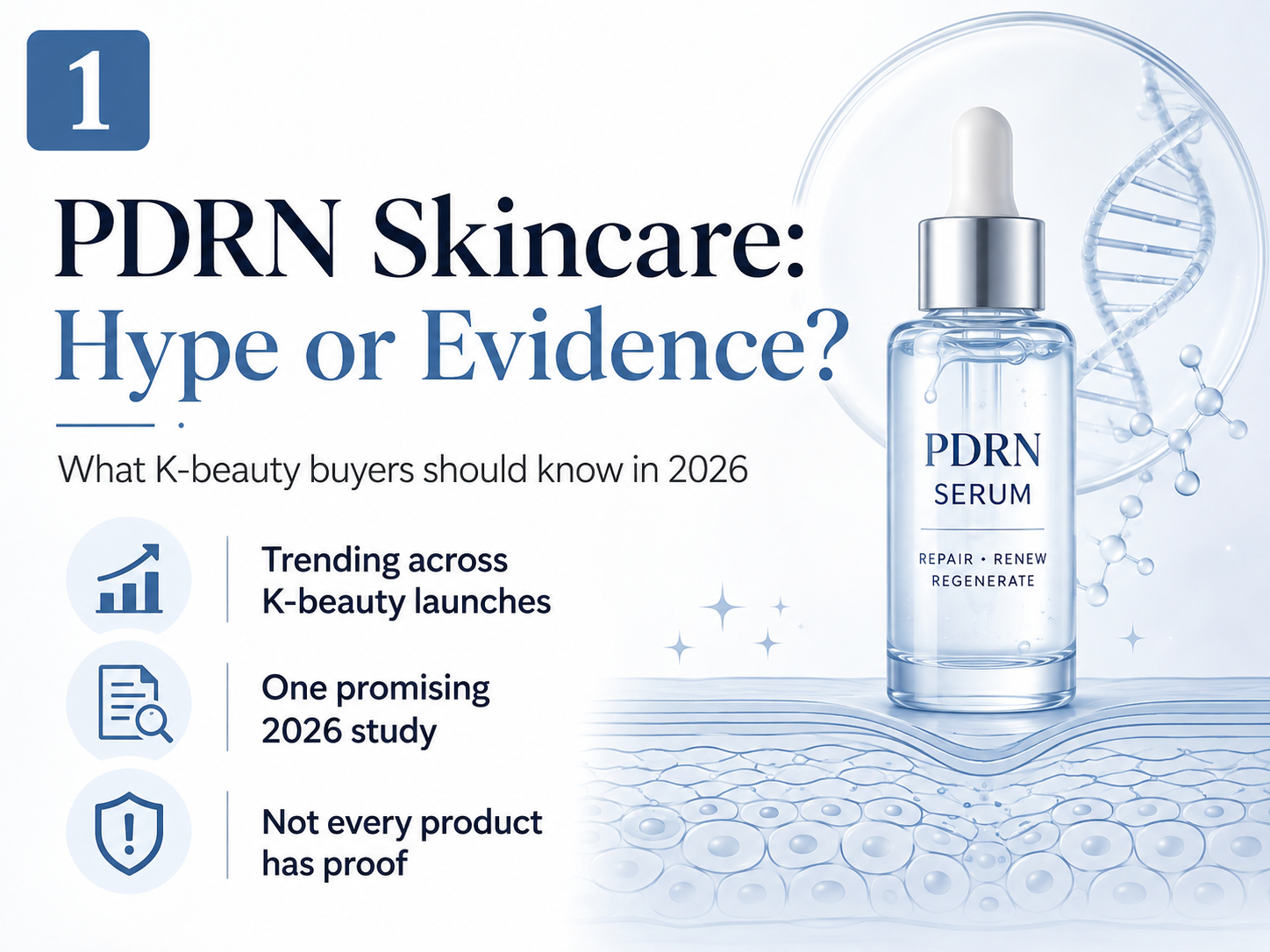
What is PDRN skincare, and does it actually work?
PDRN has moved quickly from aesthetic clinics into serums, creams, masks, and eye treatments — especially across Korean skincare.
But there is an important distinction that often gets lost in the hype:
Evidence for injected PDRN is not automatically evidence that every PDRN cream or serum will work the same way.
PDRN stands for polydeoxyribonucleotide, a mixture of DNA-derived fragments.
Traditional PDRN materials have often been purified from salmonid DNA, while newer research is also exploring plant- and microalgae-derived alternatives.
Research around PDRN is genuinely interesting. There is evidence supporting biological effects related to tissue repair, and newer studies have begun to investigate topical PDRN more directly.
That still does not mean every product labeled “PDRN” has been proven to repair skin, rebuild collagen, or outperform established skincare ingredients.
Here is what the evidence actually tells us.
The 30-Second Answer
PDRN is a DNA-derived ingredient that has been studied for tissue repair and regenerative applications.
For skincare, one of the biggest questions is delivery.
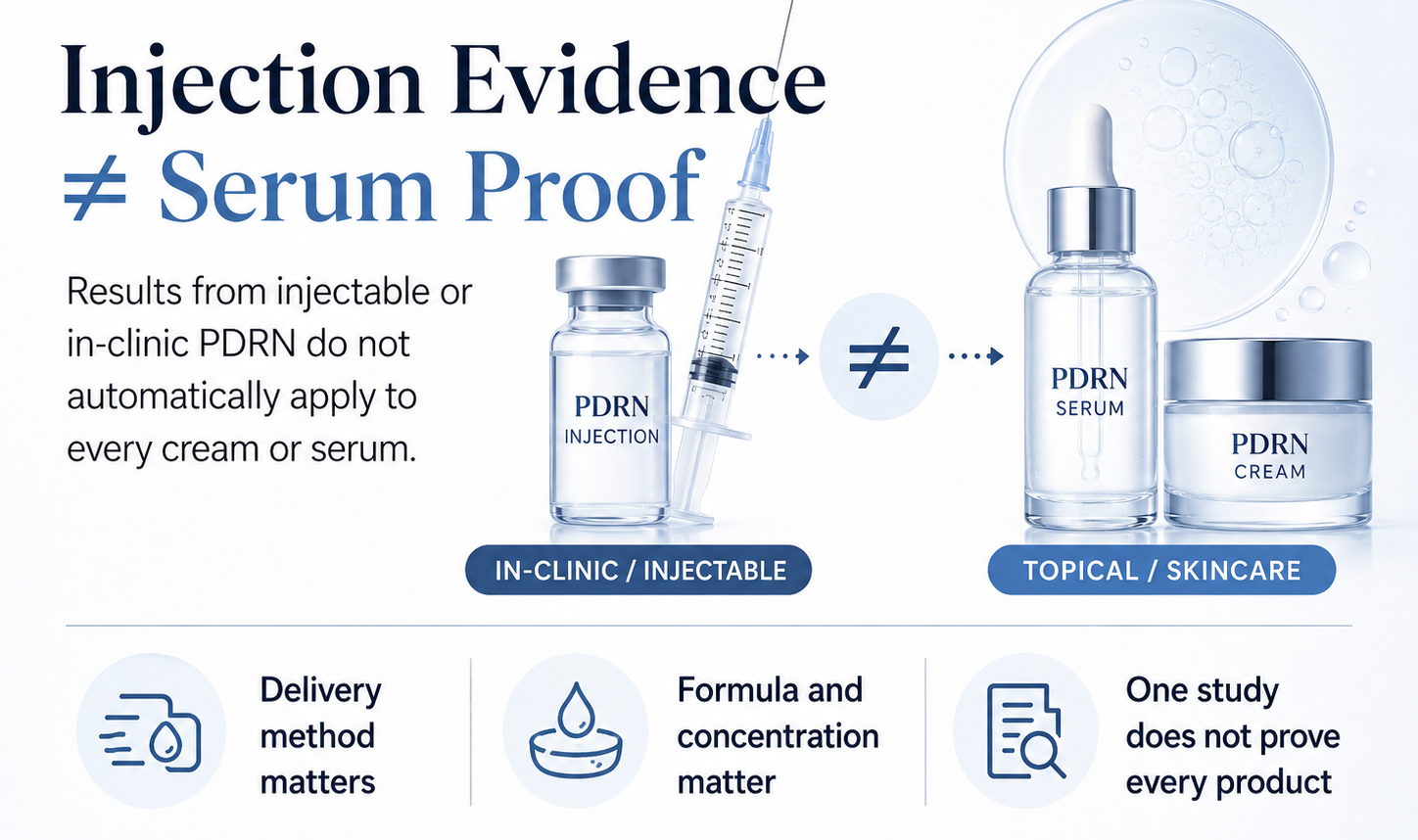
Historically, much of the clinical evidence around PDRN came from injectable, local, or medical applications rather than ordinary leave-on cosmetics.
More recently, researchers have begun studying topical PDRN specifically.
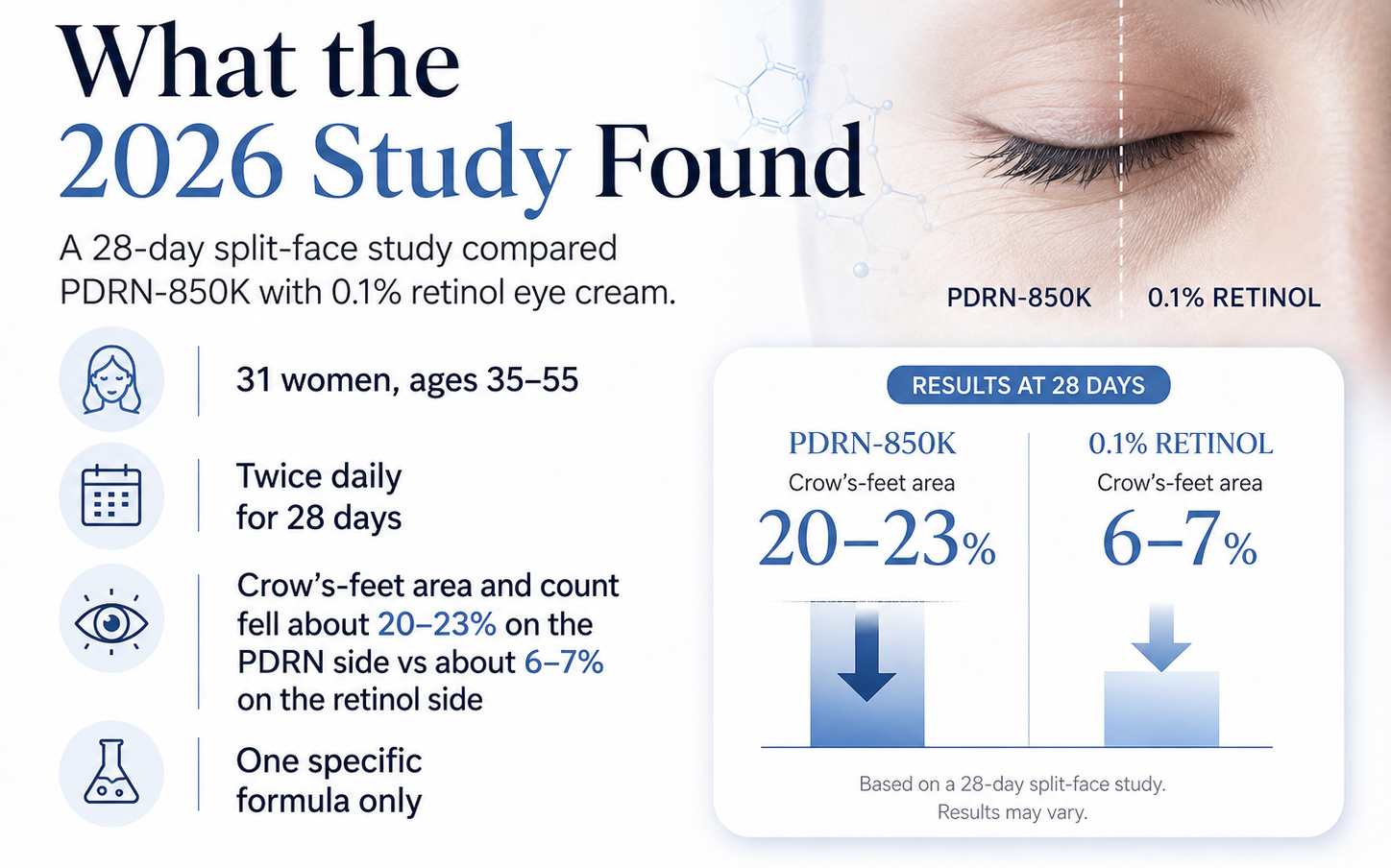
A 2026 randomized, double-blind, split-face study found promising results from a specific 0.1% PDRN-850K eye cream over four weeks.
However:
- The clinical study included only 31 participants.
- It tested one specific PDRN preparation and formulation.
- The treatment period was only 28 days.
- The results cannot automatically be applied to every PDRN serum, cream, toner, or mask.
Bottom line: Topical PDRN is promising, but formulation and delivery matter far more than simply seeing “PDRN” on the front of a bottle.
What Is PDRN Skincare?
PDRN stands for polydeoxyribonucleotide.
It consists of DNA-derived polymer fragments made from deoxyribonucleotides — the building blocks found in DNA.
Traditional pharmaceutical and aesthetic PDRN preparations have often been derived from salmonid DNA.
But “PDRN” is not necessarily one perfectly standardized material across every cosmetic product.
Different products may use different:
- Sources
- Fragment sizes
- Molecular weights
- Concentrations
- Delivery systems
- Supporting ingredients
- Finished formulations
These differences matter because a product containing PDRN is not automatically equivalent to the material used in a clinical study.
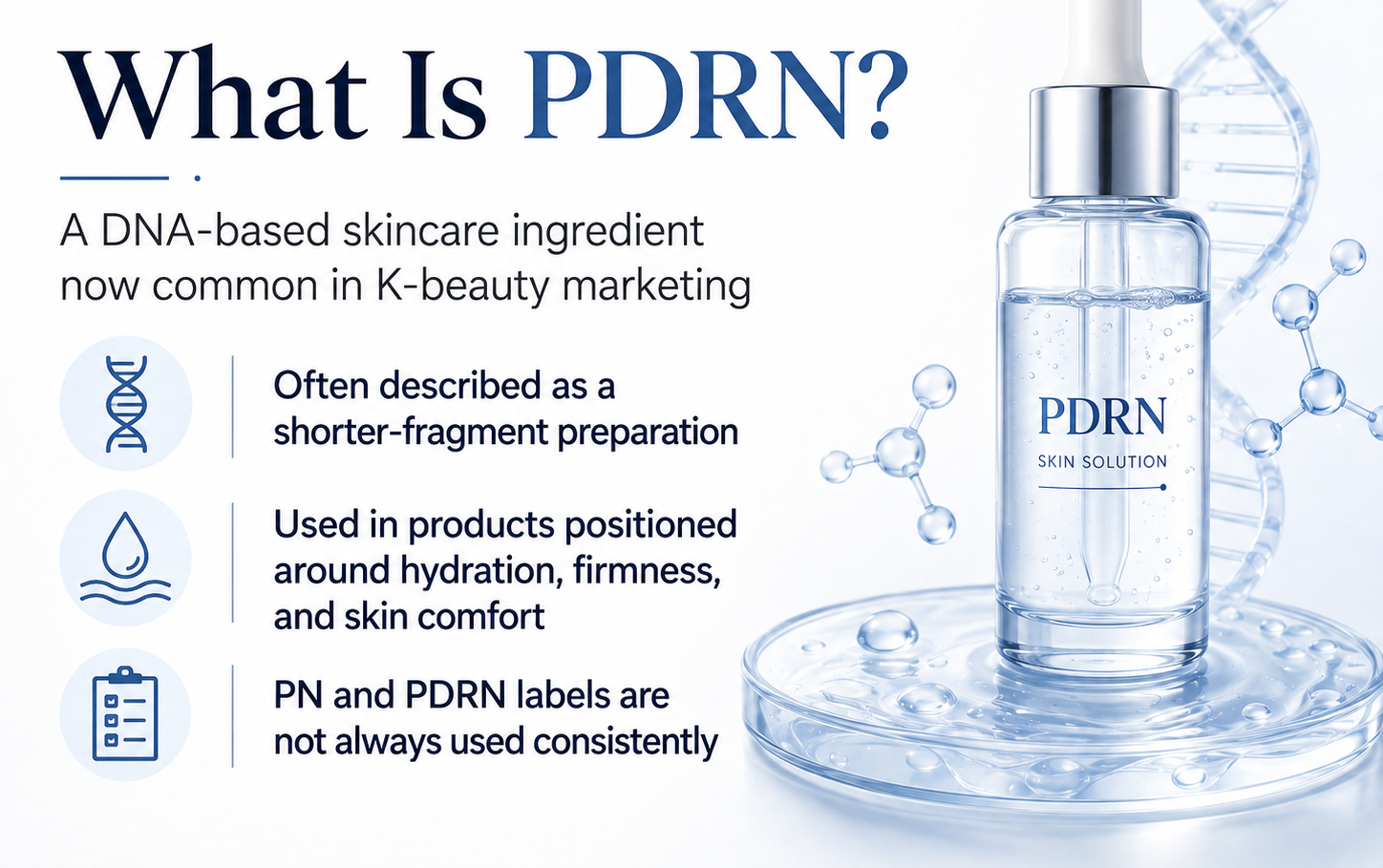
PDRN vs PN: Are They the Same Thing?
Not exactly.
You may also see PN, or polynucleotide, discussed in aesthetic medicine.
In many dermatology and aesthetic-medicine contexts, PN is described as containing relatively longer DNA fragments, while PDRN is often described as a shorter-fragment preparation.
However, terminology and product labeling are not always used consistently across scientific literature, brands, markets, and medical or cosmetic settings.
Their proposed biological roles may overlap, but that does not mean every PN and PDRN product is interchangeable.
So when a clinic treatment uses PN and a cosmetic serum contains PDRN, you should not assume that they contain the same material or deliver it in the same way.
Why Is PDRN Showing Up More Often in K-Beauty?
PDRN has become increasingly visible across Korean skincare launches and marketing in 2026, particularly in products positioned around hydration, firmness, and post-treatment-inspired care.
It also fits several broader skincare trends:
- Barrier-focused routines
- “Slow aging” rather than aggressive anti-aging
- Post-treatment-inspired skincare
- Peptides and regenerative-style ingredients
- Smoother-looking texture and bounce
- Multifunctional formulas
The marketing story is attractive.
The scientific story is more nuanced.
Another longevity-focused trend appearing alongside PDRN is NAD+. If you are exploring that category, our NAD+ skincare guide explains the evidence and delivery questions, while our best NAD+ Korean skincare products guide compares seven current formulas.
For a real-world example of how PDRN is moving into mainstream U.S. beauty retail, see our guide to the Olive Young K-Beauty Edit at Sephora.
Does Topical PDRN Actually Work?
What We Already Knew
Earlier PDRN research showed promising effects related to tissue repair and wound-healing processes, but much of that evidence did not come from ordinary cosmetic serums or creams.
That created an important question:
Can a relatively large, negatively charged DNA-derived molecule actually move through the skin when applied topically?
This has been one of the major challenges in translating PDRN research into skincare.
That is why evidence from injectable PDRN cannot simply be copied and applied to a face serum.
What Changed in 2026?
A study published in PLOS ONE on July 10, 2026 evaluated a medium-length PDRN preparation known as PDRN-850K.
The material used in the study was a high-purity PDRN extracted from salmon sperm, with an average fragment length of approximately 1,200 base pairs and an average molecular weight not exceeding 850 kDa.
Researchers investigated:
- Cellular signaling
- Reconstructed epidermal penetration
- Ex vivo skin
- Exploratory human penetration measurements
- UV-damaged human skin models
- A randomized human split-face clinical trial
The clinical portion included 31 healthy Chinese women aged 35 to 55 with self-reported sensitive skin.
Participants applied:
- A 0.1% PDRN-850K eye cream to one periocular side
- An eye cream with an identical base containing 0.1% retinol to the other side
Both were applied twice daily for four weeks.
Daytime sunscreen use was required.
At Day 28, the PDRN-treated side showed larger improvements in several measured periocular parameters.
For crow’s-feet measurements, wrinkle area and number decreased by approximately 20–23% on the PDRN side, compared with approximately 6–7% on the retinol side.
The study also reported greater short-term improvements in measurements related to dermal thickness, density, firmness, elasticity, eye bags, and tear troughs.
Those results are interesting.
But they require context.
Does That Mean PDRN Is Better Than Retinol?
No.
That conclusion would go much further than the evidence allows.
The study compared:
one specific 0.1% PDRN-850K eye cream
with
one specific 0.1% retinol eye cream
for only 28 days in 31 participants.
The researchers themselves noted that four weeks is a relatively short period for substantial mature dermal remodeling.
They also acknowledged that some early ultrasound changes could partly reflect temporary hydration or plumping.
Retinoids, by comparison, have been studied across a much broader body of research and over much longer treatment periods.
So the responsible interpretation is:
This specific PDRN formulation produced promising short-term results under the conditions of this study.
It does not prove that:
- PDRN is universally better than retinol.
- Every PDRN serum works.
- Every concentration produces similar results.
- A PDRN toner performs like the tested eye cream.
- Topical PDRN works like injectable PDRN.
There are additional limitations.
The researchers noted that Raman spectroscopy cannot unequivocally distinguish applied PDRN from naturally occurring nucleic acids in every circumstance.
The exploratory in vivo penetration test of the finished eye cream also involved only one healthy volunteer, so it should be viewed as supportive rather than definitive penetration evidence.
The PDRN material used in the study was provided by Ruijiming (Shandong) Biotechnology Co., Ltd. The authors reported no specific funding for the study and declared no conflicts of interest.
Larger, longer, and independently replicated clinical studies would strengthen confidence in the findings.
What Benefits Can You Realistically Expect?
Based on current evidence, topical PDRN is most reasonably viewed as a promising supportive skincare active, particularly in formulas positioned around hydration, texture, firmness, and barrier-focused care.
1. The Appearance of Fine Lines
The 2026 PDRN-850K trial reported measurable short-term improvements in periocular wrinkle parameters.
That is encouraging, but it is evidence for the tested formulation — not proof that every cosmetic containing PDRN will produce the same result.
2. Firmness and Elasticity
The same study reported improvements in measurements related to firmness and elasticity.
Again, the evidence should be interpreted at the formulation level.
3. Skin-Repair-Related Pathways
Laboratory research suggests that PDRN can influence signaling pathways associated with fibroblast activity and extracellular matrix regulation.
Mechanistic findings are useful for understanding how an ingredient might work.
They are not the same as proving a visible benefit from every retail product.
4. Barrier-Focused Care
Plant- and microalgae-derived PDRN research has also reported changes in skin-cell and barrier-related markers.
For example, researchers have studied PDRN derived from Panax ginseng, Gynostemma pentaphyllum, and Chlorella protothecoides.
Much of this evidence remains preclinical, so phrases such as “barrier-focused care” are more appropriate than claiming that every PDRN cosmetic “repairs the skin barrier.”
Why the Formula Matters More Than the Marketing
If you remember only one thing from this article, make it this:
“Contains PDRN” is not enough information to judge a product.
Topical delivery is one of the major scientific questions around PDRN.
A formula can differ by:
- Molecular size
- Fragment length
- Concentration
- Ingredient source
- Delivery technology
- Vehicle
- Supporting humectants
- Peptides
- Niacinamide
- Ceramides
- Other active ingredients
A product may make your skin look more hydrated or plump because of the complete formulation rather than PDRN alone.
That does not make the product ineffective.
It simply means you should evaluate the finished formula, not just the trending ingredient name.
Is All PDRN Made From Salmon?
No.
Salmon-derived PDRN is the best-known form in much of the medical and aesthetic literature.
But researchers have also investigated non-animal sources.
Examples include:
- Panax ginseng
- Gynostemma pentaphyllum
- Chlorella protothecoides microalgae
Laboratory studies suggest that some of these alternatives can influence skin-cell proliferation, migration, collagen-related activity, and barrier-associated markers.
However, the evidence base is still developing.
So if a brand claims to use “vegan PDRN,” check what the ingredient is actually derived from.
Plant-derived or algae-derived does not automatically mean clinically equivalent to salmon-derived PDRN.
Source, processing, molecular characteristics, concentration, formulation, and testing still matter.
For a direct product example of why source alone is not enough, our Clinique PDRN Cream vs Medicube comparison compares Clinique’s cica-derived positioning with Medicube’s salmon-DNA PDRN without treating either source as automatically stronger.
A useful real-world example is our Clinique PDRN Cream review: Clinique describes its PDRN as biotech-derived from cica, but the current product page does not disclose a directly comparable PDRN percentage or ppm amount.
How to Use PDRN in a Skincare Routine
For a typical PDRN serum, a simple routine may look like this.
Morning
- Cleanser
- Toner or essence, if you use one
- PDRN serum
- Moisturizer
- Broad-spectrum sunscreen
Evening
- Cleanser
- Toner or essence
- PDRN serum
- Moisturizer
If the PDRN product is a cream rather than a serum, it will generally be used later in the routine.
Always follow the directions for the individual product.
For a complete layering framework beyond PDRN alone, see our Korean skincare routine order guide for toner, essence, treatments, moisturizer, and sunscreen.
There is currently no scientifically established universal “best PDRN percentage” that applies across all cosmetic formulations.
Some K-beauty formulas also combine PDRN with spicule-based delivery systems. If you’re curious how that technology works, read our guide to spicules in skincare.
Can You Use PDRN With Retinol, Vitamin C, or Acids?
PDRN itself does not currently have a widely established set of ingredient-conflict rules comparable to some irritating or highly reactive skincare actives.
But the complete product matters.
A PDRN formula may also contain:
- Niacinamide
- Peptides
- Exfoliating acids
- Fragrance
- Retinoids
- Other active ingredients
Check the full ingredient list, not just the PDRN claim.
If your skin is sensitive or you are adding several active ingredients, introducing one new product at a time makes it easier to identify irritation.
Who Might Find PDRN Skincare Interesting?
PDRN skincare may be worth exploring if you are interested in products positioned around:
- Hydration
- Smoother-looking texture
- Firmness
- Skin comfort
- Barrier-focused care
- Early visible signs of photoaging
It may also appeal to people interested in newer Korean skincare formulations without wanting an entire routine based around exfoliating acids or stronger retinoids.
But PDRN does not replace the basics.
A well-formulated moisturizer and daily broad-spectrum sunscreen remain more fundamental than chasing the newest skincare active.
Who Should Be More Cautious?
Patch testing is sensible with any new skincare product, particularly if your skin is reactive.
Consider speaking with a qualified healthcare professional if you:
- Are currently being treated for a skin condition
- Have severe or unexplained irritation
- Have recently undergone a cosmetic procedure
- Are pregnant or breastfeeding and are unsure about the full formulation
- Have known allergies relevant to the product
For salmon-derived products, consumers who avoid animal-derived ingredients should verify the source directly with the manufacturer.
How to Choose a PDRN Product
1. What Is the PDRN Source?
Is it salmon-derived, plant-derived, algae-derived, or something else?
2. Is the Concentration Disclosed?
Not every brand publishes this information.
And concentration alone does not tell you how effectively the ingredient is delivered.
3. Is There Product-Specific Testing?
Research on a raw ingredient is not the same as testing the finished product you are buying.
4. What Else Is in the Formula?
Humectants, peptides, niacinamide, ceramides, emollients, and other ingredients may contribute significantly to the visible result.
A good real-world example is Medicube’s multi-active balm: our Medicube PDRN Pink Collagen Volume Multi Balm review explains why its Sodium DNA, NAD/NMN, retinol, peptides, and 5% Volufiline should be judged as one finished formula rather than as isolated headline ingredients.
The same formula-first rule matters when PDRN appears alongside other trending ingredients. Our best Volufiline Korean skincare products guide shows how products combining Volufiline with PDRN, peptides, retinoids, or other supporting ingredients should be judged as finished formulas rather than by one headline percentage.
5. What Is the Actual Claim?
There is a major difference between:
“helps skin look smoother and more hydrated”
and
“regenerates damaged tissue.”
Be cautious when cosmetic marketing moves from appearance claims into treatment-like claims.
6. Is It Appropriate for Your Skin Type?
A trending ingredient cannot compensate for a formula that irritates your skin or does not fit your routine.
7. Is the Price Justified?
Ask whether you are paying for:
- A well-designed complete formulation
- Meaningful concentration information
- Finished-product testing
- Good packaging
- Appropriate supporting ingredients
or mainly for the word PDRN on the label.
If you specifically want a moisturizer, our best PDRN creams guide compares seven current formulas by PDRN source, fragrance, price, and skin goal.
Ready to compare actual products? See our guide to the best PDRN products at Sephora to compare ingredient systems, prices, evidence, and routine fit.
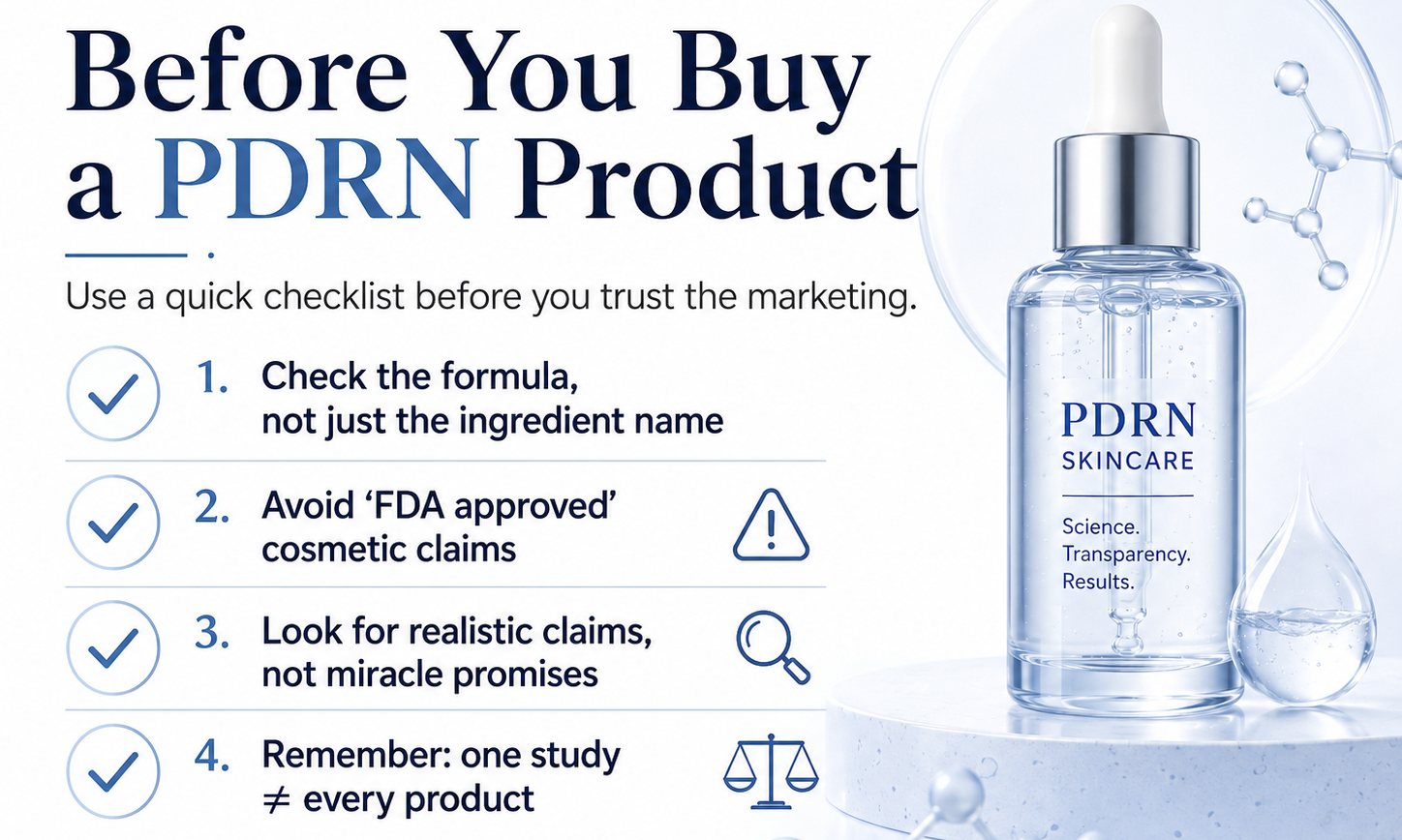
Be Careful With “FDA-Approved PDRN Skincare” Claims
In the United States, cosmetic products and cosmetic ingredients generally do not require FDA premarket approval, with the important exception of color additives.
FDA also states that cosmetic labeling does not receive premarket approval.
And a cosmetic should not be labeled or advertised in a way that suggests FDA has approved the product.
This means several phrases should not be treated as interchangeable:
FDA registered
manufactured in an FDA-registered facility
listed with FDA
FDA approved
They do not mean the same thing.
There is another important distinction.
If a product is marketed with claims that it treats or prevents disease, or affects the structure or function of the body — including the skin — it may legally be considered a drug rather than simply a cosmetic.
So when evaluating PDRN marketing, pay attention not only to the ingredient but also to what the brand actually claims the product does.
PDRN Skincare: What the Evidence Says Right Now
| Question | Current Answer |
|---|---|
| Does PDRN have biological research behind it? | Yes |
| Is there clinical research involving PDRN and tissue repair? | Yes |
| Is most older evidence based on ordinary cosmetic serums? | No |
| Is there now human research on topical PDRN? | Yes, but still limited |
| Has every PDRN cosmetic been clinically proven? | No |
| Does molecular size and formulation matter? | Very likely |
| Is PDRN proven superior to retinoids overall? | No |
| Are plant and microalgae alternatives being researched? | Yes |
The most evidence-based position in 2026 is neither:
“PDRN is just marketing.”
nor:
“Every PDRN cosmetic regenerates your skin like an injectable treatment.”
The evidence sits between those two extremes.
Wondering how PDRN compares with retinol? Read our full PDRN vs retinol comparison, including what the 2026 head-to-head study actually found.
Frequently Asked Questions
Is PDRN Really Salmon DNA?
Many traditional PDRN preparations are derived from purified salmonid DNA.
The PDRN-850K used in the 2026 PLOS ONE study was specifically reported as being extracted from salmon sperm.
Not every modern cosmetic PDRN is necessarily salmon-derived.
Is PDRN the Same as Salmon Sperm?
No.
That phrase is an oversimplification.
Some PDRN raw materials are produced by extracting and purifying DNA from salmon reproductive tissue.
The finished ingredient is a purified preparation of DNA fragments — not raw salmon sperm being added directly to skincare.
Is PDRN Vegan?
Some newer PDRN ingredients are derived from plant or microalgae sources.
Whether a finished product qualifies as vegan depends on the complete formulation and manufacturing process, not only the claimed PDRN source.
Does PDRN Penetrate the Skin?
There is promising evidence for specific preparations, but the answer is not universally established for every product.
The 2026 PDRN-850K study detected time-dependent PDRN-associated signals in viable epidermal regions across reconstructed skin models and supporting experiments.
However, the authors also identified limitations in the penetration methodology.
The in vivo penetration test of the finished eye cream was exploratory and involved one volunteer.
So it is more accurate to say:
Certain topical PDRN formulations have shown evidence consistent with skin penetration, but this cannot yet be generalized to every PDRN cosmetic.
Is PDRN Better Than Retinol?
Current evidence does not justify that broad conclusion.
The 2026 study found better short-term results on several measurements for one specific PDRN formulation than for its 0.1% retinol comparator.
That does not outweigh the much larger and longer evidence base behind retinoids as a category.
How Long Does Topical PDRN Take to Work?
There is no universal timeframe.
The 2026 clinical trial measured changes at Day 14 and Day 28.
Different retail products may use different PDRN materials, concentrations, vehicles, and supporting ingredients.
Can PDRN Replace Sunscreen?
No.
PDRN does not replace UV protection.
If photoaging is a concern, daily broad-spectrum sunscreen remains one of the most important parts of a skincare routine.
Final Verdict
PDRN is one of the more scientifically interesting ingredients appearing in K-beauty in 2026.
But it deserves a more careful evaluation than marketing headlines often provide.
There is legitimate biological research behind PDRN.
There is also newer evidence suggesting that specific topical formulations can produce measurable short-term cosmetic improvements and show evidence consistent with delivery into viable skin layers.
At the same time, the evidence base for topical consumer skincare remains limited compared with long-established ingredients such as retinoids.
The biggest mistake is assuming that research on one PDRN preparation — or research involving injections — proves that every PDRN serum, cream, toner, or mask will produce the same results.
When choosing a product, focus on:
Source.
Concentration.
Molecular characteristics.
Formulation.
Supporting ingredients.
Finished-product testing.
Realistic claims.
Price.
That is a better way to evaluate PDRN than simply buying the bottle with the biggest PDRN claim on the front.
For a current example of that rule in action, see our Medicube vs COSRX PDRN mask comparison, where the finished formulas, fragrance, wear time and price matter more than the size of the PDRN claim.
If you want to see that framework applied to a viral finished product, read our Medicube PDRN Pink Collagen Gel Mask review, which separates its hydration and long-wear glow benefits from what the PDRN label itself can actually prove.
Last reviewed: August 20, 2026
This article is for educational purposes only and is not a substitute for personalized medical advice.
References
- Ye R, Wang Q, Du L, Li L, Hu F. Topical medium-length PDRN enhances dermal extracellular matrix repair in photodamaged skin via PI3K-Akt/TGF-β-regulated pathways. PLOS ONE. 2026;21(7):e0350905. DOI: 10.1371/journal.pone.0350905.
- Kim ST. Comparison of Polynucleotide and Polydeoxyribonucleotide in Dermatology: Molecular Mechanisms and Clinical Perspectives. Pharmaceutics. 2025;17(8):1024.
- Marques C, et al. From Polydeoxyribonucleotides (PDRNs) to Polynucleotides (PNs): Bridging the Gap Between Scientific Definitions, Molecular Insights, and Clinical Applications of Multifunctional Biomolecules. Biomolecules. 2025;15(1):148.
- Park JM, et al. Effects of Chlorella protothecoides-derived polydeoxyribonucleotides on skin regeneration and wound healing. Archives of Dermatological Research. 2025;317(1):483.
- Kim E, et al. Effects of polydeoxyribonucleotide derived from Gynostemma pentaphyllum callus on skin barrier function. Biochemical and Biophysical Research Communications. 2025;776:152180.
- Analysis of Skin Regeneration and Barrier-Improvement Efficacy of Polydeoxyribonucleotide Isolated from Panax Ginseng Adventitious Root. 2023.
- U.S. Food and Drug Administration. FDA Authority Over Cosmetics: How Cosmetics Are Not FDA-Approved, but Are FDA-Regulated.
- U.S. Food and Drug Administration. Cosmetics Labeling Claims.